





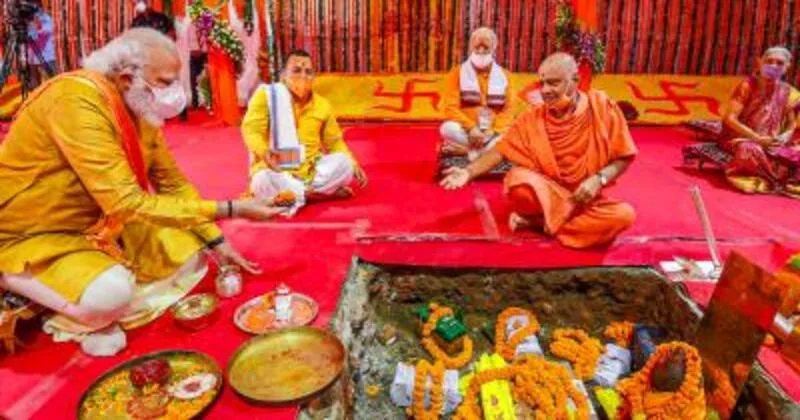
Five years ago, on this very day, history was not just remembered, it was reborn. On August 5, 2020, Prime Minister Narendra Modi laid the foundation stone for the grand Ram Mandir in Ayodhya, igniting a new era of cultural resurgence, national pride, and spiritual unity in Bharat. As the sacred soil of Ram Janmabhoomi embraced the first brick of reconstruction, it marked the culmination of centuries of hope, struggle, and unshaken faith.
The ceremony, held in the spiritual heart of Bharat, was attended by revered saints, seers, and leaders, including Rashtriya Swayamsevak Sangh (RSS) Sarsanghchalak Dr. Mohan Bhagwat, Uttar Pradesh Chief Minister Yogi Adityanath, and then Governor Anandiben Patel. However, it was the presence of Prime Minister Modi, the very charioteer of L.K. Advani’s Rath Yatra decades ago, that lent the occasion its profound national symbolism.
“Every heart is illuminated; it is an emotional moment for the entire country… A long wait ends today… A grand temple will now be built for our Ram Lalla who had been living under a tent for many years,” said an emotional Prime Minister Modi after performing the bhoomi pujan. His words echoed in the hearts of millions, resonating from the banks of the Sarayu to the temples of Kathmandu, from the ghats of Varanasi to diaspora homes in Mauritius, London, and New York.
#WATCH: #RamTemple 'Bhoomi Pujan' concludes at #Ayodhya.
Soil from more than 2000 pilgrimage sites and water from more than 100 rivers was brought for the rituals. pic.twitter.com/DRpoZEKYWw
— ANI (@ANI) August 5, 2020
The bhoomi pujan of 2020 was not just a religious ritual, it was a civilizational reckoning. It represented the end of an age of denial and the beginning of Ram Rajya, rooted in dignity, cultural pride, and unity. For decades, the sacred birthplace of Lord Ram had witnessed turmoil, denial, and legal hurdles. Yet, the patience of crores of devotees prevailed, crowned finally by the Supreme Court’s historic verdict that paved the way for this temple.
RSS Sarsanghchalak Dr. Mohan Bhagwat, present at the momentous occasion, reflected on the decades-long journey of devotion and determination. “We had taken a resolution. I remember the then RSS chief Balasaheb Deoras telling us that we will have to struggle for 20 to 30 years, only then will this be fulfilled. We struggled, and at the beginning of the 30th year, we have attained the joy of fulfilling our resolution,” he said, his voice carrying the weight of an entire movement.
The presence of 175 dignitaries, including 135 seers from across the nation, symbolised the spiritual solidarity that has kept the flame of Ram Bhakti alive through centuries. Among the sacred chants and Vedic hymns, a new chapter of India’s cultural revival was written, not with ink, but with reverence and resolve.
Chief Minister Yogi Adityanath, under whose governance the temple construction began, noted during the ceremony that “Ram Mandir is not just a structure, it is the foundation of India’s cultural self-confidence. Ayodhya will shine as the spiritual capital of Bharat and inspire generations to come.”
#WATCH | Nepal: Janakpur lit up with diyas to mark Ram Temple's 'pranpratishtha' in Ayodhya. (22.1)
(Drone Visuals) pic.twitter.com/GdHsoOULpC
— ANI (@ANI) January 23, 2024
The ripple effect of the bhoomi pujan was felt far beyond Ayodhya. In Nepal, prayers echoed at the ancient Pashupatinath Temple. Across continents, the Indian diaspora lit lamps and performed Ram Naam Sankirtan in collective celebration. It was not merely the construction of a temple, but the reawakening of a civilization.
“This is a pleasure about the fulfilment of centuries of hope. The greatest joy is because of the establishment of the self-confidence, which was lacking, today to make India self-reliant,” Prime Minister Modi had stated after the ceremony. His words, spoken at the spiritual centre of India, resounded with the force of a thousand years of suppressed aspirations finally finding voice.
RSS Sarkaryavah Dattatreya Hosabale, while speaking about the broader significance of the temple, emphasised that “The Ram temple will be a symbol of cultural nationalism in the country, which has been engulfed by an English mindset for long… With the construction of the temple, there will be both Ram and roti. Ram means cultural, sociological and spiritual development. Roti means economic growth.”
Indeed, the temple represents a deeper longing, to heal historical wounds, to reclaim the essence of Bharatiyata, and to rise again with strength rooted in dharma. For too long, the sacredness of Ayodhya was caught in the web of vote-bank politics, colonial narratives, and ideological distortions. But the bhoomi pujan of August 5, 2020, cut through the noise with the sound of shankhnaad, announcing the return of Dharma to its rightful seat.
#WATCH | Ayodhya: Pran Pratishtha ceremony of Ram Lalla at Shri Ram Janmaboomi Temple concludes.#RamMandirPranPrathistha pic.twitter.com/7j6vLrWgSy
— ANI (@ANI) January 22, 2024
What followed in the years after was not just temple construction but a renaissance of cultural confidence. The architecture of the temple itself, grand, indigenous, and sublime, reflects the genius of Indian traditional craftsmanship. Ayodhya is now being reshaped as a city of faith, heritage, and global tourism. Pilgrims throng its banks with reverence, and the spirit of Lord Ram seems to animate every brick being laid on the temple premises.
The temple also brought a remarkable transformation in the political discourse. Parties and leaders who once opposed the Ram Mandir, dismissed archaeological findings, or even mocked the faith of devotees, began chanting “Jai Siyaram.” The resistance gave way to reverence, such is the power of truth and time.
As India celebrates the fifth anniversary of this epochal bhoomi pujan, it is not just a date to remember, it is a milestone to cherish. August 5 now stands etched in the national consciousness alongside August 15. If one marks our political independence, the other marks the beginning of our cultural liberation, the reclamation of our soul.
#WATCH USA: A digital billboard of #RamMandir comes up in New York’s Times Square.
Prime Minister Narendra Modi performed 'Bhoomi Pujan' of #RamMandir in Ayodhya, Uttar Pradesh earlier today. pic.twitter.com/Gq4Gi2kfvR
— ANI (@ANI) August 5, 2020
Ayodhya today is not merely a town in Uttar Pradesh. It is a living symbol of Bharat’s eternal values of sacrifice, patience, faith, and resurgence. It is a reminder that dharma may be tested, but it never fades. It may be challenged, but it always prevails.
In the glow of countless lamps lit that day, and in the chants that still echo across the land, one truth shines eternal, Ram Lalla has returned, and with him, the spirit of a nation reborn.












Comments