





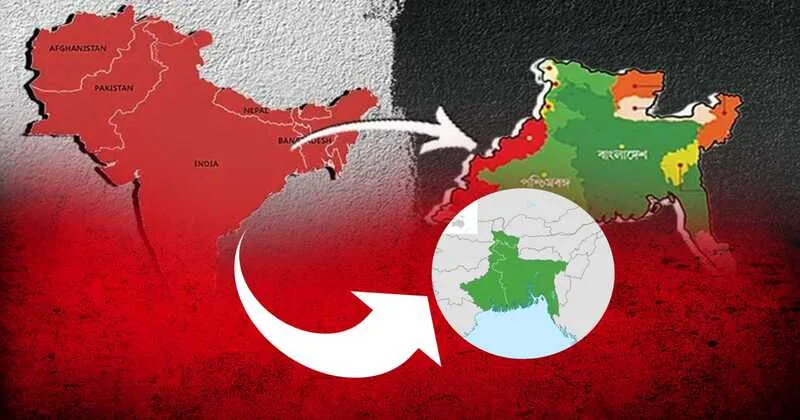
When the boundaries of a nation start getting erased in the imagination of its neighbouring country and when this imagination is not just confined to maps but when educational campuses, political forums and religious institutions are used to bring it to practical ground, then it is not just a matter confined to imagination, but it is the beginning of an ideological war of a country against its neighbouring country. In this context, present-day India is seen facing ideological and economic war on many fronts, out of which an emerging ideological front that has emerged is “Sultanat-e-Bangla”. This is not an ordinary organisation, but a multi-dimensional project that is taking forward the concept of “Greater Bangladesh” and the most worrying aspect is that behind this, the direct and indirect role of global Islamic networks like Turkey, Qatar and the Muslim Brotherhood has come to the fore.
It is not long since this incident, the date is April 14, 2025, when a poster was displayed in Dhaka University. This poster showed a map of a hypothetical “Greater Bangladesh”, which included parts of Assam, Tripura, Bengal, Jharkhand, Odisha and Bihar of India, as well as the Arakan region of Myanmar. In fact, it was not just a poster, it was an ideological manifesto that was trying to give a ground base to the imagination of the revival of Islamic nationalism in South Asia.
Detailed information in this regard has now been revealed in more depth. In fact, in the Indian Parliament, Foreign Minister S. Jaishankar has explained in detail how this idea of ’Greater Bangladesh’ is part of a well-thought-out’ ideological insurgency’. Sultanat-e-Bangla is being carried forward with the support of the Turkish Youth Federation (TYF), a Turkish non-governmental organisation. In which this organisation appears to be engaged in liberal works like rural development and empowerment of youth, but the real purpose of its functioning is to expand the agenda of ‘Islamic Jihad’. This TYF is ideologically connected to the ‘Muslim Brotherhood’, and promoting religious fanaticism in the name of education is the main strategy in its activities.
Now you should also understand about the Muslim Brotherhood; it started in Egypt in 1928. The organisation is not just a religious movement; it is a global ideology of political Islam which, when it reaches any democratic country, nourishes Islamic thinking by staying within the framework of democracy there. It tries to create such a situation that, after a while, the democratic country completely changes to the thinking of Islam, and Sharia law is implemented there. In fact, this thinking is being expanded today in the name of Islamic imperialism in India and Bangladesh in association with the ‘Turkish Youth Federation’.
In Bangladesh, ‘Sultanat-e-Bangla’ is getting both ideological guidance and financial support from the ‘Turkish Youth Federation’. Madrasas and universities of Bangladesh are under its influence. Turkish Youth Federation has empowered organisations like Jamaat-e-Islami and Hizb-ut-Tahrir in Bangladesh, which are anti-India and support the concept of an Islamic State. In March 2025, Hizb-ut-Tahrir took out a ‘Khilafat March’ in Bangladesh, in which it was openly said that Muslims in the world should not have political boundaries. Sultanat-e-Bangla is an attempt to bring this concept of ‘borderless Islamic nation’ to the land of Bengal. In which ‘TYF’ seems to play an important role in coordination.
This organisation is presenting ‘Greater Bangladesh’ not only as a geographical expansion but also as a cultural-religious state. Its agenda includes not only territorial expansion but also creating religious polarisation and social fragmentation within India. More seriously, today this ‘TYF’ is seen communicating with some radical groups of India as well. It is mentioned in the documents of the European Parliament that many Turkish NGOs, including the Turkish Youth Federation, inspire Indian Muslims towards radical ideas under the guise of Zakat (charity) and scholarships. Students are linked to Pakistan or other networks, where they are influenced by radical ideology.
Turkey is funding the activities of ISIS members in India, who are trying to radicalise Indian Muslims and create large-scale instability through the ‘transfer of technical information’. The prominent entities that have been named so far include educational institutions and NGOs such as the Turkish Cooperation and Coordination Agency (TIKA), the Yunus Emre Institute (UEI), the International Humanitarian Relief Foundation (IHH), the Turkey-Pakistan Cultural Association and the Governing Board of the Turkish Diaspora Youth Academy (YTB). All of them are using the youth of India as their weapon to facilitate interference in India’s internal affairs. The Turkish NGOs are providing funds in the form of zakat donations to organisations involved in anti-India activities.
Reports also mention that the Turkish Youth Foundation (TUGVA), owned by Bilal Erdogan, has direct links with parties and organisations such as the Pakistan-based Jamaat-e-Islami (JI) and its youth wing, the Students Islamic Organisation (SIO). Moreover, under the Islamic-style’ Erasmus’ scheme, Indian Muslim students are being brought to Turkey and given access to Pakistani organisations. So that they can work as sleeper cells for the ideology of ‘Greater Bangladesh’ and Ghazba-e-Hind while living in India. The aim of all these organisations is to create a feeling among the Muslim communities of India that their identity is not Indian but Islamic. This is a long-term threat to the social unity of the country. The most negative aspect of this entire episode is that the Prime Minister of the interim government of Bangladesh, Muhammad Yunus, also seems to be involved with them somewhere. The violence that has been taking place here against non-Muslims (Hindus and others) for the last year also shows that he is working at the behest of fundamentalist elements. The name of his daughter, Dina Afroz Yunus, has come up in connection with economic relations with ‘Sultanat-e-Bangla’.
It must be said that for India, this is a period of ideological upsurge, where the enemy is using social media, education, culture and history as weapons, not traditional weapons. Suppose India tries to face this challenge only through internal policy and does not raise it on international forums. In that case, it will send the message that India is unaware or helpless of the ideological challenge arising from its own neighbourhood. Therefore, India should seek a clear answer from Bangladesh on this issue. If necessary, it should also raise it on forums like the United Nations, Association of Southeast Asian Nations (ASEAN) and the Organisation of Islamic Cooperation (OIC). Along with this, it must be said today that concepts like Sultanate-e-Bangla and Greater Bangladesh are forcing India to reconsider its cultural, social and political unity. This fight is not just against a nation, but against a democratic Indian ideology. A jihadist fight that rejects diversity and imposes uniformity in the name of religion (mazhab). The agenda of this group is not only to question India’s geographical boundaries, but also to challenge its cultural, social and religious diversity. Therefore, India should make every possible effort to completely eradicate the idea of “Greater Bangladesh” as soon as possible; otherwise, this idea will become a very big challenge for India in the future.














Comments