





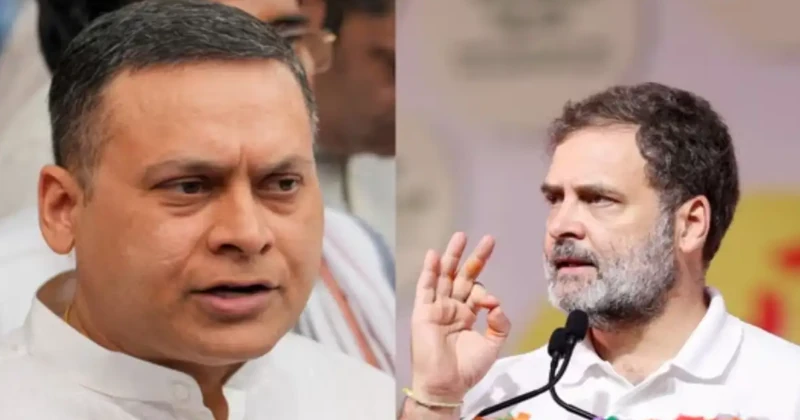
Rahul Gandhi, the scion of the Congress dynasty, has once again been reprimanded by the Supreme Court of India for making unverified, demoralising, and divisive remarks concerning India’s sovereignty, the Galwan Valley conflict, and the Indian Army’s sacrifices.
BJP’s National IT Cell Head, Amit Malviya, who minced no words in calling Rahul Gandhi a “certified anti-national a political figure whose consistent pattern of lies, alliances, and rhetoric aligns more with Bharat’s enemies than its national interest.
“Rahul Gandhi has crossed every red line,” said Amit Malviya in a scorching post on X. “In the run-up to 2024, he went around the world seeking support from foreign powers to dislodge a democratically elected Indian government. That’s not opposition politics it’s betrayal.”
Rahul Gandhi has frequently taken his attacks on Bharat abroad meeting with organisations and individuals openly hostile to Indian interests. He has:
- Alleged India is “no longer a democracy” on foreign soil.
- Echoed western talking points on Kashmir and CAA.
- Met individuals and groups with deep ties to anti-India lobbies in the West.
- At a time when Bharat is rising as a global power, these efforts to sabotage its image internationally have triggered outrage.
On August 4, the Supreme Court delivered a searing condemnation of Leader of Opposition Rahul Gandhi for his repeated, unverified, and potentially damaging statements regarding the Indian Army and national security. A bench led by Justice Dipankar Datta exposed what many have long seen as a dangerous pattern of comments he made during the Bharat Jodo Yatra on December 16, 2022.
Rahul had claimed without any evidence that “Chinese forces were thrashing Indian soldiers” in Arunachal Pradesh, in the aftermath of the 2022 Yangtse skirmish. Justice Datta confronted this lie head-on, “How do you get to know that 2,000 square kilometres of Indian territory were occupied by the Chinese? Were you there? Do you have any credible material?”
He then delivered the stinging line that now defines the debate, “If you were a true Indian, you would not say all this.” The remarks followed the Tawang clashes between Indian and Chinese forces in Arunachal Pradesh, and were seen not only as demoralising to the Indian Army but as providing ammunition to Chinese propaganda outlets.
The timeline of Anti-National rhetoric
Following the Court’s remarks, Amit Malviya also launched a devastating critique, chronicling a long and disturbing trail of Rahul Gandhi’s anti-national conduct: Rahul Gandhi’s public life has increasingly followed a trajectory marred by incendiary rhetoric, unsubstantiated allegations, and acts that many analysts believe undermine India’s institutions:
2008: Secret MoU with China’s Communist Party
In what remains one of the most opaque and alarming political moves in recent Indian history, Rahul Gandhi—alongside his mother Sonia Gandhi—signed a Memorandum of Understanding with the Communist Party of China. The Congress Party has never revealed the contents of this MoU. Soon after, donations from the Chinese government-linked organisations began flowing into the Rajiv Gandhi Foundation, which later recommended opening Indian markets to Chinese investments.
2020: Galwan Clash and the Chinese Briefing
While 20 Indian soldiers laid down their lives resisting a PLA incursion in Ladakh, Rahul Gandhi’s response was not to stand with Indian forces. Instead, he chose to accept a briefing from Chinese officials, not from Indian intelligence or the Ministry of External Affairs. He went on to publicly accuse the Modi government of “surrendering territory,” yet presented no evidence for the same.
2022–2024: Foreign Tours Turned Anti-India Roadshows
On multiple visits to the UK, Germany, and the US, Rahul Gandhi met with organisations and individuals known for their anti-India agendas. He repeated accusations of India being “no longer a democracy” and claimed that minorities were under “brutal attack”—rhetoric that not only defamed India abroad but was gleefully picked up by hostile foreign media and lobbies.
2024: Seeking Foreign Intervention in Domestic Politics
In the run-up to the 2024 Lok Sabha elections, Gandhi’s overtures to foreign powers reached a crescendo. From interacting with Pakistani-origin UK MPs to seeking attention from European Union bodies to “monitor” Indian elections, Gandhi’s actions appeared disturbingly close to inviting foreign interference—an act that some legal experts argue borders on sedition.
Earlier, in a shocking statement, Rahul referred to India as a “dead economy” while lauding Pakistan’s economic structure—at a time when Pakistan is defaulting, its people queuing for food and fuel, and its IMF loan hanging by a thread.
Simultaneously, he cast doubts on Russia, a long-standing and strategic Indian ally, raising eyebrows across diplomatic circles. “Rahul Gandhi has become a walking, talking diplomatic disaster,” said Amit Malviya. “He insults our Army, undermines our diplomacy, and supports enemies of Bharat. And now the Supreme Court has all but confirmed it.”













Comments