





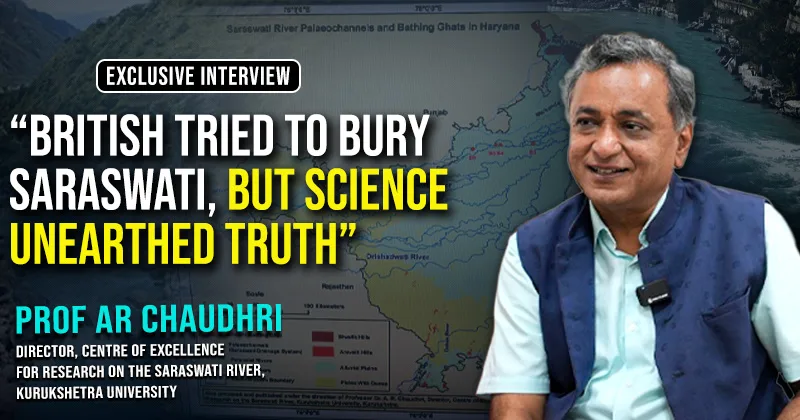
Once declared lost by colonial-era lies, now traced through science and ground truth, the Saraswati River has moved from the realm of so-called mythology to reality. To decode the geological and archaeological proofs behind Saraswati’s path and presence, Organiser Sub-Editor Yatharth Sikka spoke to Prof AR Chaudhri, Director, Centre of Excellence for Research on the Saraswati River, Kurukshetra University. Excerpts:
- Can you explain how references in the Rigveda of Sarswati helped in scientific discoveries by GSI, or your personal findings?
The Saraswati River is not just mentioned in the Rigveda, but also in the Yajurveda, Atharva veda, Manusmriti, Mahabharata, and multiple Puranas like the Vamana Purana and the Neel Mat Puran. These references served as more than just religious or literary inspiration and became guiding clues.
Especially in our research the most crucial benefit was mental and spiritual confidence. These texts gave us the inner conviction that we were on the right path in our scientific quest. As our work progressed, almost miraculously, we discovered a complete riverbed. Within that riverbed, we observed multiple sediment layers that revealed the evolutionary history of the Saraswati River. When scientifically dated, these layers traced the river’s existence back over 14,000 years in Kurukshetra till a depth of 10 m from surface ground level. If we dig deeper, the age of the sediments is bound to increase. We also identified an ancient channel that runs all the way to the Gulf of Khambhat, and this is believed to be the same route along which Balarama ji (Bhagwan Krishna’s brother) travelled from Patan to Kurukshetra during the culmination time of the Mahabharata. Interestingly, modern Vedic scholars have also confirmed this route, noting the presence of numerous religious sites aligned along this ancient path of Saraswati River.
- How did you determine whether the water flow within the palaeo-channels of the Saraswati was perennial or seasonal?
We identified the channels using remote sensing technology, which helps differentiate between dry land and moisture-bearing zones. These palaeo-channels still show moisture signatures, indicating ongoing underground recharge. While surface streams may not exist today, these areas retain higher moisture levels compared to surrounding regions, guiding us toward tracing possible subsurface interstitial water movement.
The sediment record, particularly the thickness of sand beds and the presence-absence of clay beds is a textbook case of validating the flow dynamics of a river system. The trench-log architecture of numerous trenches done by us along the Saraswati River route from Adi Badri in Yamuna Nagar to Anupgarh in Rajasthan has confirmed the perennial nature of the river flow.
After mapping these channels, we further validated them through ground truthing. We discovered ancient ghats, Shiva temples and cremation grounds (Shamsahan Ghats) along the channels that deeply aligned with Vedic customs, where ashes of the deceased kin were immersed in flowing water. The presence of such culturally significant sites strongly supports the historical existence of water flow in these paths.
- What do sediment and geological findings along the Saraswati channel reveal about the river’s age and nature?
From Yamunanagar to Anupgarh (Indo-Pak border), samples of riverine sand were collected. All were fluvial (river-origin) sediments, confirm the presence of a major river. Atomic Mass Spectrometer based Carbon-14 dating places the youngest deposits at around 1402 AD, while the oldest samples from Haryana goes back to around 14,000 years. In Ghaggar plains, sediment evidence stretches to 86,000 years, and in the Bay of Bengal delta, the surficial distal fan deposits of Gangetic deltaic system have been dated around 2.3 million years. As per Rig vedas Nadi Stuti Suktam of Book 10, the Ganga, the Yamuna and the Saraswati have been contemporary rivers suggesting thereby that the Saraswati River sediments are also of similar time frame, if not older. As per Sanatan belief system, the Saraswati River is of Satyug, the Yamuna River is of Treta Yug and the Ganga River of Dvapar Yug. Combined with Rigvedic references, this confirms Saraswati’s existence alongside the Ganga and Yamuna, and likely even earlier.
The findings of the research carried out on Kalayat Kapil Muni Temple sarovar in 2007 by me suggest that the Saraswati River was a perennial glacier fed trans-Himalayan River which carried enormous amount of water. Glacier water in paleochannels has been confirmed by stable isotope analysis of paleochannel water samples from numerous locations in Haryana. These wells were drilled and analysed by ONGC.
- What is the scientifically established origin and extinction timeline of the Saraswati River?
Answer: The river is estimated to have existed for over 60 million years. The flow from glacial sources continued until around 6000 years ago, and even post-glacial, Saraswati retained flow until the 14th century AD (1402 approx.). After that, due to anthropogenic re-routing of streams in the catchment area, climate change, tectonic and hydrological shifts, it gradually transformed into a rain-fed river with limited discharge.
- What is the connection between the Saraswati River and Prayagraj? Explain the Saraswati channel that flowed towards the Triveni Sangam?
The Saraswati River had multiple channels, and one of them did indeed flow toward Prayagraj during the time frame even before the Rigveda was compiled in shruti tradition. This channel has largely been traced now, though some technical work remains like channel characterisation and mapping. From our side, we are confident about its existence, but as researchers, we must wait until every aspect is scientifically confirmed. The data we’ve collected clearly shows that this ancient eastern channel once connected to the Triveni Sangam in Prayagraj.
Further, during the early geological epochs, due to tectonic activity, especially when the Indian landmass collided with the Eurasian plate, there were changes in ground slope, glacial melting patterns, and river volumes. This led to a shift in the flow direction of rivers. The original Saraswati channel, which once flowed toward Prayagraj, gradually migrated westward and began terminating at the Gulf of Khambhat during Mahabharat period. The riverbeds along these channels are massive, ranging from 1.75 km to over 13 km in width, proving that these were not minor streams but enormous rivers. Additionally, we have now mapped Saraswati’s palaeo-channels near Rakhigarhi and Agroha in Hisar as well as near Deegh in Bharatpur district and Reengus near Khatu Shyam Dham in Sikar district Rajasthan.
- How do you view the Aryan Invasion Theory? Do you believe it was a colonial construct aimed at discrediting the Indian civilisation?
Answer: The Aryan Invasion Theory is highly questionable and largely discredited by modern scientific research, particularly in the fields of genetics and archaeology. There was a major genetic study conducted under the National Geographic Magzine and IBM (genographic project), which mapped peopling of the world and human migrations out of Africa. The findings were very clear: The original human stock that migrated from the three centres in African continent first settled in Gujarat, then moved to Southern India, from there to Northeast India (Arunachal Pradesh, Assam), Tibet and eventually to the rest of the world. This shows, without any doubt that India was a dispersal point, not a recipient of migrating populations.
I personally observed certain tribes in Gujarat that physically and genetically resemble the Bantu tribes of Africa. Additionally, international media has tried to push misleading narratives. They claimed that Harappan sites were located 70–80 km away from the Ghaggar River. However, when we mapped these sites scientifically, we found that most of them are within just 500 meters of the actual Saraswati palaeo-channel. These distortions were deliberate to weaken the cultural continuity of the Saraswati civilisation.
- Why did the Saraswati River, despite being embedded in cultural memory and supported by modern science, disappear from educational narratives for so long?
Although British archaeologists and geologists in the 1870’s and 1935 mentioned Saraswati in the maps, some ideological forces attempted to uproot India from its civilisation, portraying Saraswati as a myth. However, the river never disappeared from the collective consciousness, our ancestors have always regarded Saraswati as the goddess of knowledge. We have now integrated Saraswati Civilisation into school curriculum but it should have happened immediately after independence.















Comments