





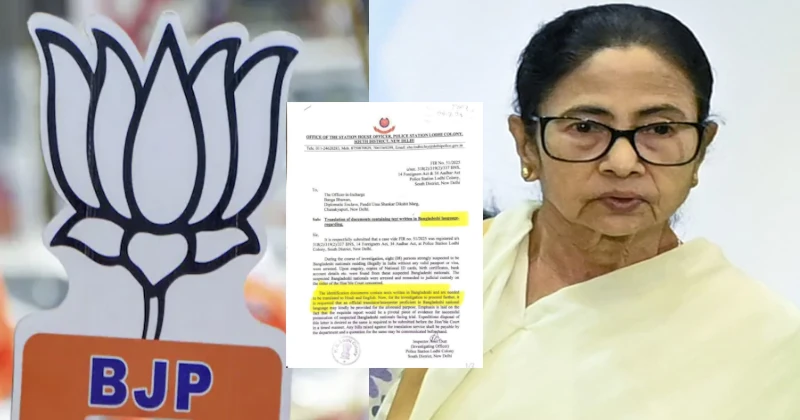
West Bengal Chief Minister Mamata Banerjee has unleashed a linguistically divisive and politically motivated tirade against the Government of India by misrepresenting a factual communication by the Delhi Police. Her remarks, which allege that the Union is insulting the Bengali language by referring to it as “Bangladeshi,” appear not only ignorant of linguistic nuances but also calculated to provoke unrest among Bengali-speaking citizens of India.
The statement, in reality, pertained to linguistic profiling tools used by law enforcement agencies to identify illegal Bangladeshi infiltrators—a critical component in national security operations. However, Banerjee, who has a long history of pandering to vote-bank politics, twisted the reference into an “insult to Bengali pride,” setting off alarm bells in intelligence circles.
See now how Delhi police under the direct control of Ministry of Home, Government of India is describing Bengali as " Bangladeshi" language!
Bengali, our mother tongue, the language of Rabindranath Tagore and Swami Vivekananda, the language in which our National Anthem and the… pic.twitter.com/2ACUyehSx8
— Mamata Banerjee (@MamataOfficial) August 3, 2025
BJP IT Cell head Amit Malviya was quick to respond, calling Banerjee’s remarks “dangerously inflammatory” and “deeply irresponsible.” He also warned that her deliberate distortion of facts to stoke linguistic passions could have far-reaching consequences, and even merit legal scrutiny under the National Security Act (NSA) for inciting enmity under the guise of linguistic identity.
Contrary to the explosive claims made by Mamata Banerjee, nowhere in the Delhi Police communication was the Bengali language of India maligned or denigrated. The reference to “Bangladeshi language” was used purely as an operational term by security agencies to denote specific dialectical patterns, phonetics, and syntax common among illegal infiltrators from Bangladesh.
Amit Malviya rightly noted, “The Delhi Police is absolutely right in referring to the language as Bangladeshi in the context of identifying infiltrators. It is being used to describe a set of dialects, syntax, and speech patterns that are distinctly different from the Bangla spoken in India.”
Mamata Banerjee’s reaction to Delhi Police referring to the language used by infiltrators as ‘Bangladeshi’ is not just misplaced, it is dangerously inflammatory.
Nowhere in the Delhi Police letter is Bangla or Bengali described as a ‘Bangladeshi’ language. To claim otherwise and… https://t.co/Ynb5o8cT6n
— Amit Malviya (@amitmalviya) August 4, 2025
In law enforcement and border security contexts, such linguistic shorthand is common practice globally. Dialects like Sylheti, Chittagonian, and Noakhali—widely spoken in Bangladesh—differ significantly from Indian Bengali and serve as critical indicators to identify non-citizens masquerading as Indian residents.
The term “Bangladeshi language” is thus a profiling category, not a cultural or constitutional insult. But to a political opportunist like Mamata Banerjee, such nuances mean little.
In her outburst, Mamata Banerjee tweeted, “See now how Delhi Police under the direct control of Ministry of Home, Government of India is describing Bengali as ‘Bangladeshi’ language! … We urge immediate strongest possible protests from all against the anti-Bengali Government of India…”
This is not just misinformation. It is a calculated attempt to stoke linguistic resentment, incite regional passions, and paint the Centre as anti-Bengali—a familiar tactic used by Banerjee whenever illegal immigration is discussed or border enforcement is tightened.
The reality is starkly different. The Constitution of India recognises Bengali (Bangla) as one of its 22 official languages under the Eighth Schedule. Bengali is taught, spoken, and celebrated across India with equal constitutional dignity. The National Anthem, Jana Gana Mana, was indeed composed in Sanskritised Bangla, and Vande Mataram, India’s National Song, was penned in Sanskrit and later integrated into the Bengali novel Anandamath.
But none of these facts validate Mamata Banerjee’s insinuation that the Indian state has labelled Bengali a “Bangladeshi” language. Rather, her intellectually dishonest co-opting of national icons like Rabindranath Tagore, Swami Vivekananda, and Bankim Chandra to defend infiltrators is deeply troubling.
This is not the first time Mamata Banerjee has chosen to stand with illegal immigrants over Indian sovereignty. Her repeated opposition to the NRC (National Register of Citizens), CAA (Citizenship Amendment Act), and border fencing initiatives reveals a consistent pattern of vote-bank appeasement at the cost of national security.
In 2021, the West Bengal Police came under fire for refusing to cooperate with central agencies during anti-infiltration drives. In 2018, her government was caught suppressing data on Rohingya settlements in North Bengal and the suburbs of Kolkata. Her opposition to the detention and deportation of illegal Rohingyas has also raised eyebrows within the security establishment.
According to IB sources, multiple infiltration routes from Bangladesh into Bengal remain active, with political patronage being a critical enabler. Areas like Malda, Murshidabad, Cooch Behar, and Basirhat have seen demographic shifts, land encroachments, and a rise in identity fraud—all correlating with illegal migration. And every time action is proposed, Banerjee has responded with rhetoric over reason.
Amit Malviya, minced no words, “To call upon Bengalis to rise against the Centre based on a complete misreading of the Delhi Police’s operational communication is not just irresponsible—it is dangerous. Mamata Banerjee should be held accountable.”
It is beyond shameful that West Bengal Chief Minister Mamata Banerjee is defending a lawful police action against illegal Bangladeshi infiltrators by weaponising language and stoking sentiment.
Let us be absolutely clear: all illegal Bangladeshi infiltrators and Rohingyas will… https://t.co/Ynb5o8cT6n
— Amit Malviya (@amitmalviya) August 3, 2025
Malviya further emphasised that language profiling is a legitimate security strategy. Globally, countries like the US, UK, and Israel routinely employ dialect-based analysis to track infiltrators and sleeper cells. India is no different, especially when infiltration from Bangladesh is a clear and persistent threat.
His assertion that all illegal Bangladeshi infiltrators and Rohingyas will be dealt with strictly as per law is not only a reaffirmation of state authority but also a stern warning to regional leaders who seek to politicise national security.
Experts have pointed out that Mamata Banerjee’s tweet by painting a legitimate security operation as an ethnic slur—could fall foul of several statutes:
- Section 153A of the IPC: Promoting enmity between groups on grounds of language.
- Section 124A (Sedition) (subject to constitutional scrutiny): If her statements are found to incite rebellion or undermine state sovereignty.
- National Security Act (NSA): If proven that her statements endangered internal harmony or obstructed national security operations.
















Comments