





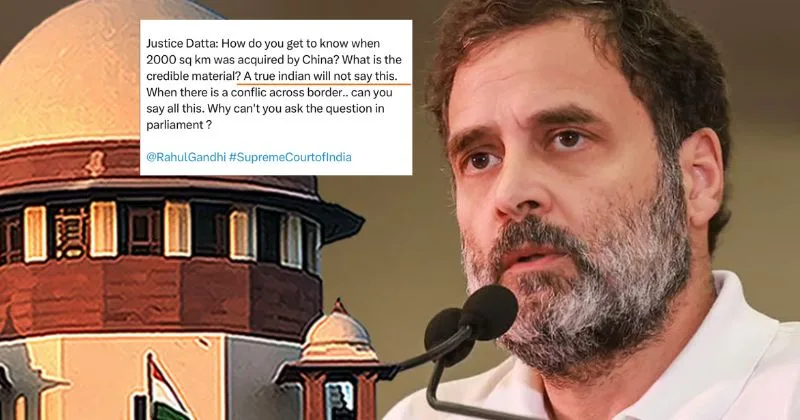
NEW DELHI: The Supreme Court on August 4 came down heavily on Leader of Opposition Rahul Gandhi in connection with remarks about the Indian Army and the 2020 Galwan clash. The apex court made scathing oral observations condemning Gandhi’s statements, calling them irresponsible and damaging to national sentiment.
The remarks, made during Gandhi’s Bharat Jodo Yatra on December 16, 2022, referred to the December 2022 clash between Indian and Chinese troops in Arunachal Pradesh and alleged that “Chinese forces were thrashing Indian soldiers,” sparking widespread outrage and legal action.
A bench comprising Justice Dipankar Datta and Justice A.G. Masih pulled up the Congress MP for making unsubstantiated claims about territorial loss to China. “Tell Dr. Singhvi, how do you get to know that 2,000 square kilometres of Indian territory were occupied by the Chinese? Were you there? Do you have any credible material?” Justice Datta asked Senior Advocate Dr. Abhishek Manu Singhvi, appearing on behalf of Gandhi.
In a stinging remark, Justice Datta added, “If you were a true Indian, you would not say all this.”
#BREAKING | Supreme Court pulls up Lok Sabha LoP & Congress MP Rahul Gandhi over his remarks on the Indian Army following the Dec 9, 2022, clash with Chinese troops.
The Court told Rahul, "You are the Leader of Opposition, say things in Parliament, not on social media," in… pic.twitter.com/Uoy0LBw5ca
— Organiser Weekly (@eOrganiser) August 4, 2025
Singhvi defended his client, arguing that Gandhi’s comments were aimed at ensuring transparency and calling out the suppression of information. “It is also possible that a true Indian will say that our 20 Indian soldiers were beaten up and killed and that it is a matter of concern,” Singhvi said in response.
Justice Datta countered, “When there is a conflict across the border, is it unusual to have casualties on both sides?” He reiterated that there are appropriate forums, such as Parliament, to raise such sensitive matters rather than using social media platforms.
The Legal Challenge: Quashing the Complaint
Singhvi urged the court to quash the defamation case, stating that it was politically motivated and aimed at harassing Gandhi for performing his duties as an opposition leader. He also noted a procedural lapse under Section 223 of the Bharatiya Nagarik Suraksha Sanhita (BNSS), pointing out that no prior hearing was given to Gandhi before the court took cognisance of the complaint.
While the bench acknowledged that this point wasn’t raised earlier in the High Court, it agreed to issue notice on the Special Leave Petition filed by Gandhi and stayed proceedings in the lower court for three weeks.
Case Background: Army Remarks Spark Legal Wrath
The complaint was filed by Uday Shankar Srivastava, a retired Director of the Border Roads Organisation (BRO). Srivastava alleged that Gandhi’s remarks were not just politically inflammatory but personally defamatory to members of the armed forces and their families.
In May 2025, the Allahabad High Court dismissed Gandhi’s plea to quash the complaint, stating that the freedom of speech does not extend to defamatory comments targeting the Indian Army. The court further observed that such comments had a demoralising effect on soldiers and their kin.
Justice Subhash Vidyarthi of the Allahabad HC observed, “Such utterances from a senior political leader have the potential to lower the morale of our armed forces and cannot be protected under free speech.”
The MP-MLA court in Lucknow, which had taken cognisance of the complaint in February 2025, had similarly noted that Gandhi’s remarks appeared to undermine the integrity and morale of the armed forces, particularly in light of his repeated claims that the Indian media refuses to question the government on Chinese incursions.
The Bharatiya Janata Party (BJP) has lambasted Gandhi repeatedly over the remarks. Party spokespersons and several retired Army officers have termed his statements “reckless” and “deeply insulting.”
Senior BJP leader and Supreme Court lawyer Gaurav Bhatia, appearing on caveat for the complainant, argued that the Congress leader’s statements crossed all bounds of acceptable political discourse and were aimed at “belittling the sacrifices of the Indian Army.”
The issue has also sparked a broader debate on the boundaries of free speech and the responsibilities of opposition leaders in matters of national security.
Dr. Singhvi emphasised that Gandhi’s criticism was aimed at demanding accountability from the government and not at tarnishing the image of the Army. “The petitioner is not anti-national,” he said. “He was raising questions about how much of the ground reality is being hidden from the people.”
However, Justice Datta reiterated that national interest must be kept above political gains. “There is a way and a place to raise these concerns. Social media cannot be the battlefield for facts when national morale is at stake,” he stated.
With the Supreme Court’s stay order in effect for three weeks, the case against Rahul Gandhi will remain paused. The bench has asked all parties to submit their responses, particularly on the procedural lapses raised by Gandhi’s legal team.













Comments