





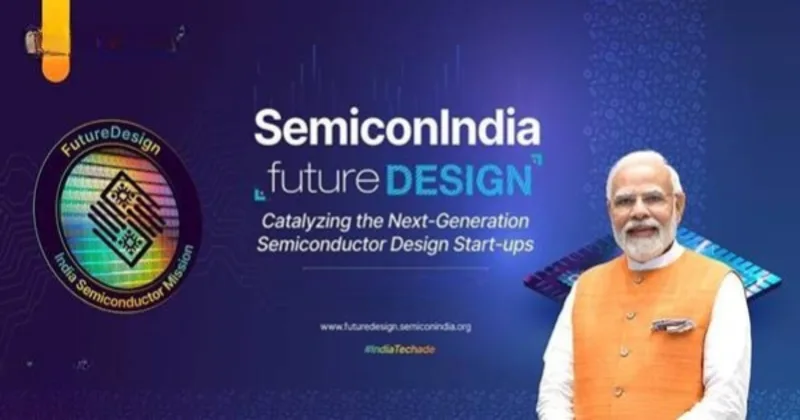
India’s quiet journey in the field of semiconductors was once unimaginable. The complexity of the work that runs the modern world is not an individual task. This field requires heavy machinery and skilled people. With the help of the government, a small but effective support can provide Indian innovators with a powerful boost. With a world-class talent pool of 20% of the world’s semiconductor design engineers and thousands of chips designed annually, India is set to grow to become self-reliant and technology-driven in the semiconductor design industry. Twenty-three semiconductor chip‑design projects were officially approved for financial backing under the Design Linked Incentive (DLI) Scheme, a critical pillar of the expansive Rs 76,000 crore Semicon India Programme.
What is the DLI Scheme?
The DLI Scheme, launched in December 2021, carries a Rs 1,000 crore budget set aside exclusively to nurture domestic chip design. This scheme has a specific focus on startups, MSMEs, academic institutions and emerging local firms. By the middle of 2025, 278 academic institutions and 72 startups had already secured access to advanced EDA tools, IP cores and foundational resources for enabling chip ideation and early-stage prototyping through the help of this scheme. This scheme provides a maximum of 50 per cent of the design expense and performance-based incentives on net sales. DLI is a decisive factor in enhancing innovation, minimizing import dependence and establishing India as a chip design global hub
What are its promises to Innovators?
The selected projects encompass a wide range of strategic chip applications, from surveillance camera processors to smart energy meters, networking solutions and microprocessor IP cores. The designs must reflect both commercial viability and national strategic interest in security, infrastructure and digital connectivity. The aggregated sanctioned budget now stands at Rs 803.08 crore (approximately US $91.6 million), where both the cost of access to design tools and direct project funding are involved.
The DLI financial framework is structured to support both design and commercialisation:
Design-prototyping support: covers up to 50 per cent of eligible project spend, capped at Rs 15 crore per project (approximately US $1.7 million).
Deployment-linked incentive: performance-based payouts of 4 to 6 percent on net sales for five years, capped at Rs 30 crore per application (approximately US $3.4 million).
Funds will be released in stages and tied to performance and achievements. From prototyping and tape-outs to fabrication to the final deployment, this ensures accountability and result orientation.
Ten out of the 23 beneficiary companies have successfully raised venture capital funding, enabling them to scale development beyond proof of concept toward commercial readiness. Simultaneously, six firms have already achieved tape-outs at global semiconductor foundries, a critical engineering milestone signifying that their designs are physically ready for fabrication. Complementing this private-sector progress, 20 chip designs from 17 academic institutions have been fabricated at SCL Mohali, India’s premier semiconductor research laboratory, using its indigenous 180 nm CMOS process. This development demonstrates India’s growing capability to enable students and faculty to design these silicon chips.
When Policy Meets Infrastructure
India’s push to become a chip-design hub emerged from a recognition that, while domestic demand for chips had surged, it was driven by telecom, AI, IoT, EVs and consumer electronics. Most semiconductor designs remain dependent on imports and fabrication facilities are still in the basic phase. The Semicon India Programme, unveiled with Rs 76,000 crore of public funding, is aimed at closing these gaps from fabs and packaging to design infrastructure and skills development. The DLI Scheme aligns tightly with this larger mission, offering both infrastructure access (via tools, IP) and financial incentives to de-risk entry for domestic innovators.
The ability to design talent is the engine of this ecosystem. The government launched complementary programmes like Chips to Startup (C2S) and SMART Labs, aimed at producing thousands of qualified engineers by 2030. Academic institutions are integrating new curricula in VLSI design, IC manufacturing and embedded systems under initiatives led by AICTE and NIELIT. As per the report, over 45,000 students across 100+ institutions have already been engaged in these efforts. Tamil Nadu is at the top of this effort, where C2S tools have been deployed in over 40 colleges and 10 institutes with the help of the government.
Cases where Vision Meets Execution
A startup working on smart energy meters, after receiving DLI support worth of ₹12 crore in prototyping costs, completed a successful tape-out overseas. With funds in hand, they’re now preparing for pilot installations across utility firms, aiming to deploy smart-grid capable meters by late 2026.
A university-led research team is developing a microprocessor IP whose design was fabricated at SCL in Mohali. The result of this development is a working chip that could serve as a licensing-ready prototype to semiconductor foundries.
A small firm in network chip design, one of the ten venture capital-backed beneficiaries, not only leveraged EDA tools under DLI, but also tapped deployment-linked incentives, now working with domestic OEMs to embed their chipset into routers and switches. Also, startups like Mindgrove Technologies (IIT Madras incubated) and Morphing Machines are working on RISC-V-based microprocessors, an open-source alternative to proprietary chip architectures, allowing greater control and reduced licensing dependency.
Why This Matters: Beyond Chips?
This move isn’t just about building chips; it’s about lowering design barriers by subsidizing the costs and providing tools. India is democratizing access to advanced chip design, especially for MSMEs and academic labs. The process of value-chain creation will be initiated and chip fabrication and commercialization (domestic jobs, skilled engineers, suppliers and ecosystem momentum) will be gained.
The Global positioning of Indian chip design startups is scaling up. India will position itself to reduce reliance on imports and even export the chip designs across global markets. Though only 23 projects were selected so far, the broader DLI Scheme and state-level semiconductor policies reflect that this is the beginning. As the government refines the schemes based on ongoing feedback and stakeholder engagement, it will expand quotas or enhance support limits after reviewing the development.
Combined with anticipated growth in India’s domestic semiconductor demand (projected to reach US $150 billion by 2030) and rising institutional participation, the ecosystem appears poised for expansion.
A Sprouting Seed with Potential to Bloom
India has sown the seeds of its chip-design revolution by empowering 23 domestic projects with infrastructure, capital, and market-linked incentives. These micro-projects, some of which are rooted in academia and some in early startups, will mark the progress in semiconductor production and pose a challenge to global giants.
With Rs 803 crore sanctioned, milestone-driven funding and early success in fabrication, these efforts reflect a developing ecosystem. They also demonstrate the power of well-designed policies to promote innovation, which had failed to enter the market in earlier days. India’s journey towards self-reliance in semiconductor design is no overnight sprint, but schemes like DLI are providing direction and momentum. With academic, startup and venture-fund collaborations, the seed of semiconductor innovation and production could grow into a vibrant chip-design ecosystem, homegrown, globally competitive and driven by Indian tale
















Comments