





When Guruji Golwalkar (Madhavrao Sadhashivrao Golwalkar) took over as the second Sarsanghchalak of RSS in 1940, he initiated a process to realise the mission and vision of the founder of RSS in a very concerted manner. One of the missions of Dr. Hedgewar (Keshav Baliram Hedgewar), the first Sarsanghchalak of RSS, was to make RSS a truly national organisation in view of the geographical context of Bharat. In fact, in his last address to the Swayamsevaks attending the 3rd year ‘Sangha Shiksha Varg’ (camp) in Nagpur in 1940, he expressed his dream in this regard unambiguously before them. He said that ‘he was visualising Hindu-Rashtra right before his eyes as Swayamsevaks from the whole of Bharat were attending the 40-days camp for the first time since the inception of the Sangh’.
RSS thereafter took a number of decisions, including the one in regard to the appointment and deputation of Pracharaks outside the areas that were considered the hub of its activities, like Vidarbha, Madhya Bharat and Marathi-speaking areas of the present Maharashtra, Telangana and Gujarat. The immediate focus was on North India and the then United Punjab. Madhav Rao Muley, one of the senior and able Pracharaks, who was considered an expert in organisational work, was deputed to Punjab as the Prant Pracharak of Punjab Prant. The Punjab Prant, in a sense, was the biggest geographical entity at that point in time.
Punjab Prant included the current states of Punjab, HP, J&K, Haryana, West Punjab (now in Pakistan) and also some parts of the North-West frontier area. Lahore was the main headquarters of this whole chunk of organisational territory. The nearby city of Amritsar was also developed as an important centre of activity, alongside Lahore. During the early years of the 1940s, Madhav Rao visited almost every province of Punjab Prant and also the Princely ruled state of J&K. Maharaja Hari Singh was the king of the state of J&K, which was then the biggest Princely ruled state of India. Sangh swayamsevaks from the areas of united Punjab came into close contact with the swayamsevaks of Jammu, Muzaffarabad, Mirpur, Kotli and Poonch.
Sialkot in Punjab was the nearest point geographically to Jammu and its adjoining areas. It helped the Sangh grow at a faster pace in Jammu city and the surrounding plains. Immediately after the first phase of the organisational work in the plain areas of J&K, the focus was applied to the hilly areas of the state. Madhavrao organised a band of dedicated swayamsevaks from Delhi, Punjab and J&K, and inspired them to work in J&K and especially in the Kashmir valley. All of these swayamsevaks were in their teens and twenties, namely Jagdish Abrol, Kedarnath Sahni, Balraj Madhok, Makhan Lal Harkara (Aima), Omkarnath Kak, and Shamlal Sharma. Later, they were joined by a number of other swayamsevaks in the second half of the 1940s, who made a great difference in the quality and quantity of work in the hilly and mountainous areas by their dedication and work.
Around 1942-43, the Shakha work began in a large part of the mountainous and hilly track of J&K. The first shakha was organised in the Kashmir valley in the year 1944, and it was conducted by Balraj Madhok and Kedarnath Sahni. Incidentally, Balraj Madhok was born in Askardu, the capital town of Baltistan in J&K. He held the Shakha in Magarmal Bagh, Srinagar, in the compound of DAV College. Within a period of two years, the RSS was a stark reality in the Kashmir valley. A prominent young swayamsevak, Amarnath Vaishnavi from Kashmir, a student of the Polytechnic college, was usually found working in the Sangh in the town of Pathankot due to his father’s posting there, and he was deeply associated with the RSS. He had some loose links with the revolutionaries in Punjab as well and would be given some secret work by them to get it accomplished.
It was in early 1946 that Madhavrao visited Srinagar and apprised the swayamsevaks there that Guruji Golwarkar would be visiting J&K in the autumn season of that year. Accordingly, preparations were set afoot for the visit. The leading swayamsevaks in Kashmir appealed to Madhavrao that Guru Golwalkar be requested to pay a visit to the Kashmir valley as well. After a month of deliberations, it was conveyed to the organisers in the valley that the visit of Guruji Golwalkar would actually be held in October-November 1946, and he would also stay in the valley for two days. This was a historic challenge for everyone. The whole work was supervised by Madhavrao himself along with Jagdish Abrol, the then Vibhag Pracharak of RSS in J&K.
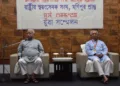
In November 1946, Guruji Golwalkar paid a visit to the J&K state and also went to the Kashmir valley for the first time. This was the first such programme in the Kashmir valley ever since the RSS was founded in Nagpur in 1925. This author was briefed by one of his close elderly relations, who confirmed to me that he was one of the attendees to the function held at Zeethyar (Jeshta Devi complex) in the Zabarwan hills near the Raj Bhawan, Srinagar. It was a programme in which around 1,000 fully uniformed RSS swayamsevaks took part, and the gathering comprised representation from every district of Kashmir valley.
Shri Guruji addressed a programme of swayamsevaks in Bakshinagar, Jammu, before proceeding towards the Kashmir valley. It was on November 10, 1946, that the programme was held in connection with the ‘Sharad Purnima’ in Jammu. Prof. Balraj Madhok, Jagdish Abrol, Makhan Lal Harkara (Aima), Barrister Narinderjeet Singh, Omkarnath Kak and Kedarnath Sahni were the key organisers of the unique event held in November 1946 in Kashmir. Unfortunately, as of this date, no one among them is available for any sort of discussion with them on the subject, as all of them have already taken leave of this world.
In 1947, Sardar Patel sought the help of Guruji Golwalkar to talk to Maharaja Hari Singh on the situation of J&K and the subject of accession. Accordingly, a team of five personalities of RSS reached Srinagar from New Delhi on October 17, 1947. The team comprised Guruji Golwalkar, Madhavrao Muley, Abhaji Thate, Barrister Narrinderjeet Singh and Vasantrao Oak. Guruji met Maharaja Hari Singh on October 18, 1947 in his palace. On October 19, 1947, he addressed a well-attended programme of swayamsevaks in the main hall of DAV College (now school) at Magarmal Bagh, Srinagar. Thereafter, the team left for Delhi by the afternoon flight.
When the government of India, consequent upon the signing of the Instrument of Accession with Maharaja Hari Singh, decided to send troops to Srinagar, the swayamsevaks, in collaboration with the local military and other volunteers, helped the air traffic control authorities to repair and renew the runway for the big aircraft to land in the Kashmir valley. Biju Patnaik, in the capacity of a pilot, landed the first IAF aircraft in Srinagar carrying Indian army officers and jawans along with their weapons and artillery, followed by a number of such flights thereafter. The Pakistani forces, in cohorts with the tribal raiders, killed and looted the Hindu and Sikh minorities in various parts of J&K, including the Kashmir valley. The swayamsevaks made every effort to reach the victims of the tragedy and even organised some relief camps in the city of Srinagar.
In connection with the vision of “Ek Nishan-Ek Vidhan-Ek Pradhan”, RSS extended full support to the Praja Parishad movement (1951-53). Consequently, 12 Swayamsevaks of Kashmir valley joined the movement as full timers (Pracharak) for three years. The main Swayamsevaks who played a key role in establishing RSS in Kashmir valley in the early years, besides the above-mentioned ones, were Avtar Krishen Kaw, Brijnath Miyan, Ram Rattan Parihar, Devkinandan Nakhasi, Dwarikanath Jalali, Bhagwat Swaroop, Kanhyalal Wuthoo, Niranjan Nath Kaul, Somnath Bhan, Mohan Lal Khar, Bansilal Khar, M.K.Raina, Prannath Miyan and Somnath Ogra.
From 1953 onwards, and particularly after the tragic death of Shyama Prasad Mukherjee in the Kashmir valley, Swayamsevaks of RSS worked under different banners in the valley of Kashmir due to the pressure tactics applied by the government led by the National Conference and Congress. There was always a tremendous pressure upon the swayamsevaks in Kashmir so far as the running of the RSS was concerned, besides the usual social pressure of the majority community. RSS devised means to run itself under different banners, including Rashtra Bhasha Pracharini Samiti, Shri Bhat Seva Ashram, Vivekananda Kendra, and Sanatan Dharma Sabha.
There were always many tests awaiting the swayamsevaks in the Kashmir valley. One of those tests was the period of emergency when the leadership of the RSS was raided by the government forces, a number of swayamsevaks were dismissed from their services and some of them even went to jail. Most of us were advised to work as underground activists and spread the message of Lok Sangharsh Samiti, led by JP, among the people. Adhikaris would come to the valley regularly to guide the swayamsevaks. The story of pre-emergency days, emergency and thereafter, including the sacrifices made by the swayamsevaks due to Islamic terrorism in Kashmir and the mass exodus of the Hindu community and the related issues will be covered in the next article….!









Comments