





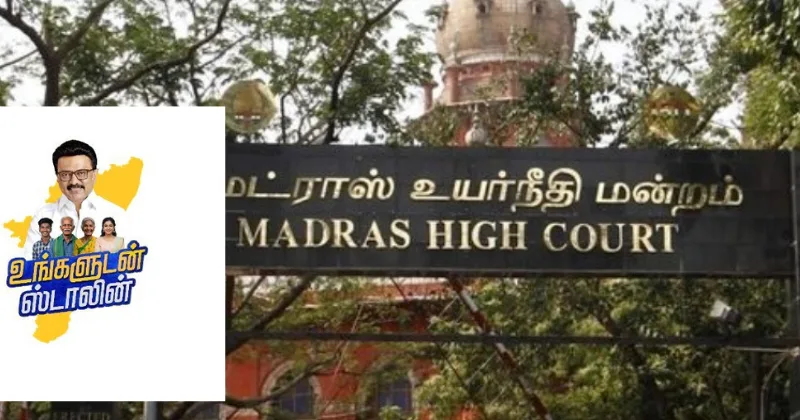
In yet another blow to the DMK government for using both living and deceased political personalities for its schemes, the Madras High Court has barred the government from using the name or photograph of any living political figure, former Chief Ministers, ideological leaders, or party emblems in the promotion of its welfare schemes.
Former AIADMK minister and current Rajya Sabha member, C. Ve. Shanmugam, filed a petition seeking a ban on the use of former CM M. Karunanidhi’s image and the name ‘Ungaludan Stalin’ (Stalin with You) in government advertisements and welfare programmes.
Shanmugam argued that naming schemes after the current Chief Minister was in violation of a Supreme Court ruling and the Government Advertisement (Content Regulation) Guidelines, 2014. The petitioner contended that such branding provided undue political mileage at the public’s expense, citing schemes such as ‘Ungaludan Stalin’ and ‘Nalam Kakkum Stalin Thittam’, which prominently featured the incumbent CM’s name.
He further submitted that even the party logo/emblem was being printed in outreach programmes launching state welfare schemes. The petitioner informed the court that DMK was preparing to launch another scheme featuring similarly impermissible pictorial representations, names, logos, and emblems. He, therefore, urged the court to issue an appropriate interim order restraining the them from issuing such publications.
The petitioner’s counsel also informed the court that the State government was planning to name other public schemes after living personalities. The Division Bench noted that such nomenclature appeared, prima facie, to be impermissible under the Supreme Court’s ruling in the well-known Common Cause case.
After hearing both sides, the First Division Bench comprising Chief Justice Manindra Mohan Shrivastava and Justice Sunder Mohan, on July 31, stated: “We are inclined to pass an interim order to the effect that, while launching and operating government welfare schemes through various advertisements, the name of any living personality, photograph of any former Chief Minister/ideological leaders, or party insignia/emblem/flag of Respondent No. 4 (DMK) shall not be included.”
The Bench added: “On prima facie considerations, we find that the prayer for interim relief is based on the apprehension that the State is proceeding to launch multiple welfare schemes in the same manner as the advertisement under challenge. The Hon’ble Supreme Court has issued successive directives regulating the content of government advertisements in the cases of (i) Common Cause v. Union of India, (2014) 6 SCC 552; (ii) Common Cause v. Union of India, (2015) 7 SCC 1; and (iii) Centre for Public Interest Litigation v. Kewal Kumar Sharma & Others, (2017) 16 SCC 715.
In a clarificatory order in the case of State of Karnataka v. Common Cause & Others, (2016) 13 SCC 639, the Supreme Court permitted certain exceptions, allowing the publication of the photograph of the incumbent Chief Minister. However, the use of photographs of ideological leaders or former Chief Ministers, prima facie, would contravene these directives.”
While clarifying that no order was being passed against the launch, implementation, or operation of any welfare scheme of the government, the Bench said the order pertained solely to the nomenclature of such schemes and associated publicity materials. It further emphasised that the interim relief was being granted solely on the basis of prima facie evidence.
The Court also clarified: “The pendency of this petition shall not prevent the Election Commission of India or other authorities from initiating proceedings based on the petitioner’s complaint under Paragraph 16A of the Election Symbols (Reservation and Allotment) Order, 1968, seeking appropriate action against the DMK.”
The Court issued notices to the Tamil Nadu government and the DMK on the main PIL filed against the nomenclature of the ‘Ungaludan Stalin’ scheme and granted them time to submit counter-affidavits. The Bench scheduled the next hearing of Shanmugam’s PIL, along with a similar petition filed by another individual, for August 13 after the filing of counter-affidavits and rejoinders.
Advocate General P.S. Raman stated that the petitioner’s claims were based on unverified printouts, which were not official government publications. He sought time to file an affidavit with authenticated records, asserting that no such images or political symbols had been used in the scheme’s promotions.
Counsel for the Election Commission of India, Niranjan Rajagopalan, submitted that any political party launching a government scheme is legally obliged to strictly follow the guidelines laid down by the Supreme Court and the directions issued by the Election Commission of India, including one dated October 7, 2016.
Meanwhile, the Tamil Nadu government’s counsel, P. Wilson, termed the petition “politically motivated and ill-founded”, alleging it was aimed at tarnishing the image of the ruling party and its leadership.









Comments