





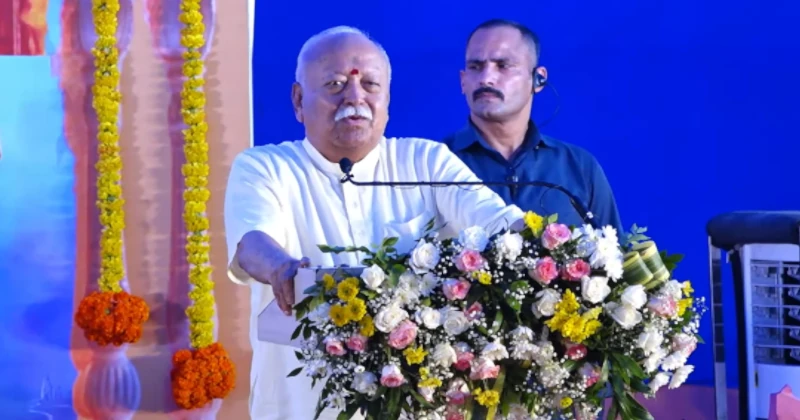
Rashtriya Swayamsevak Sangh (RSS) Sarsanghchalak Dr. Mohan Bhagwat noted to embrace Sanskrit as the living embodiment of its cultural identity and as a fundamental pillar in the mission to achieve Atmanirbharta (self-reliance). Speaking at the inauguration of the Abhinav Bharati International Academic Building at the Kavi Kulguru Kalidas Sanskrit University in Waranga, Ramtek, Dr. Bhagwat delivered a clarion message to institutions, policymakers, and the people—India cannot rediscover its true self without reconnecting with its linguistic and spiritual roots.
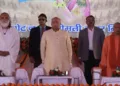
The occasion witnessed the presence of prominent dignitaries, including Maharashtra Chief Minister Devendra Fadnavis, Higher and Technical Education Minister Chandrakant Patil, Vice Chancellor Dr. Hareram Tripathi, former Vice Chancellor Dr. Pankaj Chande, scholar Dr. Uma Vaidya, and academic director Krishnakumar Pandey. But it was Dr. Bhagwat’s deeply reflective and stirring address that emerged as the ideological centrepiece of the event.
Dr. Mohan Bhagwat’s address was far more than a ceremonial speech it was a socio-cultural manifesto for India’s future. With calm authority, he laid out the philosophical and historical case for Bharat to reclaim its original civilisational confidence.
“The present circumstances and national leadership are clearly indicating that Bharat must now rise on its own strength. We must become self-reliant—not just in industry and technology but in thought, spirit, and culture. For this, we must understand our self completely,” Dr. Bhagwat said.
His message was unambiguous: Atmanirbharta is not a mere economic policy it is a national sankalp (resolve) rooted in swa-bodh (self-knowledge) and swa-sammān (self-respect). Unless Bharat rediscovers its inner spiritual and intellectual compass, self-reliance will remain incomplete.
Delving into historical insights, Dr Bhagwat noted that from 1 AD to 1600 AD by the West’s own admission India was the most advanced civilisation in terms of prosperity, innovation, and cultural sophistication.
“We were steadfast in our self-respect and cultural values. That was our strength. But when we began to lose touch with this identity, our decline began. Foreign invasions shattered our sovereignty, and the British went a step further they enslaved our intellect,” he warned. The loss of swa-tantrata (sovereignty) was not just political, he reminded the audience it was civilisational. “To reverse this, we must reclaim our swa-tva our individuality, our essence.”
At the heart of Dr Bhagwat’s message was a passionate plea to revive Sanskrit not merely as an academic subject, but as a living, breathing medium of communication that carries the spirit of India. “Language is not just a medium of communication it is a reflection of emotion, culture, and identity. Bhav (emotion) and swa-twa (individuality) are expressed through language. And Sanskrit is the root of all Indian languages it is the language of Bharat’s soul,” he declared.
He was candid about his own journey: “I have learnt Sanskrit, but I still struggle to converse in it fluently. This should not deter us. What matters is the intent to bring it into daily life. Sanskrit must reach every home not just for recitation, but for conversation.”
Dr Bhagwat noted that Sanskrit has the largest storehouse of words and concepts and is the mother of most Bharatiya languages. “Every language of our country has originated from Sanskrit. Knowing Sanskrit is like knowing India,” he said.
Importantly, Dr. Bhagwat dismantled the notion that Sanskrit proficiency requires formal academic training. “One doesn’t need a university degree to speak Sanskrit. There are homes in Bharat where Sanskrit is spoken and memorised as part of family tradition. We need to revive that tradition. Let Sanskrit walk back into our kitchens and courtyards,” he said.
He emphasised that while institutions like Kalidas Sanskrit University will receive government support, they also carry a sacred responsibility to take Sanskrit beyond their walls and into the hearts of the people. “Sanskrit needs rajya anudan (state support), but more importantly, it needs jan samarthan (people’s patronage). Both are essential for its resurgence,” he stated.
Drawing attention to the global intellectual crisis, Dr Bhagwat observed that Western nations had aggressively marketed the idea of a globalised economy, but that model had collapsed under its contradictions.
“They gave the world the idea of a global market. We gave the world Vasudhaiva Kutumbakam the world is one family. It is time we stopped copying the failed ideologies of others and started exporting our own,” he said. This was not isolationism, he clarified, but an assertion of Bharatiya civilisational ethos one rooted in harmony, compassion, and inclusiveness.
Lauding the efforts of Kalidas Sanskrit University and its Vice Chancellor Dr. Hareram Tripathi, Dr Bhagwat said that institutions like these must become cultural launchpads. “This academic campus is not just a building. It is a lighthouse of sanskriti (culture), gyan (knowledge), and swa-bodh (self-awareness). Our Sanskrit universities must not become storage houses of ancient texts they must become engines of cultural rebirth,” he asserted.
Maharashtra Chief Minister Devendra Fadnavis, echoing Dr Bhagwat’s sentiments, reaffirmed the state’s commitment to Sanskrit education and Bharatiya knowledge systems.
“We are proud to support the vision of Sanskrit as a living language. This university is part of a much larger cultural renaissance that will shape the future of Maharashtra and Bharat,” CM Fadnavis said. Higher Education Minister Chandrakant Patil also highlighted new policy measures to integrate Sanskrit into public education and higher learning.










Comments