





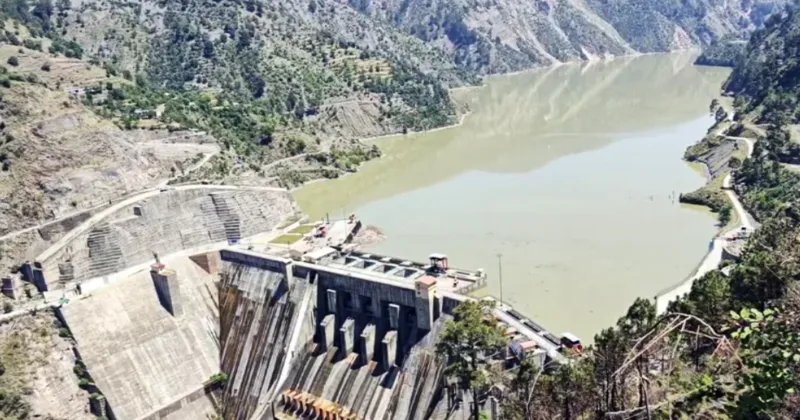
Putting words into action, the union government led by Prime Minister Narendra Modi has issued a global tender for 1,856 MW Sawalakote hydropower project. The tender was issued a couple of days back and the last date given on the document is September 10, just 40 days away. The project is the largest of its type on the Chenab river to be located downstream of Baglihar and upstream of Salal power projects.
The project is located near Sidhu village of Ramban district of the Union Territory (UT) of J&K. So far, Baglihar was the only hydropower project in this district but the initiation of Sawalakote project will boost its status as a major power producing district. Incidentally, the Sawalakote project was conceived in 1960s but Pakistan’s repeated objections under the framework of the IWT had stalled it repeatedly.
The project involves the construction of a 192.5-meter roller-compacted concrete gravity dam designed as a run-of-the-river scheme on the Chenab River. It is expected to become the largest hydropower project in J&K. Not only this, once the project is completed in about 10 years, Sawalakote and Baglihar projects, both located in the Ramban district will be able to meet substantial energy needs of the UT.
It can be mentioned here that Pakkal Dool project of 1,000 MW capacity and Ratle project of 850 MW capacity, both on the Chenab in Kishtwar district, have also gained from the pause in IWT. These two projects have also been fast tracked and the Pakkal Dool is expected to start production in the next 18 months. These two projects are being built in the PPP (Public Private Partnership) mode.
After putting the Indus Waters Treaty (IWT) into abeyance on April 23 this year, the issuance of this tender can be considered as one of the most significant steps taken by Bharat. It also indicates that the Modi government is now fast tracking many hydropower projects on which IWT constraints had bound it in knots earlier.
The story of Sawalakote project on the Chenab is not very different from the Tulbul Navigation Project on Jhelum river which too remained stuck for too long due to IWT constraints. Decades ago, some work was started for undertaking this project. However, it was shelved without the government saying much about the reasons for its decision. Later, when Farooq Abdullah government assumed power in October 1996, it tried to revive the project.
Between 1997 and 2002, when Farooq Abdullah bowed out of power, a Norwegian consortium led by Lehmeyer did some survey works pertaining to this project. Its engineers, many of them French, were based in Chanderkote village of Ramban district which is also the head office of Baglihar project. Terrorism in the hinterland, and deeper rural belts of Ramban, was a major constraint at that time. Later, Mufti Mohammad Sayeed took over as Chief Minister in November 2002 and some time during his tenure of three years, Sawalakote project was scrapped altogether.
One of the hindrances in the execution of projects of this size (of Sawalakote) are the Environmental Impact Assessment (EIA) reports. However, according to information in the public domain, a panel of the Environment Ministry panel has given “in-principle” approval for the diversion of over 847 hectares of forest land for the project. Yet, the final approval is subject to the UT government’s grant of environmental clearance and it is now considered a mere formality as Chief Minister Omar Abdullah is very keen that the hydropower projects in the UT are taken up expeditiously.
On the energy security front, Sawalakote project’s revival aligns with India’s push for energy self-reliance. Bharat’s strategic use of water resources from the Western Rivers allocated under the IWT is also a long overdue step. On paper, under the IWT framework, India can construct as many hydropower plants as run of river (RoR) on the Western Rivers. However, Pakistan’s cussedness in objecting to every single project that Bharat initiated on these rivers was a major thorn in the flesh. With the Treaty constraints not there, the completion of these projects is bound to impact the economy of the UT of J&K in a major positive way.
Incidentally, the union government is also working for clearing of mandatory environmental and other regulatory mechanisms so that projects like Kirthai and Lower Jhelum-II are speedily completed. Overall, the putting of IWT in abeyance is proving to a major boon for the nation, and undoubtedly for the UT of J&K.















Comments