





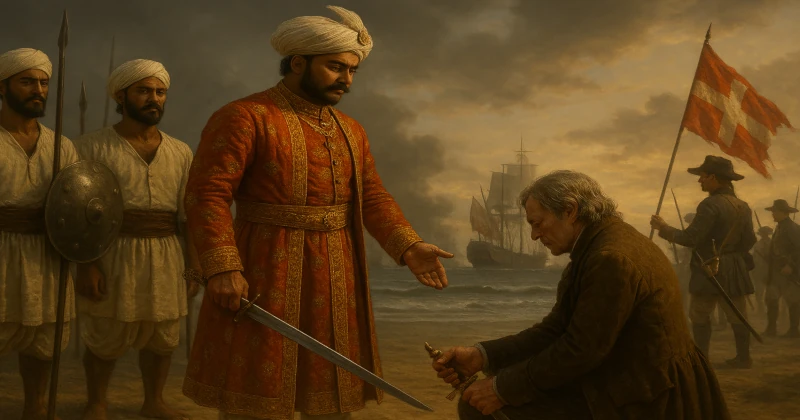
In Bharat’s vast tapestry of resistance, some stories remain buried. While Marathas, Rajputs, and 1857 revolutionaries are rightfully celebrated, the Lions of Travancore warriors from Kerala’s sacred soil remain unsung. These were not mere soldiers but visionaries and patriots with unshakable faith. Their defiance shook colonial powers — Dutch, Mysorean, and British alike. Travancore’s tale is one of survival, sacrifice, and spiritual nationalism. From Marthanda Varma’s battlefield brilliance to Vaikom Padmanabha Pillai’s strikes against Fateh Ali Sahab Tipu (Tipu Sultan), from Veluthampi Dalawa’s rebellion to the flames at Bolgatty Palace, their saga demands resurrection. Anizham Thirunal Marthanda Varma forged a kingdom by dedicating it to Bhagwan Padmanabha, making invasion sacrilege. He built a professional army, navy, and strategic alliances, turning Travancore into a fortress. Unlike expansionist empires like the Mughals, Travancore’s warriors defended land, culture, and faith. Trained in Kalaripayattu, their strength came from dharma, not conquest. They fought not for gold but to protect temples, people, and pride—battling injustice, ignorance, and erasure.
“Not all heroes rode elephants or wore crowns. Some stood barefoot, sword in hand, with fire in their hearts.”
The rise of the southern flame: Marthanda Varma
In an era of fractured kingdoms and constant warfare, Marthanda Varma rose not just as a king but as the architect of modern Travancore. Known for his unyielding resolve and strategic brilliance, he transformed chaos into opportunity, forging a powerful and unified state with calculated ruthlessness. His most legendary triumph was the Battle of Colachel, where he decisively defeated the Dutch East India Company — one of the earliest setbacks for European colonial forces in Bharat. This victory signalled Travancore’s emergence as a sovereign power capable of defending its land. Beyond the battlefield, Marthanda Varma centralized administration, strengthened the army, and crushed internal threats like the Ettuveetil Pillamar. His diplomacy skillfully balanced rival interests, and his reforms paved the way for economic and political stability. Marthanda Varma’s legacy is that of a transformative leader — fearless in war, wise in governance, and unwavering in his commitment to a united and sovereign Travancore.
Dharma Raja: The lion’s heir
Following Marthanda Varma, Dharma Raja Karthika Thirunal elevated Travancore as both a military stronghold and a moral sanctuary. Revered as the “King of Dharma,” he ruled with a rare fusion of courage, compassion, and philosophical wisdom. Amid Fateh Ali Sahab Tipu ( Tipu Sultan)’s brutal campaigns along the Malabar coast, thousands fled in terror. Dharma Raja welcomed them into Travancore, not as an act of charity, but as a sacred duty to uphold dharma. His reign balanced spiritual devotion and military readiness. While foreign powers schemed, Dharma Raja fortified Travancore with the help of extraordinary men like Vaikom Padmanabha Pillai, a fearless warrior, and Raja Kesavadas, a visionary Dewan. Under his leadership, Travancore stood as a beacon of hope, protected not just by arms but by conscience
Dharma Raja’s legacy lies in his belief that true power stems from righteousness, where justice, courage, and compassion intertwine to create a kingdom both formidable and humane.
Raja Kesavadas: The visionary architect behind Kerala’s maritime future
Raja Kesavadas was more than a skilled administrator; he was a visionary leader whose foresight fundamentally shaped Travancore’s economic and military strength. Serving as Dewan during turbulent times, Kesavadas combined dedication with bold, long-term planning that benefited generations. His most groundbreaking contribution was advocating the development of a major port at Vizhinjam. Amid external threats and internal challenges, he recognized the need for a modern maritime hub to boost trade, international ties, and naval defense. Kesavadas’s proposal to transform Vizhinjam from a small village into a strategic seaport was revolutionary. Today’s Vizhinjam International Seaport stands as a testament to his far-sighted vision and understanding of global trade dynamics. Kesavadas also streamlined trade, enhanced revenue, and strengthened defenses, crucial to preserving Travancore’s independence. A pioneer bridging tradition and modernity, his legacy of courage and innovation continues to inspire. His vision shows how committed leadership can alter history and shape a prosperous future.
Vaikom Padmanabha Pillai: The thunderbolt of Travancore
Vaikom Padmanabha Pillai was a warrior unlike any other—he sought no glory from medals or titles but etched his name deep into Travancore with relentless defiance and unmatched skill. Born during Fateh Ali Sahab Tipu ( Tipu Sultan)’s expansion, he became the unconquerable shield of his homeland. His genius was in guerrilla warfare—using patience, cunning, and deep knowledge of the land. At the Battle of Nedumkotta, he transformed natural geography into a fortress with trenches, canals, and traps. His smaller forces dealt crushing blows that humiliated Tipu’s army, proving warfare was as much psychological as physical. His unpredictability— night raids, ambushes, sabotage—kept enemies on edge. His greatest feat was the bold assault on Bolgatty Palace, forcing the British resident to flee. This symbolic victory declared Travancore’s refusal to bow. More than a commander, Padmanabha Pillai was a tempest of vengeance and vision, defending sacred land with honor and unbreakable spirit, inspiring generations to protect their heritage.
Veluthampi Dalawa: the flame that burned the empire
In an era of cautious diplomacy and fragile compromises, Veluthampi Dalawa took a bold, defiant stand. As Prime Minister of Travancore, he was no mere bureaucrat but a force of nature whose rebellion shook British colonial rule in southern Bharat. His courage made him a symbol of hope for a people weary of foreign domination. His defining act was the Kundara Proclamation, rallying commoners and warriors to resist the British East India Company. Unlike those who negotiated quietly, Veluthampi led troops personally, turning discontent into a powerful roar against imperial authority. A master of asymmetric warfare, he used Kerala’s rugged terrain to disrupt British supply lines and instill fear in colonial forces. Despite being outnumbered and relentlessly pursued, his spirit never broke. Surrounded in Mannadi, he chose death on his terms, ending his life but not his legacy. Veluthampi remains Kerala’s enduring symbol of resistance and freedom.
The battle that changed history: Colachel
In 1741, Travancore announced itself globally when the Dutch East India Company attempted to seize the spice-rich kingdom. Landing at Colachel, they faced defeat by Marthanda Varma’s forces—a rare European loss to an Indian kingdom. Dutch commander Admiral De Lannoy was captured and became Marthanda Varma’s trusted general. Together, they modernized Travancore’s army with European tactics under Indian discipline. Colachel was more than a victory—it declared that Europe would not conquer under the Lion’s watch.
The roar that shook empires: the battle of Nedumkotta
In the late 18th century, Fateh Ali Sahab Tipu ( Fateh Ali Sahab Tipu ( Tipu Sultan) aimed to invade Travancore’s riches but faced the Nedumkotta—a massive defense wall crafted by Dewan Raja Kesavadas and defended by Vaikom Padmanabha Pillai. The fortifications included trenches, hidden pits, water traps, and disguised firing posts. In 1789, Tipu’s forces, expecting an easy victory, were ambushed and routed by a smaller militia. Tipu barely escaped, marking a rare defeat where the tiger’s claws met the lion’s fangs—and lost.
The Bolgatty Palace strike: A dare that shocked the colonials
On a moonless night, Padmanabha Pillai led the daring Bolgatty Raid against British Resident Colonel Macaulay’s palace in Kochi. Crossing backwaters silently, his men launched a fierce attack flames lit the lawn, swords clashed, and sleeping British guards fell. Macaulay barely escaped the onslaught. The burning palace sent a powerful message: Travancore would not submit. This was more than an attack—it was a bold declaration that the lion had awakened and was hunting.
Not just Warriors— Builders of Nationhood
Beyond the sword, Travancore’s lions built a nation. Raja Kesavadas, one of the greatest administrators Bharat ever produced, transformed Alappuzha into a bustling port town, dubbed the “Venice of the East.” His vision linked trade, naval defense, and spiritual administration. He understood that prosperity was the first line of defense. Marthanda Varma and his successors invested in temples, irrigation, naval shipyards, and education. The spiritual and the tactical walked hand in hand. Dharma was not just a chant — it was a code of conduct. Sovereignty wasn’t just political — it was sacred.
Forgotten, But not lost
Why did Bharat forget her southern sentinels? Not by accident — but by design. Colonial rulers didn’t just conquer territory — they conquered memory. They feared warriors like Vaikom Padmanabha Pillai, Raja Kesavadas and Veluthampi Dalawa, whose fierce defiance shattered the illusion of imperial supremacy. So, they erased them from textbooks, hoping time would bury their roar. But the betrayal didn’t end with the colonizers. So-called liberal historians, driven by their ideological crusade, chose to silence the Lions of Travancore. Why? Because these warriors didn’t fit their narrative. Their story was one of faith, nationalism, and dharma values that the ideological elite sought to suppress. Instead, they glorified figures like Fath Ali Sahab Tipu — the same Tipu Sultan who massacred Hindus, destroyed temples, and waged ruthless war across Kerala — painting him as a misunderstood hero. It wasn’t history. It was propaganda — and it came at the cost of truth.
Why the lions still matter
The Lions of Travancore didn’t fight for applause, press, or monuments. They fought for the sacred soil, for the temples of their ancestors, for a land where culture wasn’t traded for compromise. These weren’t rebels. They were guardians of a civilization who used strategy, spirituality, and sheer courage to repel empires from their doorstep. Their resistance was not loud it was relentless. From the trenches of Nedumkotta to the flames of Bolgatty Palace, their discipline turned the tide of invasions. They didn’t seek power. They stood for principle.
The roar must return
Empires erase. Ideologues rewrite. And time forgets unless we fight to remember. Travancore’s war was not just for land, it was for Bharat’s soul. A Bharat where freedom bowed to faith, not to foreign flags. A Bharat where resistance wasn’t rebellion, but duty. The legacy of Padmanabha Pillai and Veluthampi Dalawa is not just history, it’s a blueprint for courage. Their blood still whispers through Kerala’s rivers and hills, through every Kalaripayattu move, every temple bell, every child taught to protect before they protest. It’s time to shatter the silence. To reclaim the names buried by bias. To remember that Bharat’s freedom wasn’t granted — it was wrestled from the jaws of empires by warriors who asked for nothing but honor. The Lions of Travancore are not forgotten. They will rise again — fierce, unbowed, and blazing with the fire that once guarded a civilization.










Comments