




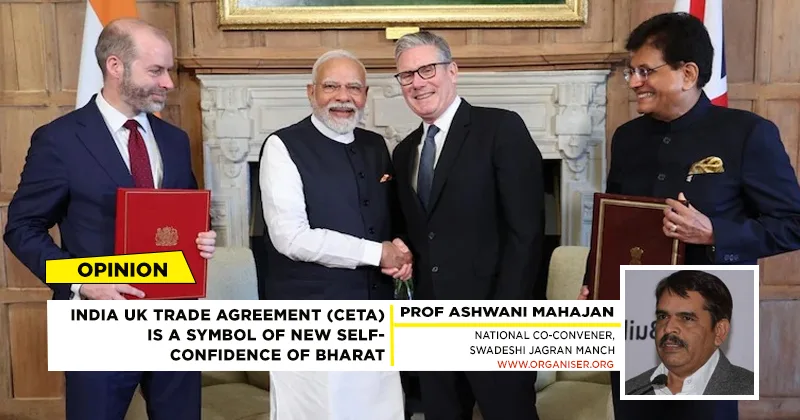
The India-UK Comprehensive Economic and Trade Agreement (CETA) was signed on July 24, 2025 in London in the presence of Prime Minister Shri Narendra Modi. This is the first free trade agreement of India with a developed country in the European region. After this agreement, 99 per cent of exports from India will now enter the UK at zero duty, giving India an edge over its competitors who continue to have high duty or at least non-zero duty, and boosting India’s exports accordingly.
The official side claims that after this FTA, India-UK trade can double from the current US$ 56 billion by 2030. This will help small entrepreneurs including sports goods, artisan products and other labor-intensive industries. The Commerce Minister has also written in his article that India is well positioned to become one of the top three suppliers of textiles, leather and footwear to the UK, which will help small businesses, artisans and craftsmen, including women, to emerge as key players in global value chains. Exports of gems and jewellery, engineering goods, chemicals and electronic products such as smart phones are also expected to jump.
Protection of farmers and support to fishermen
Commerce Minister Piyush Goyal has mentioned that zero percent tariff on 95 percent agricultural products will boost the export of agricultural products to the UK, leading to rural prosperity, as duty-free market access is estimated to increase agricultural exports by 20 percent in the next 3 years. The Commerce Minister writes that no concession in tariff on dairy, apples, oats and edible oils have been given, which will keep our dairy safe and help maintain price stability to protect our farmers. In addition, India will get access to UK marine product markets which will help our fishermen, as tariff on marine products will come down from 20 per cent to zero per cent after this agreement.
Officials claim that the IT/ITE agreement will create new opportunities for Indians by providing concessions for mobility of professionals including those in financial services and education. In addition, India has ensured favourable mobility provisions for skilled professionals including contract service providers, business travellers, yoga instructors, musicians and chefs.
It is important to note that the current CETA benefits 45 per cent of manufacturing exports ($6.5 billion), as our $8.0 billion exports already had zero per cent duty access under UK rules before this agreement. These include petroleum, medicines, diamonds and aircraft parts. Currently, medium to high duty is imposed on $8.6 billion of UK exports to India; and India has agreed to eliminate duty on 90 per cent of these items. Products such as salmon, mutton, aircraft parts, machinery and electronics (65 per cent of the total) will get immediate relief with zero duty, while duty reduction will be phased out over the next 10 years on the other 26 per cent of products, including chocolates, soft drinks, cosmetics and auto parts.
Agreement on Government Procurement
However, this is the first time that an agreement has been reached with a developed country to allow government procurement on such a large scale. Prior to this, there was an agreement with the UAE to allow limited government procurement. Now, about 40,000 high-value contracts of central ministries and departments, including transport, green energy and infrastructure, will be available to British suppliers. These firms will get national status and they will be able to bid through India’s central public procurement portal and ‘GeM’ (Government e-Marketplace) platform. More importantly, only British origin goods with 20 per cent domestic content will be classified as second-class local suppliers under India’s public procurement order, a category previously reserved for Indian firms with 20-50 per cent local content. Agriculture, MSME and small value contracts have been excluded from this provision of CETA. Although with this, Indian companies will also get an opportunity to participate in British government procurement, but it remains to be seen how our companies are able to cross various obstacles being imposed by the British government in this regard.
Services
India has opened up sectors such as telecoms (100 per cent FDI), financial services (FDI cap in insurance sector 74 per cent), auditing, construction and environmental services to British firms under CETA. British professional qualifications in sectors such as accountancy will be recognised, except for legal services.
But British offers in services are far more limited. While CETA allows Indian investment in sectors such as IT and consulting, there is no binding commitment to ease visa access for Indian professionals. This is reminiscent of the visa restrictions imposed by several ASEAN countries, despite India’s ASEAN free trade agreement, including Services. Significantly, when India signed a free trade agreement with ASEAN countries, many ASEAN countries, contrary to expectations, tightened their visa rules even further. Though, 1800 visas have been offered for specific roles such as yoga teachers and classical musicians, but the UK has not restored the post-study work visa; and has retained its strict points-based immigration rules. One benefit for more than 75,000 Indian workers is that they will no longer be required to pay for social security in the UK, provided they are paid in India.
Change in approach
So far, India has been cautious about opening up government procurement. The only free trade agreement (FTA) where India gave limited access to government procurement was with the UAE, where there was no major threat of market capture. But at that time, fears were expressed in several quarters that this might set a precedence for future agreements. UK firms have been allowed to bid for 40,000 high-value central government contracts; and the concessions in free trade agreements (FTAs) with the EU and the US government could go even further. Public Procurement has been a key tool in industrial policy globally to protect domestic industry, which has been abandoned in this free trade agreement.
Reciprocity is a natural process in trade agreements. It cannot be assumed that only one party will benefit from the agreement. In such a situation, Britain has given a lot of concessions to India. Now, compared to earlier, Indian manufacturing products and agricultural products will be able to enter the British markets easily. Indian companies will now be able to take part in UK government procurement as well. India will definitely get some benefits in the service sector as well. But what will be the effect of the concessions given by India in return will be known only in the coming time. But it is true that after this agreement, the governments of both the countries are expressing happiness. Here it has to be understood that after Brexit, Britain was a little isolated in the European markets. After this agreement with India, Britain will enter a new era of trade. This trade agreement of India with the UK also shows India’s confidence that now India can move forward with cooperation for mutual benefit by making trade agreements with developed countries. Till now, this kind of confidence was rarely seen while making trade agreements with developed countries.













Comments