





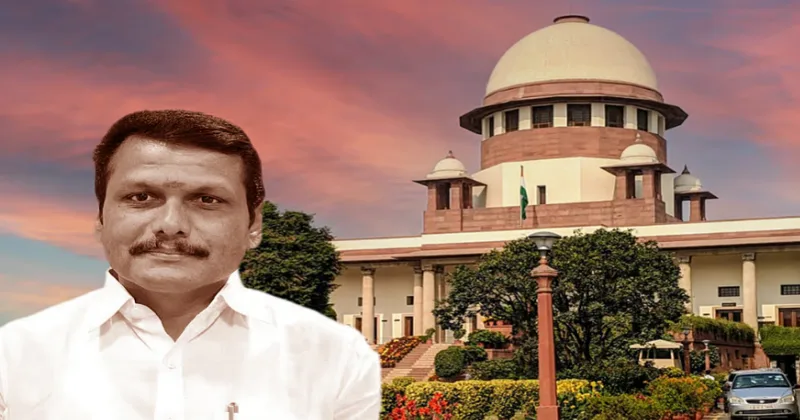
In a scathing indictment of the Tamil Nadu government’s handling of the infamous cash-for-jobs scam, the Supreme Court has slammed the state’s decision to club over 2,000 accused individuals in a single trial, warning that the proceedings would require “a cricket stadium” to accommodate the sheer number of defendants and witnesses. The apex court on Wednesday, continuing its hearing from Tuesday, July 29, expressed grave concerns that the state’s strategy appeared to be a deliberate “fraud on the system” designed to indefinitely delay the prosecution of former Dravida Munnetra Kazhagam (DMK) minister V Senthil Balaji, the alleged kingpin of the scam.
The bench, comprising Justices Surya Kant and Joymalya Bagchi, did not mince words, asserting that the state seemed more interested in prosecuting those who allegedly paid bribes – “the poor parents who wanted a job for their children” – rather than focusing on the primary culprits. This approach, the judges stated, suggested an intent to ensure that “in the entire lifetime of the minister, the trial proceedings never come to an end.”
The controversy stems from a series of job scam cases linked to V. Senthil Balaji, who served as Transport Minister in the AIADMK regime between 2011 and 2016. He, along with his brother and personal assistants, is accused of collecting substantial sums of money by promising various government jobs. The total number of accused now exceeds 2,300 people, with over 500 witnesses expected to testify.
The Supreme Court’s strong observations came during its hearing of a plea filed by Y. Balaji, represented by Senior Advocate Gopal Sankarasubramanian. The petition challenges a March 2024 order of the Madras High Court, which had dismissed objections to the clubbing of charge sheets in these cases.
Sankarasubramanian painted a damning picture of the state’s alleged complicity and efforts to shield the former minister. He highlighted that just two days after Senthil Balaji was granted bail by the Supreme Court in September 2024, he was controversially reinstated as a minister in the current Tamil Nadu government. Balaji only stepped down from the cabinet on April 27, 2025, after the Supreme Court’s intervention questioned his continuation in public office while facing serious money laundering charges and offered him a choice between holding office or remaining on bail.
“The state had helped in every step,” Sankarasubramanian contended, alleging “match-fixing” in the legal process. He argued that the original cases had been quashed at the High Court level through what he termed a “friendly match,” only to be revived due to the Supreme Court’s intervention. “If such match fixing is allowed, then the umpire will lose his wicket,” he warned metaphorically, urging the apex court to order a CBI probe and an independent prosecution of the cases to ensure impartiality.
The bench on Wednesday reiterated its concern over the practical impossibility of conducting such a massive trial in a standard court hall. “With 200 witnesses summoned in a court hall, it will perhaps be one of the most populated trials in India… you will need a cricket stadium… Almost impossible task will be to mark their presence. There will be 100s of AI generated accused on that day,” the judges remarked, highlighting the logistical nightmare created by the clubbing of cases.
The Supreme Court demanded a clear and definite “prosecutorial plan” from the state, characterizing its current approach as a “very rudderless ship.” The judges underscored that the state’s actions suggested a deliberate intention to delay proceedings indefinitely by implicating individuals who were allegedly victims of the scam, thereby diverting focus from the main perpetrators. “You are more keen to prosecute them so that in the entire lifetime of the minister, the trial proceedings never come to end. This is your modus operandi. This is a complete fraud being committed on the system,” the bench asserted.
The court also pressed the state to identify the key players beyond the minister himself. “We would like to know besides the minister, who were the alleged brokers or middlemen? Who were the officers who acted on the recommendations of the minister? Who were the members of the selection committee? Who were the authorities who gave the appointment?” the bench questioned, seeking clarity on the broader network involved in the scam.
Sankaranarayanan proposed that the prosecution should distinguish between the “genuine accused” – such as the minister, his brother, his personal assistants, and others who directly solicited bribes – and those who are currently arrayed as accused simply for being “bribe givers.” He suggested that the latter could potentially be treated as witnesses, and advocated for the appointment of a Special Public Prosecutor (SPP) to ensure the trial was conducted independently and fairly.
However, counsel for the State, Abhishek Manu Singhvi, opposed the suggestion for an SPP, arguing that it would “send the wrong signal,” implying a lack of trust in the state’s own prosecution and judiciary. He contended that it would create a perception that the state was unwilling to prosecute its own officials. Despite this opposition, the court maintained that the appointment of an SPP would help “dispel any wrong public perception” about the trial, especially given the involvement of a former minister and bureaucrats in the case.
Justice Bagchi further questioned the state’s rationale for clubbing the cases, noting, “How would [you] achieve clubbing until and unless we gave a suggestion that you see the witnesses with regard to their degree of marginal culpability and prime culpability? Why should it come from us? This thought never crossed your prosecutor’s mind.” This observation further solidified the court’s view that the state’s approach was ill-conceived and potentially malicious.
The court also recalled how “all the FIRs were quashed at the HG level thanks to a kind of a friendly match made there.” It emphasized that these matters were only revived “because of the judicial intervention of this court,” and asked for a list of witnesses to ascertain the overlap between accused and witnesses, further indicating its intent to streamline the proceedings and ensure justice.
Senthil Balaji’s journey since his arrest on June 14, 2023, has been mired in controversy and accusations of delaying tactics. Immediately after his arrest, he was admitted to a private hospital complaining of chest pain, undergoing alleged surgical procedures. Critics, including the ED, viewed this as an attempt to avoid questioning. After court intervention, he was eventually lodged in jail following interrogation, during which the ED described him as “uncooperative.” Subsequent attempts to delay the case included numerous petitions, including Habeas Corpus pleas and challenges to the ED’s powers.
Finally, a bench led by Justice Abhay S. Oka granted him bail in September 2024, noting that the trial was “unlikely to end in the near future.” His subsequent reinduction into the Tamil Nadu cabinet three days after his release drew sharp criticism, with the Supreme Court in April 2025 questioning how a person facing serious money laundering charges could continue in public office. This led to his resignation from the cabinet on April 27, 2025.















Comments