





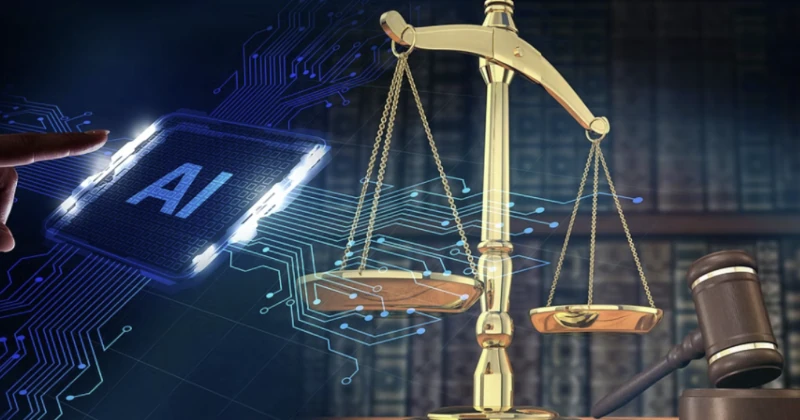
In the modern day, technology and the law are starting to interact in previously unthinkable ways. Once a distant promise of the future, artificial intelligence (AI) is rapidly making its way into legal offices, courtrooms, and legislative settings. AI is widely recognised as a potent instrument to improve the effectiveness, accessibility, and responsiveness of legal institutions, from automating legal research to supporting judicial decision-making.
Although this technical advancement is astounding, it also poses important queries. Is it possible for a machine to comprehend justice? Is it possible for algorithms to maintain justice in the same manner as a judge interpreting the Constitution? What occurs when a machine’s analysis of a legal matter is devoid of the moral nuance that human society frequently demands?
These are not only technical or legal problems. They are philosophical and ethical as well. And to completely comprehend them, we need to look not only to contemporary legal theory but also to Dharma, the ancient Indian concept of fairness.
Dharma is more than just morality or religion. It is an idea that includes responsibility, morality, the essence of justice, and ethical order. Dharma was regarded in Indian civilisation as the supreme norm that governed the conduct of people, leaders, and even judicial bodies. As a result, when discussing AI in law, we also need to discuss Dharma since, regardless of how effective it may seem, law without ethics is a useless tool.
Artificial Intelligence and the Modern Legal System: Opportunities and Concerns
The application of artificial intelligence is growing in many areas of the legal system. To increase effectiveness and openness, the Indian judiciary has started experimenting with AI. SUPACE (Supreme Court Portal for Assistance in Court Efficiency) was introduced by the Supreme Court in 2021. To facilitate decision-making, judges can use an AI-powered application to process case materials, summarise documents, and filter information. To expedite processes, High Courts have also used AI-driven legal databases, virtual hearings, and e-filing.
AI is applied in many different legal scenarios worldwide. Bail and sentence judgments in the US are made using instruments such as COMPAS. It is being used in the European Union to automate certain aspects of legal due diligence and to ensure cross-border regulatory compliance. It is also being used by law firms worldwide to evaluate lawsuit risks, do due diligence, and design contracts.
The benefits of applying AI to the legal field are clear. For those who might otherwise be left behind, it improves access to justice, saves time, and lowers human error. For instance, virtual hearings have made it possible for litigants in remote locations to access court services. AI-based legal research tools can help lawyers obtain judgments, statutes, and precedents more quickly.
However, there are also significant worries about this increase. The quality of AI systems depends on the quality of the data they are trained on. The results will be biased if the data is unrepresentative, prejudiced, or incomplete. This can be risky in the legal field. Consider a bail algorithm that unjustly penalises members of marginalised populations, even though structural prejudice is the reason for their higher arrest rates, as evidenced by historical statistics.
Furthermore, AI is unable to comprehend the human emotions and circumstances of a case. Law is not just about following the rules; it’s also about justice, fairness, and compassion. These are values that cannot be expressed solely through codes or numbers. A judge presiding over a family dispute, for instance, might have to take interpersonal dynamics, cultural sensitivity, and emotional damage into account. These are things that no machine can comprehend completely.
In addition, there are constitutional and legal issues. The right to equality before the law is guaranteed by Article 14 of the Indian Constitution. Does an AI tool’s interpretation of two people’s data violate their right to equality if the results differ? The rights to life and personal freedom are protected under Article 21. Is someone’s constitutional rights being violated if they are wrongfully convicted or denied bail due to an algorithmic error?
In the 2017 Puttaswamy judgement, the Supreme Court ruled that the right to privacy is a fundamental right guaranteed by Article 21. Large volumes of personal data are frequently gathered and analysed by AI systems, particularly those employed in surveillance and law enforcement. Who is the owner of this data? What is its use? Could the State abuse it? In Indian law, these questions are still mostly unsolved.
Even if AI might expedite the administration of justice, justice’s essence must never be sacrificed.
Dharma, Mimamsa, and the Ancient Indian Legal Philosophy
Long before AI was imagined, Indian thinkers were engaged in deep reflections on law, justice, and interpretation. Unlike modern systems that often separate law from morality, the Indian legal tradition saw the two as inseparable. Law was not just a set of rules but a reflection of Dharma.
The concept of Dharma is deep and intricate. Depending on the situation, it might indicate several things. Dharma, as used in law, is justice based on equity, truth, and the moral order of society. Dharma is frequently emphasised as the foundation of all legal and political activity in ancient books such as the Manusmriti, Yajnavalkya Smriti, and the Mahabharata. Dharma was supposed to be followed even by monarchs. As the guardian of justice rather than merely the upholder of the law, the king was referred to as the Dharma-pāla.
However, how do we define Dharma in a certain circumstance? The Mimamsa school of philosophy was the most significant of the legal reasoning and interpretation systems that ancient Indian scholars devised for this purpose.
Originally focused on interpreting Vedic rituals, Mimamsa was established by the sage Jaimini. However, it developed into a more comprehensive system of legal hermeneutics, or the science of understanding legal texts, throughout time. Consider it the archaic kind of constitutional interpretation used in India.
The Mimamsa philosophers posed challenging queries, such as: What occurs when two rules clash? Which rule ought to be applied first? How can we interpret a command’s intent? In contemporary constitutional law, these issues remain pertinent.
Mimamsa, for instance, created the idea of Apurva, which translates to “the invisible moral consequence of an action. This is comparable to how contemporary judicial systems consider how a decision may affect other cases and society as a whole.
Tantrayukti, or organised reasoning, is another idea that outlines methods for resolving conflicts in texts by considering context, sequence, and aim. This is similar to how courts interpret the Constitution today using the doctrines of purposive interpretation or harmonious construction.
It is noteworthy that the Tantrayukti method was incredibly consistent, logical, and rational. It wasn’t strict or dogmatic. It recognised that justice must change with the times while maintaining Dharma at all times.
Today’s AI is deficient in this exact area. AI is unable to assess intents. It is unable to settle ethical disputes. It is unable to choose between conflicting moral principles. Nevertheless, the law requires all of this. Therefore, using AI in law is insufficient. It needs to be considerate of Dharma in its civilisational design.
The Way Forward: Constitution, Technology, and the Dharmic Future of Justice
We must make deliberate decisions concerning the development and application of this technology as India advances in integrating AI into its legal system. We need to ask not just what AI can do, but also what it ought to be able to do. AI must be used to forward the objectives of our Constitution and the ideals of our society.
“We the People” is the first phrase of the Indian Constitution. This serves as a reminder that people, not markets or algorithms, are the reason the legal system is in place. The State is directed by Article 38 to promote justice that is social, economic, and political. Unless technology is held to human standards, this cannot be accomplished.
A few doable actions are crucial: First and foremost, India needs to create its moral guidelines for the application of AI in judicial proceedings and courts. These must have their roots in Dharmic principles and Indian constitutional ideals, as well as international best practices. Second, there needs to be transparency in the AI systems utilised in court proceedings. People ought to be able to comprehend the decision-making process. Natural justice and due process require this. Thirdly, without human oversight, no AI system should be permitted to render legally binding decisions. The final say must remain with the judges. Human judgment should not be replaced by technology; rather, it should support it. Finally, Indian jurisprudence, Mimamsa logic, and constitutional ethics must be taught in law schools and engineering schools. A new breed of judges, coders, and lawyers who are cognizant of both code and conscience is required.
India has the opportunity to present a new legal AI model to the world that is grounded in ethical duty, constitutional wisdom, and civilisational philosophy rather than just efficiency. India can be the conscience in a world of machines.
Justice in the Machine Age Must Still Have a Human Heart
Artificial intelligence has the potential to be a very effective tool for improving the effectiveness and inclusivity of our legal system. However, justice is not efficiency. Furthermore, speed is unfair. We must make sure that genuinely human and uniquely Indian values inform our instruments as we transition to an AI-driven legal future.
According to Indian tradition, just as power without justice is dangerous, law without Dharma is meaningless. According to the Constitution, the State must act with both authority and public accountability.
AI should be our helper, not our arbiter. Instead of replacing humanity, let it serve it. And let’s create a future in which technology is sensible and intelligent.
Since justice, more especially, true justice cannot be found in data. Dharma contains it.
















Comments