





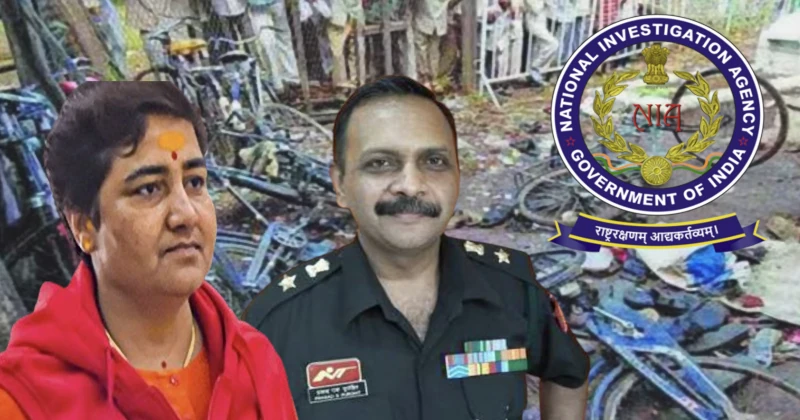
On July 31, 2025, the Special National Investigation Agency (NIA) Court in Mumbai delivered a verdict that did more than exonerate seven accused individuals in the 2008 Malegaon blast case it exposed a politically engineered saga that weaponised the justice system to manufacture a myth: Hindu terror. The acquittals of Sadhvi Pragya Singh Thakur, Lt Col Prasad Shrikant Purohit, and five others were not only legal milestones but a damning indictment of how institutions can be manipulated to pursue ideological agendas.
For nearly two decades, the Malegaon case was a crucible of state-sanctioned narrative-building, media sensationalism, and political vendetta. Behind the veil of national security and anti-terror operations, a chilling experiment was conducted: frame a community to construct a ‘counterweight’ to Islamist terror.
Nestled in Maharashtra’s Nashik district, Malegaon has long been a flashpoint of communal tension. A textile hub with a sizeable Muslim population, the town has witnessed several acts of violence and unrest over the decades most notably in 2001 and 2006, when blasts attributed to Islamic terror outfits like SIMI and LeT ripped through its crowded lanes.
On September 29, 2008, a blast once again shook Bhikku Chowk. This time, however, something strange happened: the usual suspects weren’t just absent from the list of accused they were deliberately ruled out early in the investigation.
The bomb, packed onto an LML Freedom motorcycle, killed six and injured over 100 people. Initial police reports indicated it was a low-intensity IED possibly the handiwork of SIMI factions. But within weeks, the investigation took a drastic, unprecedented turn.
The Maharashtra Anti-Terrorism Squad (ATS), under Hemant Karkare, quickly took charge. Citing intelligence inputs and call records, the ATS veered away from earlier Islamic terror hypotheses and focused on Sadhvi Pragya Thakur.
Sadhvi was arrested on October 23, 2008. Shortly after, Lt Col Prasad Purohit and Major Ramesh Upadhyay followed. The ATS claimed they were part of a covert organisation named ‘Abhinav Bharat’, working to retaliate against Islamist terror by promoting a violent Hindutva agenda.
They alleged that a group called Abhinav Bharat, comprising Army personnel, sadhus, and RSS-linked sympathisers, was behind the blast. Lt Col Prasad Purohit, a military intelligence officer, was accused of being the lynchpin — supplying RDX, planning attacks, and coordinating operations.
Over the next few months, multiple arrests were made. Among them:
- Sadhvi Pragya Singh Thakur, whose motorcycle was allegedly used in the blast.
- Lt Col Purohit, accused of providing material and ideological support.
- Sameer Kulkarni, Ramesh Upadhyay, and others, linked to Abhinav Bharat.
With these arrests, the phrase ‘saffron terror’ was born. Media outlets pounced on the narrative. Politicians, particularly from the Congress, cited it to draw ideological equivalence between Islamist extremism and Hindu nationalism. But what looked like a breakthrough investigation soon began to unravel.
What followed was not just legal drama it was ideological spectacle. For the first time, India was being told that terrorism wasn’t exclusive to jihadist networks.
The ATS built its case on a few central pillars:
- The blast vehicle was once registered under Sadhvi Pragya’s name.
- Meetings of Abhinav Bharat in Bhopal and Faridabad allegedly planned the attack.
- Call records showed communication between the accused.
- Statements of ‘witnesses’ recorded under duress.
Yet, every one of these pillars was either legally untenable or factually flimsy:
- The motorcycle had changed hands multiple times.
- No physical or forensic evidence placed the accused at the scene.
- Witnesses later recanted, claiming they were tortured or bribed.
- Confessions were obtained in violation of legal procedures, often under MCOCA.
- Alarm bells rang, but the machine of persecution had already been set in motion.
Parallel investigation NIA exposes the ATS
In 2011, the NIA took over the case. What it found was shocking:
- ATS officers had planted evidence.
- Several confessional statements were either fabricated or extracted under torture.
- No reliable chain of custody for key material evidence existed.
- Lt Col Purohit had actually informed military superiors about Abhinav Bharat’s activities—indicating he was an infiltrator, not a conspirator.
By 2016, the NIA’s supplementary chargesheet diluted the ATS narrative entirely. It dropped MCOCA charges and questioned the credibility of witness testimonies. But by then, the damage was done.
Political Weaponisation of ‘Saffron Terror’
While courts and agencies debated facts, politicians exploited fiction. Congress leaders including Digvijaya Singh, Sushilkumar Shinde, and P. Chidambaram frequently used the term ‘Hindu terror’ or ‘saffron terror’ in public discourse. This was portrayed as a necessary ideological counterbalance to the narrative of Islamic terrorism.
The most brazen moment came in 2013 when Shinde, then Home Minister, stated that BJP and RSS were running ‘terror training camps’—statements later cited by Pakistani delegates in international forums. The Malegaon case wasn’t just about one blast. It became the bedrock for a broader political attack on Hindu identity and nationalism.
From 2009 to 2025, the judicial process crawled:
- Multiple judges were transferred.
- Witnesses repeatedly turned hostile—some citing fear, others alleging torture.
- Over 300 prosecution witnesses were examined.
- Volumes of records and exhibits were presented, many of which collapsed under scrutiny.
In 2011, the NIA, formed after the 26/11 attacks to probe pan-India terror cases, took over the Malegaon probe.
What it found was shocking.
In 2016, the NIA filed a supplementary chargesheet:
- Dropped MCOCA charges against the accused.
- Questioned the legality of ATS confessions, calling them non-admissible.
- Noted serious procedural violations, including lack of corroborative evidence.
- Discharged several individuals previously named by the ATS.
While the NIA did retain charges under UAPA and IPC against a few, including Purohit and Pragya, the very backbone of the ATS’s “Hindu terror” theory was collapsing.
In 2017, Sadhvi Pragya was granted bail. The judge noted that prima facie, there was no evidence of her involvement. The Supreme Court, in 2018, allowed Lt Col Purohit to be released on bail, citing procedural lapses and weak evidence.
2025 Acquittal
Judge A.K. Lahoti’s verdict was a scathing rejection of the ATS’s case. Key observations included:
- No credible link between the accused and the bomb materials.
- Witness statements were contradictory and unreliable.
- Forensic reports were manipulated or inconclusive.
The ATS acted with “preconceived notions and ideological motivations.” He ruled that suspicion, no matter how grave, could not replace hard evidence. All seven accused were acquitted. The myth of Hindu terror crumbled in a courtroom.
The toll was devastating:
- Sadhvi Pragya: Nine years in jail, numerous health issues, psychological trauma, and a public character assassination.
- Lt Col Purohit: Imprisoned for years, labelled a traitor, ostracised by peers.
Sameer Kulkarni, Ramesh Upadhyay, and others: Families destroyed, careers lost, and reputations ruined. Socially boycotted and professionally sidelined, they bore the cost of a political witch-hunt. From 2008 to 2015, India’s mainstream media ran a relentless campaign portraying the accused as radical Hindu terrorists. Channels and publications parroted leaked ATS documents, often without verification.
The Malegaon blast case has been one of the most controversial terror trials in India’s post-2000 history, not merely because of the deaths and injuries involved, but because of the way it was instrumentalised to construct the “Hindu terror” narrative.
This narrative aggressively peddled by sections of the political class and amplified by media houses labelled saffron-robed monks and decorated military officers as terrorists. The damage to their lives, careers, and reputations was incalculable. Pragya Thakur spent nearly nine years in jail, during which she suffered serious health complications. Lt Col Purohit was suspended from service and jailed for over nine years without a conviction.













Comments