





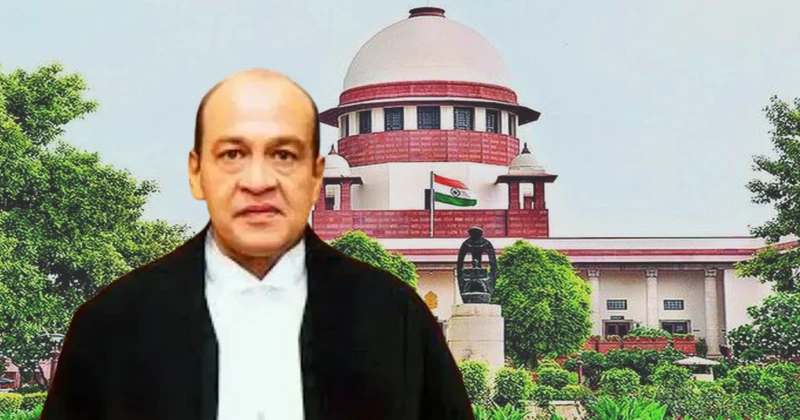
The Supreme Court has reserved its judgment in the explosive cash scandal involving Justice Yashwant Verma of the Allahabad High Court. The apex court’s stern observations, directed at Verma during Wednesday’s hearing, have paved the way for a possible impeachment motion, bringing India’s judiciary under intense public and constitutional scrutiny.
The courtroom drama unfolded before a Bench of Justice Dipankar Datta and Justice A.G. Masih, as Justice Verma sought to invalidate the in-house committee report that found him guilty of serious misconduct. The report, triggered after a fire at his official residence in March 2025 led to the discovery of charred bundles of high-denomination currency, became the centrepiece of this unprecedented judicial storm.
The Bench did not mince words. Addressing Verma’s delayed petition challenging the committee report, Justice Datta said, “Your conduct does not inspire confidence. You waited for a favourable finding and once it didn’t come, you rushed here.” The court rejected the suggestion that Verma had been denied due process, questioning why he had chosen to appear before the in-house panel only to later allege constitutional violations.
When Verma’s senior counsel, Kapil Sibal, argued that the in-house committee lacked legal authority and that its recommendation to the President and Prime Minister was unconstitutional, Justice Datta responded sharply, “Chief Justice is not a post office. He has a duty towards the nation.”
The court reminded Sibal that the in-house procedure, although administrative, had been affirmed in multiple judgments and functioned as a legitimate trigger for impeachment proceedings under Article 124 of the Constitution.
Sibal argued that the committee’s recommendation was non est (void in law) and lacked procedural safeguards. He accused the panel of “damning my client without granting a full and fair hearing,” and warned of a dangerous precedent if administrative reports could lead to the removal of a sitting High Court judge.
But the court remained unconvinced. Justice Datta reminded the counsel that the Judges (Inquiry) Act, 1968, was Parliament’s prerogative, and the in-house mechanism merely recommended initiation not execution of impeachment.
Justice Masih added, “You are a constitutional authority. You knew the in-house process could trigger Parliament’s process. Then why didn’t you approach the Court earlier?”
With the Supreme Court reserving its verdict and refusing to stay the recommendation made by then CJI Justice Sanjiv Khanna to the President and Prime Minister on May 8, the constitutional road now stands clear for initiation of an impeachment motion in Parliament—the first in over a decade.
If Parliament accepts the recommendation and gathers the requisite support (50 Rajya Sabha or 100 Lok Sabha MPs), it could lead to Justice Verma becoming only the second judge in independent India to face impeachment, following Justice Soumitra Sen in 2011, who resigned before the process concluded.
Timeline of the Scandal
- March 14, 2025 (Holi Night): A fire breaks out at Justice Verma’s government residence in Delhi. Firefighters discover bundles of burnt currency notes, leading to a sensational cash recovery.
- March 20, 2025: Then CJI Sanjiv Khanna orders the formation of a three-member in-house committee including Chief Justices Sheel Nagu, G.S. Sandhawalia, and Justice Anu Sivaraman.
- May 8, 2025: Based on the panel’s damning report, Justice Khanna writes to the President and Prime Minister, recommending the initiation of removal proceedings.
- July 23, 2025: CJI Gavai recuses himself from the case citing prior involvement.
- July 28–30, 2025: The Supreme Court hears Justice Verma’s petition and reserves its verdict.
In a dramatic twist during the hearing, the court confronted advocate Mathews Nedumpara, who claimed to have accessed the confidential report from LiveLaw. The Bench threatened legal action for breaching confidentiality. However, Senior Advocate P.V. Dinesh clarified that the legal news portal had never published the report.
The court warned against misuse of privileged documents and hinted at initiating action if false statements were made before the court.
Justice Verma, in his petition, claims he was not present in Delhi during the fire and had no knowledge of the cash found. He has alleged violation of natural justice, procedural lapses, and “trial by media.” His legal team has asserted that the in-house process bypasses Parliament’s authority and is unconstitutional when used to initiate removal.












Comments