





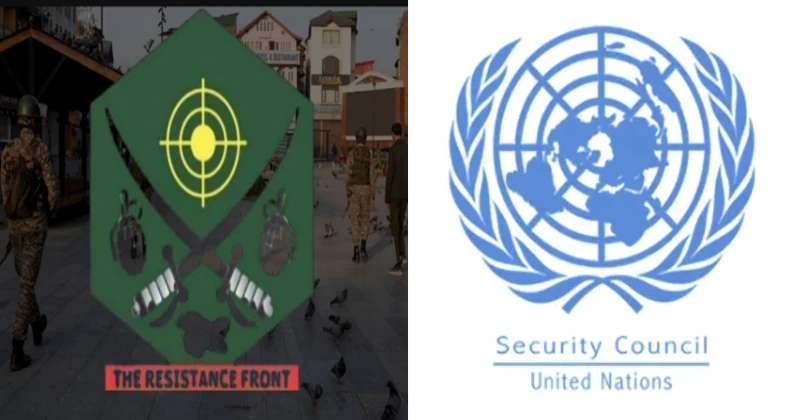
The United Nations Security Council’s (UNSC) Sanctions Monitoring Team has, for the first time in five years, officially named Pakistan-based Lashkar-e-Taiba (LeT) and its proxy The Resistance Front (TRF) in connection with the brutal Pahalgam terror attack that killed 26 civilians on April 22. This explosive acknowledgment by the 1267 ISIL (Da’esh) and Al-Qaeda Sanctions Committee has exposed Islamabad’s strategy of using ‘secular-sounding’ proxy names to mask state-sponsored jihadist violence in J&K.
The 36th Analytical Support and Sanctions Monitoring Team (MT) report, adopted by consensus among Security Council members, marks the first explicit mention of LeT since 2019, and unequivocally ties the group and its offshoot, TRF, to the April 22 bloodbath at the popular tourist destination in South Kashmir’s Pahalgam.
“The attack was claimed that same day by The Resistance Front (TRF), who in parallel published a photograph of the attack site. The claim was repeated the following day. On 26 April, however, TRF retracted its claim. There was no further communication from TRF, and no other group claimed responsibility,” the report states.
Crucially, the report cites two UN member states affirming that the attack could not have been executed without support from Pakistan-based Lashkar-e-Taiba. One of these states categorically stated:
“TRF is synonymous with LeT.” While another state attempted to dismiss the claims and dub LeT as “defunct,” the weight of the evidence provided by India and endorsed in the MT report firmly establishes the operational continuity and violent legacy of LeT through its rebranded avatars like TRF.
This damning inclusion in the MT report follows sustained, evidence-based diplomacy by India across 2023–24. According to government sources, India had submitted detailed inputs to the UN Monitoring Team, including a comprehensive dossier on TRF’s origins, linkages to LeT, and its role in recruiting, arming, and infiltrating terrorists into J&K.
In May 2024, an inter-ministerial delegation led by the Ministry of External Affairs (MEA) travelled to New York to brief UN officials and share specific intelligence. Indian Missions globally, backed by Members of Parliament, lobbied for stronger international recognition of Pakistan’s proxy terror outfits operating under the garb of local resistance groups.
“The paragraph on TRF and the Pahalgam attack is the first and largest under the South Asia section of the report. It is in sync with what we’ve been saying TRF is LeT in disguise and it’s supported by Pakistan’s deep state,” a senior Indian official said.
The timing of this report is crucial. Just weeks earlier, Pakistan’s Foreign Minister Ishaq Dar had boasted in Parliament that Islamabad had succeeded in removing any reference to TRF from a UNSC press statement condemning the Pahalgam attack. That earlier statement had acknowledged the “reprehensible act of terrorism” but did not name the perpetrators a tactical win for Pakistan achieved through backdoor lobbying.
Now, that narrative lies in ruins. “The mention of TRF in the MT Report is how the world views Pakistan’s lies and deceitful narrative. Their strategy of plausible deniability using modern-sounding names like ‘The Resistance Front’ or ‘People Against Fascist Front’ has been punctured,” said a senior Indian diplomat.
The UN report comes close on the heels of the United States designating TRF as a Foreign Terrorist Organization (FTO) and a Specially Designated Global Terrorist (SDGT). The US State Department clearly stated that TRF was responsible for multiple terror attacks, including the Pahalgam massacre, and reiterated its ties with LeT.
Notably, the US response highlighted President Donald Trump’s continued national security doctrine, aimed at bringing justice to victims of terrorism and holding Pakistani-based networks accountable.
Formed in 2019 after the abrogation of Article 370 in J&K, TRF was Pakistan’s strategic attempt to mask jihadist violence behind a civilian, local resistance façade. It has been actively involved in online radicalisation, terrorist recruitment, weapon smuggling, and cross-border infiltration.
Its commander and founder, Sheikh Sajjad Gul, has been designated a terrorist under India’s Unlawful Activities (Prevention) Act, 1967. The group has orchestrated multiple attacks on civilians, elected representatives, and security personnel in the Valley since 2020.
TRF was officially banned by India in 2023, but Pakistan continues to deny its existence, despite mounting international documentation.
India’s military response to the Pahalgam attack was swift and decisive. In late April and early May 2024, the Indian Armed Forces launched Operation Sindoor, targeting terror launchpads and infrastructure inside Pakistan-occupied J&K and across the Line of Control. The precision strikes led to a four-day border conflict, which ended after Pakistan’s military sought a ceasefire on May 10 under international pressure.
The UN Monitoring Team report now retrospectively justifies India’s military and diplomatic response, affirming that the Pahalgam massacre was not an isolated incident but a state-backed cross-border terror operation disguised as indigenous resistance.











Comments