





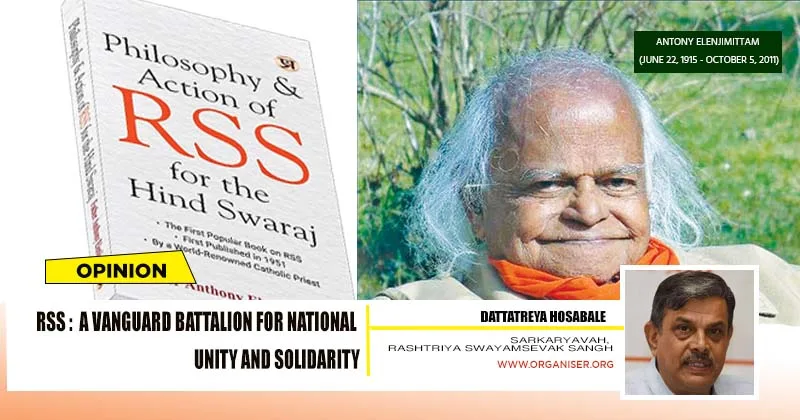
It is with immense joy and profound significance that I stand before you today to celebrate the re-publication of a truly remarkable book, Philosophy and Action of RSS for the Hind Swaraj by Father Antony Elenjimittam. The timing of this re-release is nothing short of serendipitous, aligning perfectly with Lokmanya Tilak’s birth anniversary, a significant coincidence, given that Dr Keshavrao Hedgewar, the revered founder of the RSS, was a staunch follower of Tilak’s profound ideology.
Today (July 23) is an auspicious day indeed, marking not only Tilak’s 170th birthday but also the birth anniversary of the legendary Chandrashekhar Azad. Dr Hedgewar himself was deeply involved in our nation’s freedom struggle, especially aligning with Tilak’s fervent Swadeshi movement. He was a prominent youth figure among Tilak’s followers in Nagpur and even served as the joint secretary of the Vidarbha Prant Congress. These connections underscore the deep roots of the RSS in Bharat’s struggle for Independence.
A Beacon in Turbulent Times
The original launch of Father Elenjimittam’s book on Vijayadashami in 1951 came at an incredibly crucial juncture for the RSS. Having just completed 25 years in 1950, the organisation faced immense challenges. As many are aware, following Gandhi ji’s assassination in 1948, the then-Government, based on false accusations, banned the RSS. Thousands of our Swayamsevaks were imprisoned, their homes attacked and even burned, and many lost their jobs. Yet, despite these hardships, the ban was lifted unconditionally on July 9, 1949, because not a single charge against the RSS could be proven, a fact reaffirmed by subsequent Government commissions. While some still, for political gain, propagate these falsehoods, the truth is known to all.
What makes Father Elenjimittam’s book so extraordinary is that it was penned by a Christian priest during a period when the RSS was grappling with an existential crisis. We lacked funds for our dedicated karyakartas and had very few affiliated organisations – only the Akhil Bharatiya Vidyarthi Parishad had just begun in 1949. At that time, the general public had little to no knowledge of the silent, tireless work of RSS Swayamsevaks in society. Father Elenjimittam’s unbiased perspective, driven by a genuine desire for Bharat’s welfare and progress, and his deep appreciation for Bharatiya sanskriti despite his foreign religious background, made his insights truly unique. I urge you to view his arguments within that historical context, especially now, as the RSS approaches its centenary, with millions of Swayamsevaks working across 25 different organisations nationwide. Elenjimittam’s book, written by someone who never even attended an RSS ‘shakha,’ contained truly prophetic observations about the RSS’s future potential.
A Scholar’s Unbiased Gaze
Father Elenjimittam’s research was extensive and profound. He possessed a deep understanding of Bharatiya thought leaders and ancient texts like the Kathopanishad, Bhagavad Gita, and the works of luminaries such as Radhakrishnan and Rabindranath Tagore. This scholarship reflects his unwavering commitment to Bharat’s cultural and material upliftment. His work also meticulously analysed various socio-cultural and spiritual movements of his time, including the Brahmo Samaj, Arya Samaj, Hindu Mahasabha, the Congress, and the Communist Party. He did this to highlight the unique essence of the RSS and its inherent capability for long-term work towards Bharat’s resurgence. I can proudly affirm today that Elenjimittam’s predictions have indeed come true.
This re-publication is not merely for propaganda; it is an invitation for deeper study of the RSS’s historical context. Twenty-five years ago, I discovered a copy of the original book in the RSS archives in Delhi, and that’s when the idea of re-publication took root. How serendipitous that it coincides with the RSS’s 100th year! The foreword to the original book was penned by Jamnadas Mehta, a prominent Mumbai-based Congress leader, who commended Father Elenjimittam for providing accurate information about the RSS precisely when it was desperately needed. Mehta praised the author for not allowing his judgement to be “warped by the mob psychology or political party partisanship.”
Redefining Secularism and Nationalism
Father Elenjimittam’s views on secularism were particularly insightful. He critiqued a “pseudo-secularism” promoted by the British that, in his view, ignored Bharatiya sanskriti. He believed that “secularism without Indian culture is anti-national” and even asserted that Gandhi ji would be considered “anti-secular” by such a definition. He boldly declared, “anti-religious secularism is a national evil.” Regarding nationalism, Elenjimittam described the RSS’s vision as “ethical, rationalist, and humanistic.” He deliberately clarified this to counter the negative connotations of nationalism, often associated with Hitler and Mussolini’s racism in the West. Elenjimittam argued that Bharatiya nationalism has a distinct meaning, experience, and history, and the RSS truly embodies this ethical, rational, and humanistic form.
He also passionately advocated for promoting Bharatiya sanskriti and traditions, suggesting we learn from Western scholars like Max Muller but primarily build upon our own rich Bharatiya knowledge traditions. He stressed the need for national education that is free, Sanskrit-based, and Sanskriti-centric to foster true nationalism, believing this is precisely what the RSS aims to achieve. He used the evocative phrase “rejuvenating the Indian National Soul” to describe the RSS’s objective.
Elenjimittam’s understanding of the RSS’s concept of ‘Hindu’ was profound. He stated that the RSS views ‘Hindu’ as the very name of Bharat’s nationality. He even described the RSS as a “new Sangha,” a blend of Sanatan Hindu and Buddhist principles, recognising its modern evolution.
A Holistic Vision
He greatly praised the RSS’s relief work during the Partition, noting their tireless aid to displaced countrymen. He reiterated the RSS’s fundamental belief that all Bharatiyas are “children of the soil” and that its doors are open to everyone based on nationality, not religion.
Elenjimittam unequivocally refuted the notion of the RSS being militaristic or fascist, instead characterising it as working with a “missionary zeal.” He called RSS Swayamsevaks “the watch guards of India’s National Soul,” upholding fundamental ethical values. He urged for an education system and economy inspired by the Gita, Upanishads, and Vedas, believing the RSS would strive for this.
He stressed the RSS’s unwavering commitment to national unity, overcoming social disparities and inconsistencies, and eradicating social evils like untouchability. He saw the RSS as a transformative, inclusive movement, one that transcends regionalism and casteism, and he was confident in its future success in promoting nationalism.
Economically, Elenjimittam expressed deep concern for Bharat’s material upliftment in the post-independence era, recognising the widespread poverty and illiteracy left by years of British rule. He firmly believed the RSS should work to alleviate the material needs of the deprived. Today, I proudly point out that the RSS has indeed expanded its service activities significantly, with 1.25 lakh service projects in nearly 5000 locations across Bharat, a testament to the foresight Father Elenjimittam had. He believed fulfilling material needs was not just a material endeavour but also contributed to cultural upliftment, echoing the profound Bharatiya sanskritik philosophy of “first feed the stomach, then pray to God.”
Navigating Bharat’s Challenges: The Middle Path
Finally, Elenjimittam identified two major challenges for Bharat: communism and communalism. He warned against “capitalist cruelty and irreligious socialism,” advocating that Bharat should be saved from both. He believed the RSS, with its discipline, culture, and idealism, was eminently capable of achieving human dignity, social equality, and national solidarity. Elenjimittam envisioned a “middle path” for the world, steering clear of both “materialist communism” (lacking spiritual and cultural pride) and “religious orthodoxy” (resisting modern change). He concluded that the RSS is uniquely equipped to lead Bharat on this path.
I encourage all scholars, researchers, and the general public to view this re-published book as more than just RSS literature. It is an invaluable opportunity to understand the organisation’s context and its profound vision for Bharat’s present and future.
I will conclude with Father Elenjimittam’s own dedication in the book, where he praises RSS members as the “vanguard battalion for national unity and solidarity,” “auto-charging dynamo of power and light,” and “well-knit solid disciplined national army” in a “re-nascent and re-florescent Vedantic India.” He honours those who sacrifice individual interests for the greater good, embodying the timeless Bharatiya tradition of prioritising the larger whole—family for society, society for mankind. This, he believed, makes Bharat safe in their hands.
The ultimate purpose of this book’s re-publication, therefore, is not just to study the RSS but to inspire a sacred resolve within each of us to contribute to the kind of Bharat Father Elenjimittam so eloquently envisioned.










Comments