





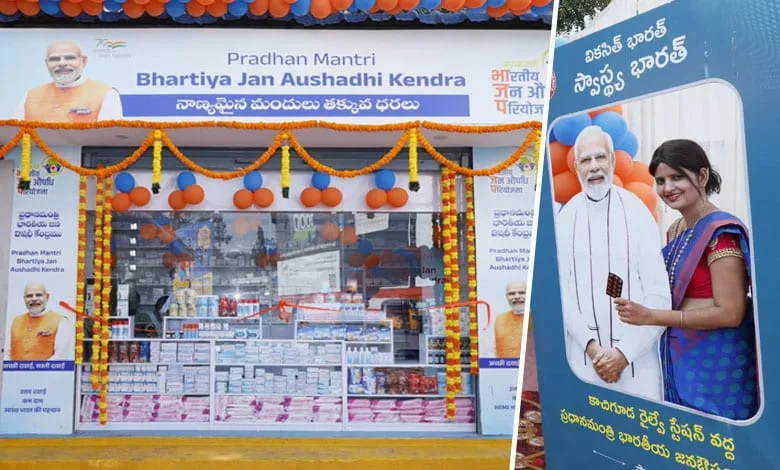
In a heartening testament to “Sabka Saath, Sabka Vikas, Sabka Vishwas”, the Modi-led NDA government has demonstrated that true governance transcends political boundaries. Even in states where the BJP does not hold power, Kerala, Tamil Nadu, and Karnataka, the Centre’s flagship Pradhan Mantri Bhartiya Janaushadhi Pariyojana (PMBJP) has flourished, transforming access to affordable healthcare for millions.
As of June 30, 2025, a staggering 16,912 Jan Aushadhi Kendras (JAKs) have been established across Bharat, enabling the availability of high-quality, low-cost generic medicines. The initiative has already saved citizens an estimated Rs 38,000 crore, a lifeline for many families battling rising medical expenses.
The Ministry of Chemicals and Fertilisers, through MoS Anupriya Patel’s response in the Lok Sabha, revealed that Kerala (1,525 JAKs), Karnataka (1,417), and Tamil Nadu (1,357) are among the top beneficiaries. This success story reflects not just the scheme’s strength but also the government’s unshaken commitment to equitable development.
Rooted in the vision of Seva (Service), Sushasan (Good Governance), and Gareeb Kalyan (Welfare of the Poor), PMBJP has become a beacon of hope, especially for patients struggling to afford basic medication. The scheme’s success in these southern states also underscores how strong health infrastructure, local literacy, and proactive participation have complemented the Centre’s mission.
At its core, this initiative proves one thing clearly: when the intent is pure, and the goal is collective good, political lines do not divide delivery.
Committed to making medication affordable for all
Though originally launched in 2008, the PMBJP truly found its footing only after 2014, when Prime Minister Narendra Modi’s government breathed new life into the scheme. What had remained dormant due to the Congress-led UPA’s neglect was reimagined with renewed vigour, intent, and policy focus, anchored on affordability, accessibility, and awareness.
This revival is not an isolated case. It reflects a broader trend under the Modi government of dusting off long-forgotten or under-utilised welfare initiatives and turning them into engines of empowerment. Be it PM Awas Yojana, Ujjwala, Ayushman Bharat, or life insurance schemes like PMJJBY, the BJP-led NDA has consistently shown how targeted execution on the ground can lift large sections of society from the shackles of poverty.
Today, Jan Aushadhi Kendras are no longer just affordable medicine shops, they have evolved into critical components of India’s public healthcare ecosystem, especially for the poor and middle class. These Kendras now provide over 2,110 essential medicines and 315 surgical products, often at 50 percent to 80 percent lower than market prices. From cancer and heart disease drugs to anti-diabetics and even nutraceuticals, the PMBJP formulary addresses a wide spectrum of therapeutic needs.
Recognising the growing demand, the government has already announced a plan to expand the range to 2,200 medicines and 320 surgical products by March 31, 2026.
Kerala, Karnataka, and Tamil Nadu take the lead
Kerala, Karnataka, and Tamil Nadu have emerged as leaders in the rollout of the Pradhan Mantri Bhartiya Janaushadhi Pariyojana (PMBJP). Together, these three southern states account for over 20 percent of all Jan Aushadhi Kendras (JAKs) in the country.
As revealed by Minister Anupriya Patel in a recent Lok Sabha address and official ministry press notes, the individual state numbers stand as follows:
- Kerala: 1,525 Kendras
- Karnataka: 1,417 Kendras
- Tamil Nadu: 1,357 Kendras
Reaching the last mile
While these states are setting benchmarks, the spirit of Jan Aushadhi is touching lives across the length and breadth of Bharat. Uttar Pradesh, with 2,644 Kendras, leads in absolute numbers, followed by Bihar (800), Maharashtra (711), and Gujarat (757).
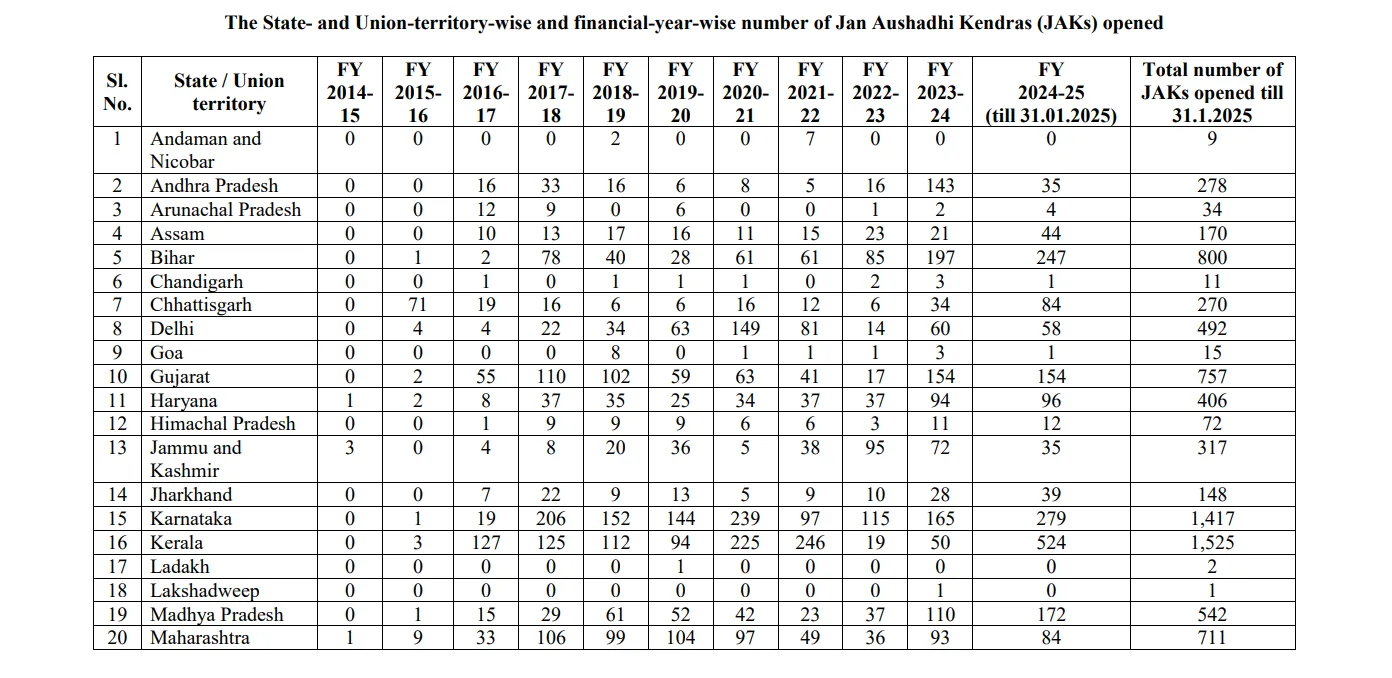
Even India’s remotest corners have not been left behind. Aspirational districts and far-flung Union Territories like the Andaman & Nicobar Islands (9 Kendras), Arunachal Pradesh (34), and Ladakh (2) are now connected to the affordable medicine chain.
To ensure inclusive growth and regional balance, the government offers targeted incentives. Kendras opened in the North-East, Himalayan and island regions, or operated by women entrepreneurs, SC/STs, persons with disabilities (divyangjans), and ex-servicemen, receive one-time financial assistance of Rs 2 lakh to procure furniture and essential equipment.
Taking affordable medicines to the masses
Recognising that lack of awareness was a major hurdle in the early days of the PMBJP, the Pharmaceuticals and Medical Devices Bureau of India (PMBI), the scheme’s nodal implementing agency, has crafted a dynamic, hybrid outreach strategy.
From cinema slides in rural theatres, hoardings, and auto-wraps, to bus branding and broadcasts on Common Service Centre (CSC) TV screens, the campaign has left no stone unturned. On the digital front, an aggressive push is being made through Facebook, X (formerly Twitter), YouTube, and Instagram, ensuring the message of affordable healthcare reaches every screen, big or small.
The annual Jan Aushadhi Diwas on March 7 has now evolved into a nationwide celebration. From exhibitions and medical camps to public rallies, the day is marked by people’s participation across districts, towns, and villages—spreading the idea that quality healthcare is a right, not a privilege.
Quality without compromise
Perhaps the most understated success of the PMBJP is its unwavering focus on quality. Every single medicine dispensed at Jan Aushadhi Kendras is procured only from WHO-GMP-certified manufacturers, and each batch is mandatorily tested in NABL-accredited laboratories.
Beyond that, routine vendor audits are conducted to ensure standards are not just maintained but constantly improved. This commitment to safety and trust has helped the government break through the brand obsession that traditionally dominates Indian pharmaceutical preferences.
Over 25,000 kendras by 2027
With 16,912 Jan Aushadhi Kendras operating as of June 2025, the government has set its eyes on a bold new milestone: 20,000 Kendras by March 2026 and 25,000 by March 2027. Unlike earlier schemes, there’s no cap on state-wise distribution, ensuring expansion reaches even the tribal belts, backwards districts, and rural interiors.
The Jan Aushadhi movement is not just about cheap medicine. It’s about a new healthcare philosophy, one where the government walks hand-in-hand with the citizen, not as a benefactor, but as a partner in progress.
Jan Aushadhi Kendras ease healthcare burden
For states like Bihar (800 Kendras) and Odisha (682 Kendras), where high out-of-pocket medical expenses have long pushed countless families into poverty, the rise of Jan Aushadhi Kendras has been nothing short of transformational. These centres are no longer just pharmacies; they are lifelines offering dignity and relief to those living on the edge of survival.
In tribal belts of Chhattisgarh and Madhya Pradesh, a silent shift is underway. Populations that once depended on unregulated, informal, or even harmful sources for medicine are now turning to Jan Aushadhi Kendras in aspirational districts. The trust in generics is growing, and with it, so is faith in the system.
Policy backing with legislative muscle
Momentum for this movement was further reinforced in Parliament through Question No. 718, raised by MPs Dilip Saikia, Lumba Ram, and Shobhanaben Mahendrasinh Baraiya on February 7. In her response, Minister of State Anupriya Patel reaffirmed the Centre’s unwavering commitment to affordable and accessible healthcare, but also emphasised the critical need for state-level cooperation to sustain and expand these benefits.
To institutionalise the change, the Ministry has directed all Central Government hospitals and CGHS wellness centres to prescribe only generic medicines. Supporting this push, Medical Council of India Circulars and the Indian Medical Council Regulations (2002) make it mandatory for doctors to write prescriptions using generic names in capital letters, promoting transparency and trust.
Sabka Saath, Sabka Vikas, Sabka Vishwas in action
What began as a scheme to reduce medicine costs has matured into a quiet healthcare revolution. Jan Aushadhi Kendras today reflect the true spirit of Sabka Saath, Sabka Vikas, Sabka Vishwas, a mission where inclusion is not just a political ideal, but a working principle.
With Kerala, Karnataka, and Tamil Nadu setting benchmarks in outreach and adoption, and the Centre targeting 25,000 Kendras by 2027, the Pradhan Mantri Bhartiya Janaushadhi Pariyojana (PMBJP) is a model of how people-first policies can be implemented at scale.
As India moves steadily toward universal health coverage under Ayushman Bharat and other welfare programs, Jan Aushadhi Kendras are emerging as the building blocks of a healthier, more equitable India, where quality healthcare at affordable prices is no longer a privilege, but a constitutional promise made real.











Comments