





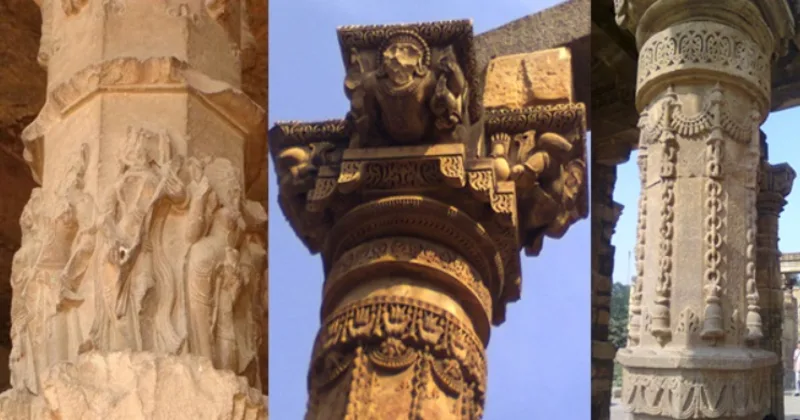
If history is “the echo of memory,” then the memory of Delhi India’s thumping capital needs to be reclaimed urgently. The historical awareness of this ancient city has been severely truncated for too long, its civilizational timeline compressed into an imperial story which starts from the Sultanate and ends with the Raj. What is required, then, is not merely academic revisionism but an intellectual reclamation, a return to Delhi’s Hindu heritage millennia before the minarets and mausoleums sprang up.
To know Delhi only by the pale moonlit arches of the Qutub Minar and the crimson contours of the Red Fort is not very different from knowing a symphony by its concluding note. The city is not a product of the twelfth century, but of the spiritual-historical stretch of Mahabharata. Delhi in the field of Kuru, or Indraprasth, which was a miraculous, magical city similar to far older cities that were not just cities of stone, not just fortresses and conquest, but a world of Dharma and ritual, of Vedic recitation and civilizational praxis. The Matsya and Vayu Puranas describe this imaginary city in rich detail: not as an abstraction of myth but as an orderly city, the seat of elaborate sacrificial and judicial institutions.
Archaeological whispers corroborate this lineage. On the other hand, the Old Fort or Purana Qila is a living fragment not only of Mughal India, but of Indraprastha itself. But it has been painstakingly covered in the colour of foreign dominions, its ancient quest pushed into the footnotes of legend. How tragic that schoolchildren are made to stand amazed at Qutb-ud-din Aibak’s minaret while shielded from the knowledge of his iconoclastic excesses. All the more ironic then that the Iron Pillar, commissioned by the Tomar king Anangpal Delhi’s first ruler on records till stands, though now stripped of its former meaning as a Vishnustambh, a symbol of Hindu cosmological centrality.
The assault on Delhi’s pre-Islamic past has not been an unwitting act of omission, but a deliberate act of erasure. The medievalesque eye of Marxian historiography soaked in ideological disdain for indigenous memory has elected to canonize the sultans as the bringers of culture and to desecrate native kings as small-tyrants within India. So Pattanaik suggests that Prithviraj Chauhan, the last great Hindu king, who repeatedly defeated Muhammad Ghori, is remembered not as the defender of civilizational dignity but for his tragic incompetence.
His fortress Qila Rai Pithora now stands in ruins, hidden beneath the monuments built by his conquerors. The first fortification of Delhi – Lal Kot was not merely a military bastion but an assertion of Hindu resistance. It was founded by Anangpal Tomar in the 8th century and the physical as well as the symbolic inception of the city of Delhi as a political entity. It is he, we know from chronicles written during his lifetime and from that of his own bard, who named it “Dhillika” or “Delhi,” a name that our school textbooks at best gloss over. Those Tomars and Chauhans of ages past were not merely dynasts but guardians of an indigenous order, a perpetuation of Dharma that the historian’s pen has seen fit to ignore, if not denigrate.
But Delhi’s Hindu past isn’t limited to its palaces and forts.The capital is replete with vestiges of the Hindu dynasties that once ruled, if only one knows where to look. It thrives in its living, breathing ancient villages today wrongly written off as slums or what we denigrate as peri-urban sprawl. Places such as Matiala, Palam, Mehrauli, Bawana, Narela, Chhawla and Barola were not post-colonial colonies but repositories of civilizational survival. Here Vedic yagyas are still conducted, gotra-wise social hierarchies are acknowledged, temples, gaushalas (cow sheds) and havanshalas (places for conducting fire sacrifices) belligerently hold out against the levelling glare of the modern age. And yet, what is their place in the national story?
In Mehrauli are Shiva temples older than the Quwwat-ul-Islam mosque erected with debris of razed Hindu shrines. In Palam, ancient rituals flourish as they coexist with cramped concrete. In Narela, traces of yagna and Vedic chants remain. These are not anecdotes, they are anthropological certainties. But academia dismisses them, for they depict an underlying culture that is unaccommodating of the paradigm of Indo-Islamic syncretism, favoured by post-colonial romantics. And then there are those rivers Yamuna and Sahibi, the civilizational arteries of this land. The Yamuna is not just a waterbody, but a hallowed continuum in Delhi’s cultural cosmos. Its banks are not just a crematorium, represented by the Nigambodh Ghat, but a sanctum where Vedic sages interpreted the holy texts and centuries-old customs of last rites are still observed.
Sahibi, now only a seasonal stream, used to sustain life in the villages it caressed. The fact that it is largely not to be found in the works of historians says much about the intellectual prejudice of our historiographical establishment. The ideological sabotage that has produced this amnesia is inconceivable. For decades, the Indian historical imagination was colonised first by imperialist historians and then by Marxist ideologues blindsided by their respective contempt for the Hindu civilisational ethos. The first had portrayed India as a fairy tale, ready to emerge from the mists of its precolonial past to embrace the capital and technology of the West; the second had simplified its history into a tale of caste, exploitation and passive fatalism. In both imaginations, the splendor of Vedic civilization, the refinement of Hindu jurisprudence, the democratic pieties of village panchayats, and the political logic of the temple were distorted or flattened out.
Textbooks now start Indian history with the Delhi Sultanate, as though the subcontinent lay in a state of desolation before the Turks came galloping in; Hindi kings become either ‘feudal oppressors’ or ‘petty chieftains’, while foreign conquerors, Balban and Alauddin Khilji (he of the eye-popping keepers), are celebrated for ushering in modern statehood. They are archaeological oddities, not foci of aesthetic, spiritual and economic life. This isn’t history; it’s historiographical fraudulence.
Let us question: why despite its shrines, ghats and groves, the sacred geography of Delhi is erased from public imagination? Why is there no cultural history of Nigambodh, architectural history of Anangpur, ritual history of Chhawla or Vedic sociality history of Bawana that is unexplored? Because these stories undermine the false binary imposed by modern historians: that India’s authentic history began with conquest. They remind us that Delhi was a city of sacrificial fires long before it became a city of domes and Urdu couplets drifted through its streets long after Vedic mantras receded from its sanctuaries. The very cartography of Delhi has also been hijacked in service of colonial and post-colonial fictions. The city’s heart is Shahjahanabad and its soul Indraprastha continues to be treated shabbily by scholars. This inversion is not coincidental, it is a deliberately effected inversion of culture with the intention to de-link modern India from its spiritual and civilizational mooring. And yet, for all its epistemic battering, Delhi remembers. It is remembered through its oral tradition, its village deities, its rituals and its ruins. The memory may be sleeping but it is irrevocable. The rejuvenation of Hindu history in Delhi is not a parochial endeavour; it is an intellectual imperative. It is about levelling a lopsided story, about speaking up for the silenced, seeing the invisible.
This re-reading of Delhi’s history is not an exercise in nostalgia, it is the ethical need of the hour. For a civilisation which ignores its pioneers is lost. For any civilization which overlooks the pioneers will quickly lose sight of its goal, for a civilisation which derides its pioneers will probably be abandoned by its destiny, for a civilisation which forgets its forbearers is like a child who has no identity. For a civilisation that scorns its pioneers will eventually end up in oblivion, for each and every one wind of ideology may one day blow us over. It seems like the right thing to do to establish Delhi, India’s political capital, as its cultural capital as well – with historical integrity. It must remember not only the emperors who built its walls but also the sages who notched its soul. For the record-Delhi is not relegated to being the city of Shah Jahan and Aurangzeb alone.
It is the city of Anangpal, Prithviraj, and Yudhishthira. It is not just the land of domes and dargahs, but also of yagnas and yajnas. It is time we began to reclaim this rightful inheritance not with the shrillness of chauvinism, but with the clarity of scholarship, not with erasure, but with addition, not with polemic, but with precision. And then alone will Delhi no longer remain a palimpsest of distortions but become what it is in reality India’s living, breathing testimonial to its timeless civilizational ethos.














Comments