





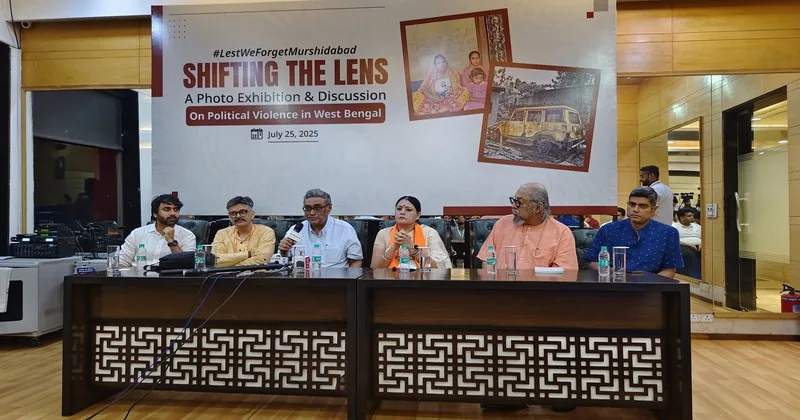
New Delhi: In a haunting reminder of stories often relegated to the margins of public discourse, Organiser Weekly hosted a powerful photo exhibition and discussion titled ‘Shifting the Lens’ at the Constitution Club of India. The event placed the spotlight on the targeted violence against Hindus in West Bengal’s Murshidabad district—violence that has largely escaped national outrage and media scrutiny.
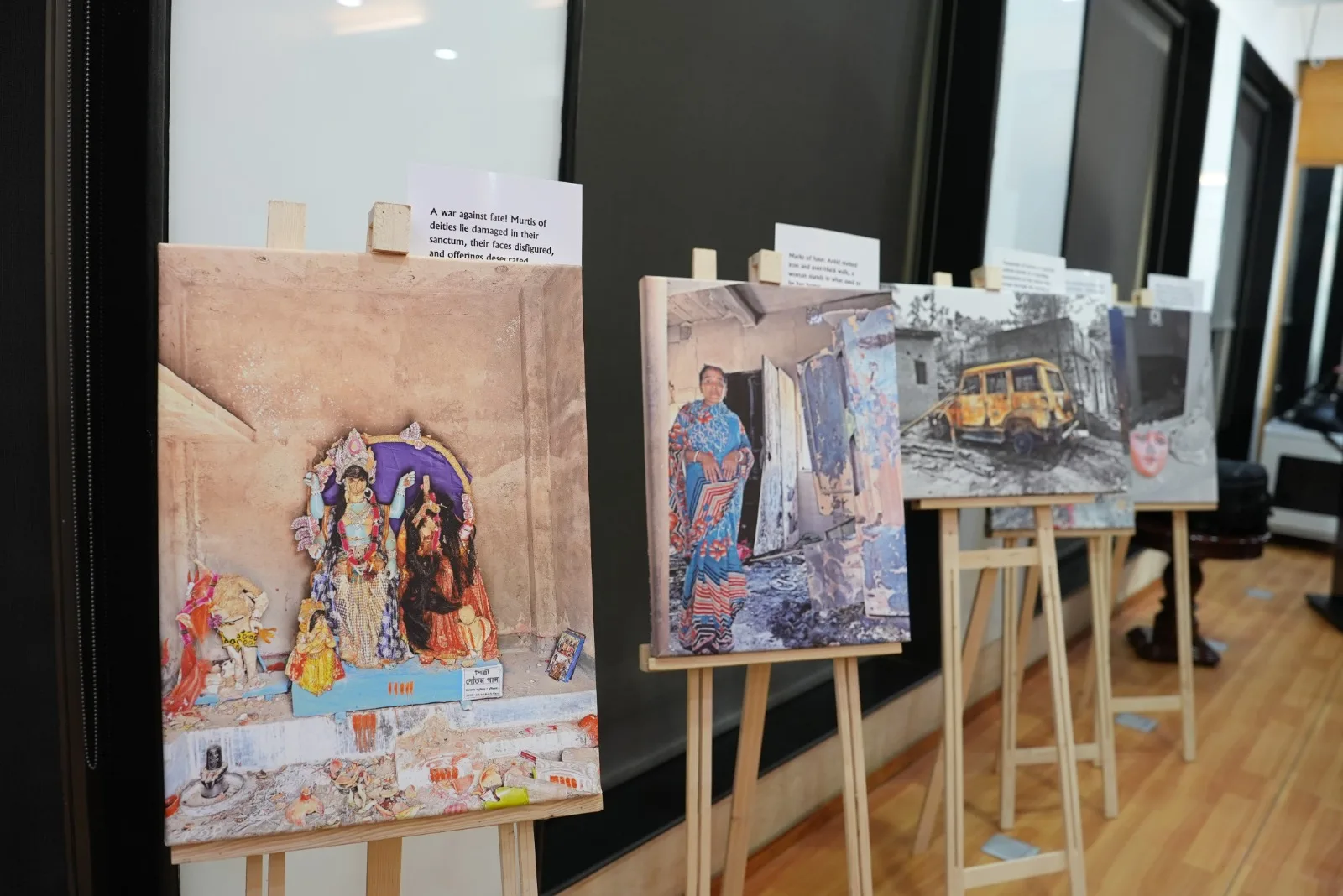
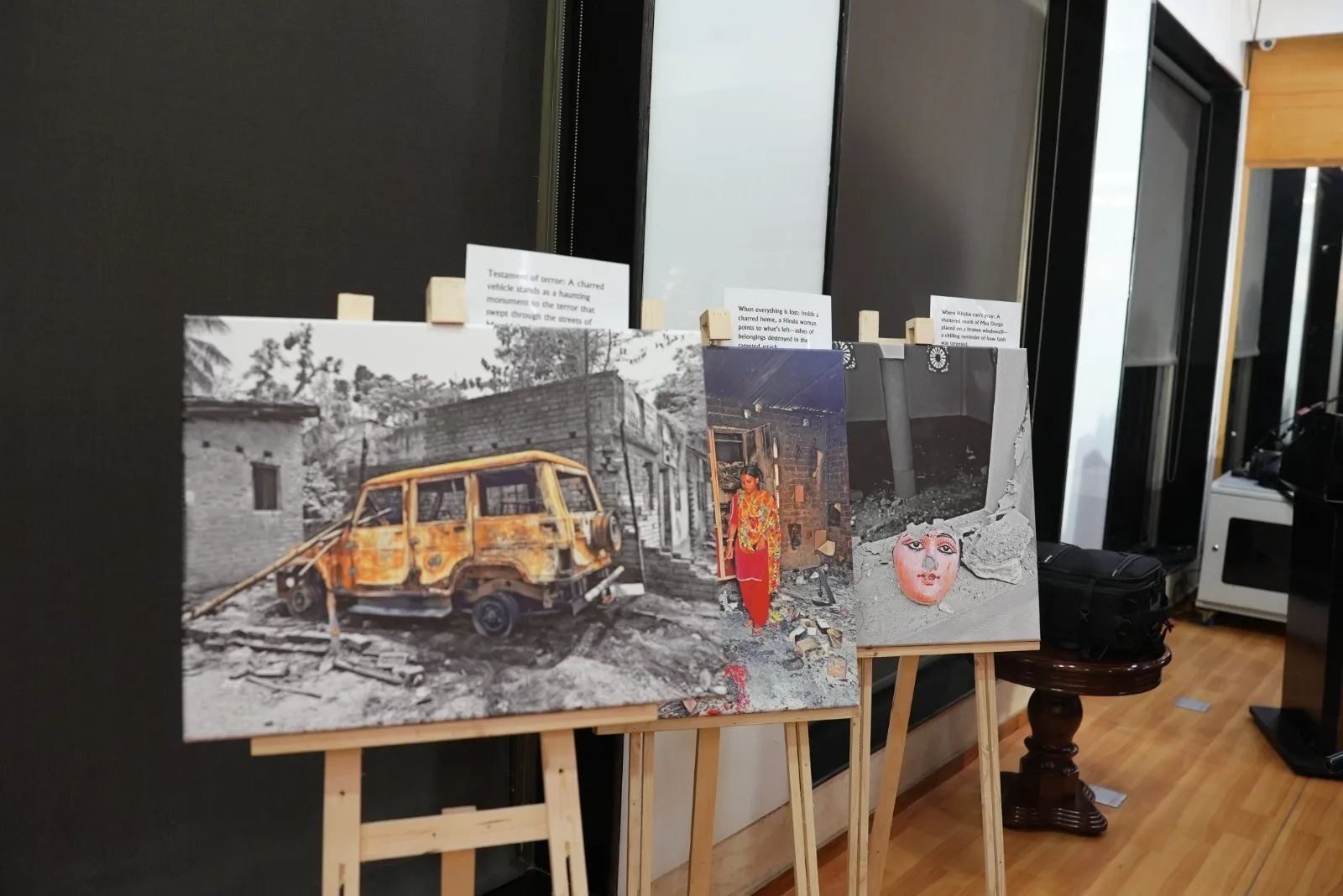
At the heart of the exhibition were searing images by Nishant Kumar Azad, Senior Assistant Editor with Organiser Weekly, who travelled through Bengal’s interior with courage and conviction, documenting the aftermath of political violence and communal intimidation with raw honesty.
The event wasn’t merely about showcasing visuals—it was about unmasking a pattern of systemic erasure. Eminent voices across journalism, politics, and academia joined the discussion, each one emphasising the urgency of remembrance in a time of silence.
A Hindu-Free Map in the Making?
Former Rajya Sabha MP and BJP’s National Executive Member, Swapan Dasgupta tied the threads together with an alarming observation—that violence in Bengal is not just about bloodshed, but about erasure and replacement.
“What is happening in West Bengal and what is happening in Bangladesh are not different,” he stated, before detailing a visit to Betbona, a village where patterns of selective violence were crystal clear.
“One of the tragedies of covering West Bengal is that unless you go to a village, the real picture remains hidden. Betbona is one such Muslim-dominated village, where Hindus are in danger. What we witnessed in Betbona was that only Hindu houses were selectively targeted. During the violence, Muslim houses remained untouched, but the neighbouring Hindu house was destroyed using petrol and bombs.”
Highlighting the real objective of tragetted violence against Hindus in Bengal, Swapan Dasgupta stated, ““When you hear the ground reality of what is happening in Bengal, it becomes clear that Hindus are becoming an endangered species here. Security agencies during the violence have themselves advised Hindus to get on boats and leave the area. The perpetrators’ intention isn’t to kill them, but to drive them away and create a Hindu-free area. This pattern is not restricted to Betbona alone but is being observed across Bengal.”
Referring to the Newtown area in Kolkata, which is now predominantly occupied by the Rohingyas, Swapan Dasgupta stated, “The police also say that it has become a complete no-go area. How they came and settled there is unclear. There is a complete demographic shift taking place in certain parts of the country.”
Recounting the Atrocities Firsthand
BJP leader and MLA from Asansol South in West Bengal, Agnimitra Paul presented a ground-level account of what transpired in Murshidabad—an account that sounded more like war reporting than peacetime politics.
Referring to the way the violence started after the Friday Namaz in Murshidabad, Paul stated that at least nine Hindu temples were vandalised and their homes were set on fire. Hindus were forced to escape their place by crossing the river and had to take shelter elsewhere. Women were raped.
She further shared how two Hindu youths, Hargovindo Das and Chandan Das, who were hawkers, were brutally killed simply because they were Hindus.
Agnimitra Paul brought to the fore about the role of the TMC leader Monirul Islam, who shared the stage with banned organisation PFI. Paul stated that he is shielded by Mamata Banejee government. Paul minced no words in stating that Mamata Banerjee is protecting illegal Bangladeshis and Rohingya. In order to clean the menace of illegal Rohingayas and Bangladeshis who are residing in west Bengal, Paul demanded the implementation of SIR in Bengal.
When Demography Fuels Violence
Veteran journalist and Senior Advisor at the Ministry of Information and Broadcasting, Kanchan Gupta, pointed to a pattern that is often observed but rarely addressed with courage—demographic shifts, illegal infiltration, and political appeasement. Gupta mentioned that the primary reason for the violence is due to the demographic change that has taken place. Mosques ae used to incite violence against the Hindus and the police remains a mute spectator. Recalling the Sandeshkhali incident, in which several women were sexually exploited, raped by Shahjahan Sheikh, Gupta said that it was due to the demographic change that such heinous crimes were committed.
“This Is a Churning”
Organiser Weekly Editor Prafulla Ketkar reminded the audience that this was not just an exhibition—it was an ideological mirror. He spoke about the importance of the event and said, “Today’s gathering is not an event or program. It is churning. Whatever is happening in Bengal is no different than whatever is happening in Bangladesh. Organiser has been covering Bengal for decades, starting from the 1950s.
Setting the record straight about the false narrative that was spread, Ketkar said, “There was a concocted narrative created in Kolkata that due to the rise of BJP and RSS, this violence has been happening in Bengal. But the question is: why has this violence been happening in states like Kerala and Bengal, and not in states like Madhya Pradesh or elsewhere where BJP is in power?”
Prafulla Ketkar too reiterated the changing impact of demography and added, “The hard truth is that wherever demography changes, we see this pattern of political violence initiated by Islamist elements. Most of the victims of this political violence are Dalit Hindus. But no one talks about them.”
Satire, Censorship, and Survival
Meanwhile, Deep Halder, author and Contributing Editor at The Print recounted his own brush with institutional retaliation. He reflected on the post-2021 Bengal election violence and the consequences of simply reporting it.
“After the results of the Bengal Assembly Elections in 2021, horrifying videos started surfacing. What happened was disturbing—two women were raped, many were assaulted, and this information was provided by Bengal BJP. I tweeted this news. But the very next day, Bengal Police took a screenshot of my tweet and claimed it was fake news.
“A few days back, there was a discussion on Facebook, questioning why we can’t have a web series on Bengal like Panchayat. Someone replied, ‘If it’s about Bengal, it won’t be Panchayat, it will be Mirzapur.’ The photos that are placed in this exhibition are horrific and show the atrocities on Hindus.”
Witnessing Must Lead to Responsibility
Shifting the Lens was not merely an exhibition and discussion—it was an indictment. It challenged the normalisation of violence, the complicity of institutions, and the silence of the elite. It reminded everyone that in an era of carefully curated outrage, bearing witness may be the first and final act of resistance.
During his ground reporting in post-poll Bengal and afterwards in Murshidabad, Nishant Azad bore witness to scenes that were both harrowing and systematically silenced. He visited remote villages where Hindu homes had been selectively targeted, their walls charred and religious symbols desecrated. In Murshidabad, he documented vandalised temples, women recounting stories of violence, and entire families forced to flee their ancestral homes across rivers in search of safety. Azad met survivors who had lost loved ones—brutally assaulted or killed solely for their religious identity.











Comments