





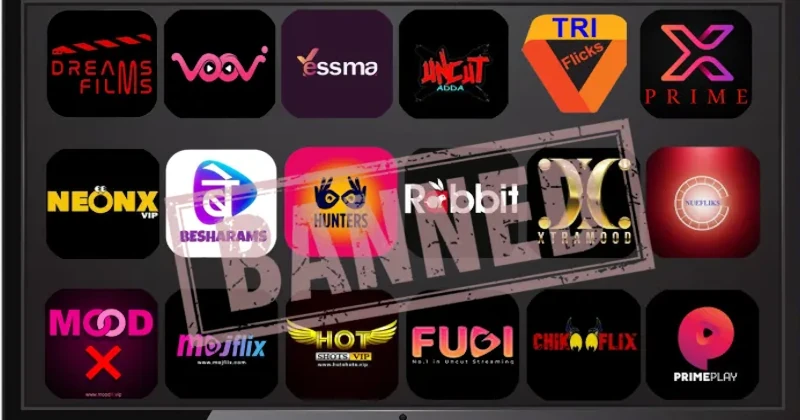
The Ministry of Information & Broadcasting (MIB), Government of India, has banned 25 OTT platforms and associated websites for repeatedly violating Indian laws, streaming sexually explicit, obscene and culturally offensive content, and defying national standards of decency and morality.
This is the largest digital crackdown to date by the Union Government against platforms allegedly peddling pornographic content disguised as “entertainment”. With this move, the government has sent a clear and unambiguous message: India’s digital space is not a lawless playground, and freedom of expression cannot be misused to promote filth, objectification of women, and destruction of cultural values.
The decision follows a detailed investigation conducted by the MIB, resulting in a 90-page internal report that documented the type, pattern, and frequency of objectionable content available across these platforms. The report found that most of the content hosted on these platforms was:
Sexually explicit in nature, including multiple scenes of nudity, simulated sexual activity, and vulgar dialogues.
- Lacked any social message or storytelling merit, existing solely to titillate.
- Targeted younger audiences, posing a significant risk to adolescent mental health and behavior.
- Promoted the indecent representation of women, violating established laws protecting gender dignity.
- Advertised obscenity through aggressive marketing and pop-up ads, even on unrelated websites, further amplifying the reach of such content.
Two shows cited in the report Qatil Haseena from ALTBalaji and Badan from ULLU were noted to contain near-pornographic sequences without any narrative structure or artistic value, merely stringing together sexually provocative scenes to attract subscribers.
The crackdown is fully rooted in India’s existing legal framework. The Government invoked multiple statutes and clauses, including:
1. Information Technology Act, 2000:
- Section 67: Punishes publishing or transmitting obscene material in electronic form.
- Section 67A: Deals with the publishing of sexually explicit content, attracting even stricter penalties.
- Section 79(3)(b): Removes legal immunity of intermediaries (like OTT platforms) if they fail to act on governmental takedown notices.
2. Bharatiya Nyaya Sanhita, 2023: Section 294: Criminalises obscene acts and words in public (including digital domains), particularly when aimed at corrupting public morals.
3. Indecent Representation of Women (Prohibition) Act, 1986: Section 4: Prohibits any representation of women that is derogatory, lascivious, or sexually explicit.
4. IT Rules, 2021 (Intermediary Guidelines and Digital Media Ethics Code):
- Rule 3(1)(d): Clearly prohibits intermediaries from hosting or publishing unlawful content, especially affecting the sovereignty, integrity, and public order of India.
- Rule 7: States that any intermediary violating these guidelines loses its immunity and becomes criminally liable. By invoking Rule 7, the Government has stripped the banned platforms of all protective cover, enabling further prosecution if they continue to operate illegally or via mirror websites.
Following the report, the Authorised Officer and Joint Secretary of the MIB, also serving as the Nodal Officer for unlawful content, issued a formal notification directing all ISPs in India to disable public access to the 25 identified platforms and their domains.
The notification was also shared with the Department of Telecommunications (DoT) to ensure complete compliance and technical execution. Any attempt by these platforms to resurface under different names or via proxy links is expected to be met with instant blocking.
The following platforms were deemed violators and ordered to be blocked:
ALTBalaji, ULLU, Big Shots App, Desiflix, Boomex, Navarasa Lite, Gulab App, Kangan App, Bull App, Jalva App, Wow Entertainment, Look Entertainment, Hitprime, Feneo, ShowX, Sol Talkies, Adda TV, HotX VIP, Hulchul App, MoodX, NeonX VIP, Fugi, Mojflix, Triflicks, ShowHit
This decisive move signals that the Government of India is no longer going to remain a silent spectator to the degradation of Indian digital space, which had been hijacked by OTT sleaze factories masquerading as creative enterprises.
Supreme Court lawyer and social activist Vineet Jindal, who has led legal crusades against platforms like ULLU and ALTBalaji, welcomed the decision:
“This is not a victory for me, it is a victory for Bharat’s youth, families, and civilizational values. These apps were poisoning minds and breaking the moral backbone of our society. This ban is a bold and historic message: Bharat will not allow the pornification of its digital public space.”
This isn’t the first time that the government has acted against OTT obscenity. In March 2024, 18 similar platforms were banned, including Besharams, Dream Films, and Hunters. The government had also de-platformed 57 social media handles, 10 mobile apps, and 19 websites—all linked to peddling vulgarity.
This time, the crackdown is deeper, wider, and more forceful the biggest so far against OTT immorality in India.
However, this latest action represents a significant escalation in terms of both the number of platforms and the breadth of enforcement, reflecting the Government’s increasing concern over unchecked digital vulgarity. This crackdown also comes amid a broader digital sanitation campaign by the Government of India. The Ministry of Electronics and IT revealed in Parliament that 1,524 illegal online betting, gambling, and gaming apps and websites have been blocked between 2022 and June 2025.
Minister of State Jitin Prasada reaffirmed India’s commitment to a “safe, open, and accountable internet”, emphasising that offshore platforms that evade Indian taxes or violate Indian laws will be blocked outright.
This includes
- GST evasion by foreign gaming apps.
- Obscene ads by unregistered platforms.
- Unauthorised content streaming in violation of India’s digital ethics framework.
The current ban serves as a wake-up call to OTT producers and content creators. The key message, Storytelling is welcome. Smut is not. Creativity is celebrated. Cultural sabotage is not.
Digital platforms must now:
- Vet content for legality and moral standards.
- Register under relevant laws, including the IGST Act.
- Establish robust internal mechanisms to filter out unlawful content.
- Adhere strictly to the Code of Ethics annexed to the IT Rules, 2021.
Failure to comply could mean not just de-platforming, but prosecution under Indian Penal Law, including jail terms and fines.














Comments