





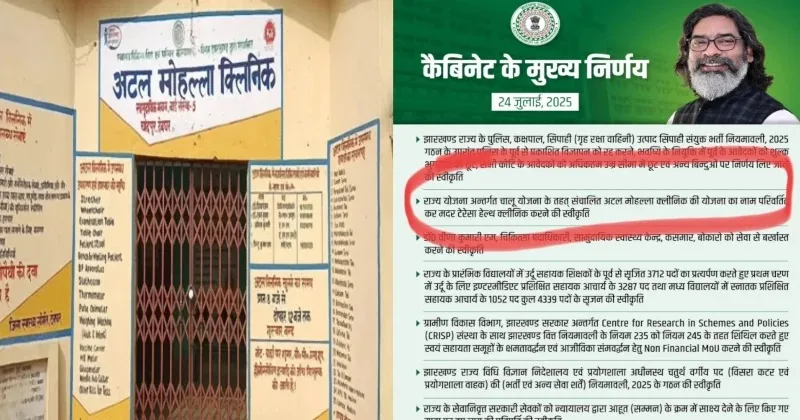
Ranchi: Jharkhand government on July 24 announces to rename the ‘Atal Mohalla Clinic’ to ‘Mother Teresa Advanced Health Clinic’. The decision was taken in a cabinet meet headed by Chief Minister Hemant Soren.
The scheme which aims to provide quality health service in the urban pockets was initially launched by the BJP government led by former CM Raghubar Das in 2019 and has 140 centres across the state.
The government’s move however has received strong response from the opposition Bharatiya Janata Party (BJP) whose leaders have critised the decision.
Reacting sharply to the decision, BJP spokesperson Pratul Shah Deo on July 25 said that the government decision to rename the scheme is unfortunate.
“The Jharkhand government has taken a very unfortunate decision by renaming the Atal Mohalla Clinic, named after our state’s founder and Former PM Atal Bihari Vajpayee to Mother Teresa Advanced Clinic. The decision is not appropriate at all and does not conform to political convenience.
Shahdeo added that the government has removed the name of the person who gave us the state and naming it after Mother Teresa about whom we should check the reality as there were allegations of anti-constitutional activities and conversion against Teresa’s organisation ‘Missionaries of Charity’.
Taking to X, Shahdeo further raised fingers on the decision stating that “People of Jharkhand should definitely read the famous British writer Christopher Hitchens’ The Missionary Position and watch the documentary Hell’s Angel made by Christopher himself.”
“The book Mother Teresa- The Final Verdict written by Aroup Chatterjee also sheds considerable light on Mother Teresa’s life.
Shahdeo further noted that the Union Government in the year 2021 had refused to renew the FCRA license of the Missionaries of Charity citing its involvement in anti-constitutional activities and conversion.
Allegation against ‘Missionaries of Charity’
Allegations related to child trafficking surfaced against the sister institutes run by the order founded by St Teresa in Jharkhand in 2018.
Various discrepancies were found reportedly in the records pertaining to pregnant women and their newly born babies in the centres run by the institution.
The matter came to light after a woman staff of one of the centre was arrested on alleged charges of selling infant born to unwed mothers for money, leading to the revelation of the child trafficking racket.
The revelation prompted the Women and Child development minister to order an immediate inspection of all the child care homes which are runs by the organisation Missionaries of Charity.
Notably, the National Commission for Protection of Child Rights (NCPCR) in October last year had also written a letter to the Jharkhand government seeking filing of FIRs and initiating action in cases of sexual abuse of minors.
The NCPCR in the letter had asked the concerned officials to issue directives to register cases under provisions of the POCSO act of all the victims identified as minors whose documents have been seized during the subsequent inquiry conducted.
The commission’s team during its visit to the state in September 2019 was provided with the statements of two minor girls who were victims of sexual abuse and later brought to ‘Nirmal Hridaya Centre’ by their parents where they reportedly gave birth to their child.
The child protection body in the letter had asked for a detailed report of children belonging to other states if any, who were victim of pregnancy and sexual abuse and were residing in the institute related to ‘Missionaries of Charity’.
While globally revered as a beacon of compassion, Mother Teresa’s legacy in India is increasingly being reassessed through a critical lens. Allegations continue to surface that question the very foundation of her charity work in the country — especially the intertwining of medical aid with religious conversion.
Although hailed for her mission to serve “the poorest of the poor” in Kolkata, critics argue that Mother Teresa’s operations were far from humanitarian in intent. Reports and testimonies suggest that her real focus lay in promoting dogmatic Catholicism and expanding the Church’s reach in India. According to several former volunteers, medical care in her homes was substandard, and suffering was often seen as a form of spiritual virtue rather than a condition to be healed.
More controversially, her institutions allegedly became channels of religious evangelism, where the dying and destitute were subtly — and at times overtly — encouraged to convert to Christianity. Observers argue that this approach weaponized suffering to achieve the broader goals of religious expansion. “Conversion was not an accidental outcome, but the core mission,” said a former researcher who documented her work.
British author Christopher Hitchens, in his book The Missionary Position, described her operations as “a cult of suffering” rather than acts of compassion, and Indian activists have echoed this concern. They claim that her services lacked transparency, misused funds, and prioritized faith over health, making her legacy less about selfless care and more about Church-driven growth.




![Maoist leader Raghuram Hembram killed in encounter in Hazaribagh [ANI/Photo]](https://organiser.org/wp-content/uploads/2025/09/1-4-e1757915536365-120x64.webp)










Comments