





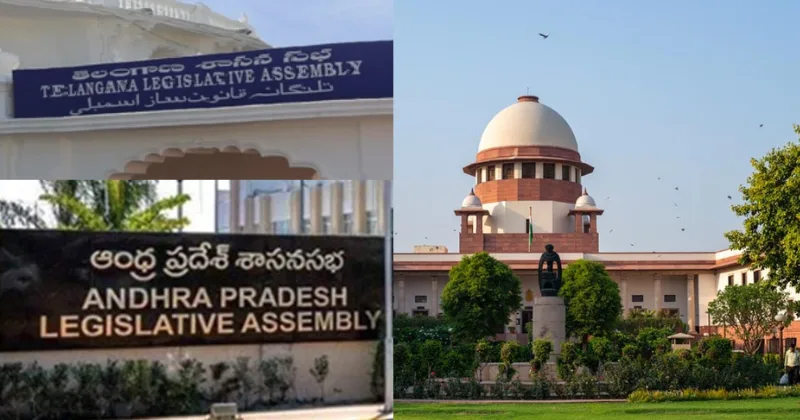
New Delhi: In a significant setback to demands for increasing Assembly seats in Andhra Pradesh and Telangana, the Supreme Court on July 25 dismissed multiple petitions seeking directions for a fresh delimitation exercise in the Telugu states. The petitions had argued for implementing Section 26 of the Andhra Pradesh Reorganisation Act, 2014, to increase the number of Assembly constituencies.
A bench led by Justice Surya Kant rejected the plea filed by Professor K. Purushotham Reddy and others, ruling that such a demand runs contrary to constitutional limitations set under Article 170(3) of the Constitution.
“It was contended that AP and Telangana were arbitrarily excluded while a similar delimitation was conducted for Jammu & Kashmir. However, we have found no merit in the argument that such exclusion is either arbitrary or violative of the Constitution,” Justice Kant stated in the verdict.
The Court noted that the delimitation in Jammu & Kashmir occurred following its reorganisation into a Union Territory and is not governed by Chapter 3 of Part 7 of the Constitution, unlike the states of AP and Telangana.
Addressing the plea’s reliance on the AP Reorganisation Act, Justice Kant observed that on a plain and harmonious reading, Section 26 of the Act is subject to Article 170 of the Constitution. Accepting the petitioners’ argument would open the floodgates for all states to seek similar parity. The constitutional mandate under Article 170(3) serves as a bar, and therefore, the demand fails.
The Court also addressed the argument based on the doctrine of legitimate expectation, clarifying that while it is a well-established principle, it cannot override express constitutional provisions.
The expectation under the AP Reorganisation Act cannot be viewed in isolation, as it is subject to Article 170(3), and thus, no enforceable legal right arises from it, the bench noted.
Accordingly, the Supreme Court dismissed the plea filed under Article 32, effectively closing the door on any near-term increase in Assembly constituencies for Andhra Pradesh and Telangana.
















Comments