





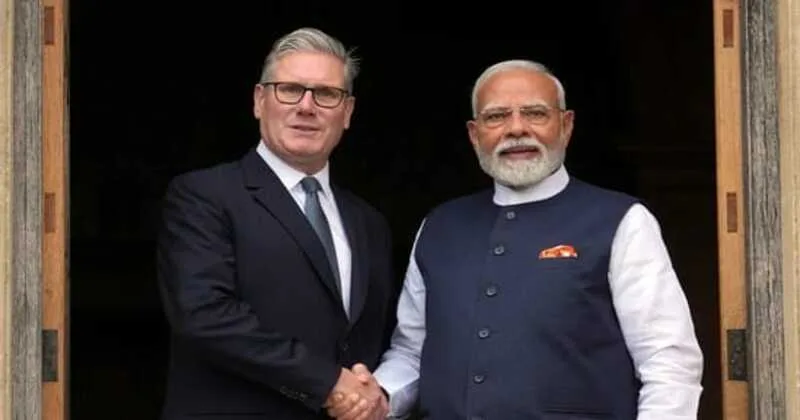
In a major diplomatic and economic breakthrough, India and the United Kingdom have signed a landmark Free Trade Agreement (FTA) in the presence of Prime Minister Narendra Modi and his British counterpart, Prime Minister Keir Starmer. This strategic accord is poised to significantly boost bilateral trade, which currently stands at $60 billion, with expectations to double it to $120 billion by 2030. By 2040, both nations hope to expand this further by an additional $40 billion, signalling a new era of economic cooperation.
At the heart of the agreement lies the near-total elimination of tariffs, covering approximately 99% of tariff lines and nearly the entire trade value. This sweeping reduction is set to bring substantial benefits to Indian exporters, especially those in the agriculture and food processing sectors. Indian agricultural goods will now gain duty-free access to the UK market, receiving more favourable treatment than even European nations such as Germany and the Netherlands.
Addressing the press meet with UK PM @Keir_Starmer. https://t.co/mHEk8Fz1Q7
— Narendra Modi (@narendramodi) July 24, 2025
Traditional Indian products such as turmeric, pepper, and cardamom, along with processed foods like mango pulp, pickles, and pulses, are expected to witness better profit margins and wider market penetration under this new framework. This will not only strengthen India’s foothold in ethnic markets in the UK but also place these goods more prominently in mainstream retail outlets. Agricultural exports from India to the UK are projected to grow by over 20 per cent within the next three years. The elimination of import duties on more than 95 per cent of India’s agricultural and processed food products will be a key driver of this expansion.
The agreement covers a wide range of items including fruits, vegetables, cereals, spice blends, fruit pulps, and ready-to-eat meals. By lowering import costs for these products, the FTA improves their competitiveness and market appeal. It is also expected to encourage a shift in Indian agriculture towards high-value crops and greater global integration. At the same time, India has safeguarded its sensitive sectors. Items such as dairy products, apples, oats, and edible oils will retain their current tariffs, ensuring protection for domestic farmers and producers.
Another critical dimension of the FTA is the boost it promises to India’s fisheries sector, especially in states like Andhra Pradesh, Odisha, Kerala, and Tamil Nadu. The elimination of UK tariffs ranging from 4.2 per cent to 8.5 per cent on nearly 99 per cent of seafood exports, including shrimp, tuna, fishmeal, and feed, is expected to catalyse growth in India’s marine exports. With the UK importing $5.4 billion worth of marine products annually, Indian producers are well-positioned to increase their market share.
India and the UK sign the Free Trade Agreement pic.twitter.com/2fwGiiQYcR
— ANI (@ANI) July 24, 2025
The deal also enhances prospects for India’s premium branded exports in beverages and plantation products. Indian coffee, tea, and spices, currently holding modest shares in the UK import market, are expected to gain ground with the removal of duties. Instant coffee, in particular, will become more price-competitive in the premium segment, challenging European brands.
This agreement aligns with India’s broader goal of reaching $100 billion in agricultural exports by 2030. With comprehensive tariff elimination and market access, the India-UK FTA is poised to transform India’s agri-export landscape and offer a powerful boost to farmers, food processors, and coastal economies alike.
The India-UK Free Trade Agreement was signed as a key outcome of Prime Minister Narendra Modi’s visit to the United Kingdom, marking a major step forward in India’s global trade ambitions. With this landmark deal in place, Prime Minister Modi is set to depart for the Maldives on Thursday evening for the second leg of his tour, which coincides with the island nation’s 60th anniversary of independence from Britain and six decades of diplomatic relations with India, further reinforcing India’s commitment to deepening regional and global partnerships.












Comments