





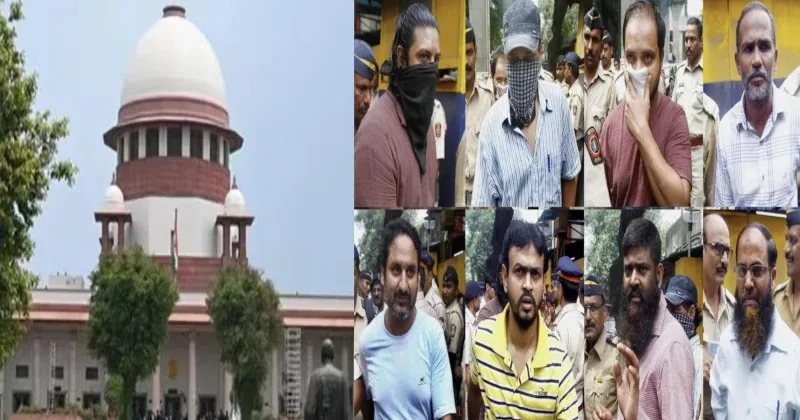
In a significant development, the Supreme Court of India on July 24 stayed the Bombay High Court verdict that acquitted all 12 accused in the 2006 Mumbai train bomb blasts case that killed more than 180 people and injured over 800. The top court has made it clear that the High Court’s judgment cannot be used as a legal precedent in any future matter.
A bench comprising Justices MM Sundresh and N. Kotiswar Singh passed the order while hearing a petition filed by the Maharashtra Government, which had challenged the High Court’s ruling from earlier this week. The bench, however, did not order the re-arrest of the acquitted individuals, stating that since they had already been released, there was no question of bringing them back into custody at this stage.
Supreme Court stays Bombay High Court judgement that acquitted twelve accused persons in connection with the 2006 Mumbai train blasts pic.twitter.com/A8KDPYBceI
— ANI (@ANI) July 24, 2025
The devastating serial blasts had occurred on July 11, 2006, during peak rush hours, when seven pressure-cooker bombs exploded in first-class compartments of Mumbai suburban trains within a span of 11 minutes. The coordinated explosions rocked trains near the stations of Matunga Road, Mahim Junction, Bandra, Khar Road, Jogeshwari, Bhayandar, and Borivali, triggering nationwide outrage and one of the most extensive anti-terror investigations in the country.
While Solicitor General Tushar Mehta, appearing for the Maharashtra Government, sought a stay on the High Court’s judgment, he clarified that he was not pressing for re-arrest of the accused. Instead, Mehta stressed the larger legal implications of the Bombay High Court’s findings, particularly concerning future cases under the Maharashtra Control of Organised Crime Act (MCOCA).
“These findings of law may affect future MCOCA trials,” Mehta told the court.
Taking note of the Solicitor General’s concerns, the Supreme Court bench ordered that the High Court’s acquittal “shall not be treated as a precedent” and issued notice to all 12 acquitted individuals. Justice Sundresh also observed that some of the accused were reportedly Pakistani nationals, which may have larger implications for national security concerns.
High Court Overturned The Death Sentences, Life Terms
The Bombay High Court’s July 15 verdict had overturned a 2015 judgment by the MCOCA Special Court, which had sentenced five of the 12 accused — Faisal Sheikh, Asif Khan, Kamal Ansari, Ehtesham Siddiqui, and Naveed Khan — to death, while the remaining seven were given life imprisonment for their alleged role in the deadly conspiracy.
In a surprising and controversial ruling, the High Court had remarked, “The prosecution has utterly failed to prove the case against the accused. It is hard to believe that the accused committed the crime.” The court added that the evidence — including explosives, arms, and maps recovered during the investigation — did not appear to be linked to the train bombings. Furthermore, the prosecution could not definitively establish what kind of explosives were used, undermining its entire case.
The acquittal shocked many, including senior political leaders and families of victims. Former Maharashtra Chief Minister Devendra Fadnavis described the decision as “shocking” and pledged that the state would take all legal steps to challenge the acquittals in the Supreme Court, which it subsequently did.
The 2006 Attack: India’s Most Chilling Urban Terror Strike
The 2006 Mumbai train bombings remain one of the deadliest terror attacks in India’s history. The use of rigged pressure cookers, packed with RDX and ammonium nitrate, magnified the lethality of the attacks. The first explosion occurred at 6:24 pm, and the last detonated at 6:35 pm, tearing through overcrowded compartments packed with daily commuters returning home from work.
The explosions triggered panic, chaos, and carnage, leading to nationwide outrage and a sweeping counter-terrorism investigation that eventually culminated in the 2015 convictions. The case was tried under multiple laws including the Indian Penal Code, Unlawful Activities (Prevention) Act, and MCOCA.
With the Supreme Court now stepping in, the case has taken a fresh turn. The stay effectively freezes any legal influence the High Court verdict might have had on other ongoing or future cases involving similar anti-terror legislation. It also gives the Maharashtra Government a legal window to re-present its case and challenge the acquittal on substantive grounds.














Comments