





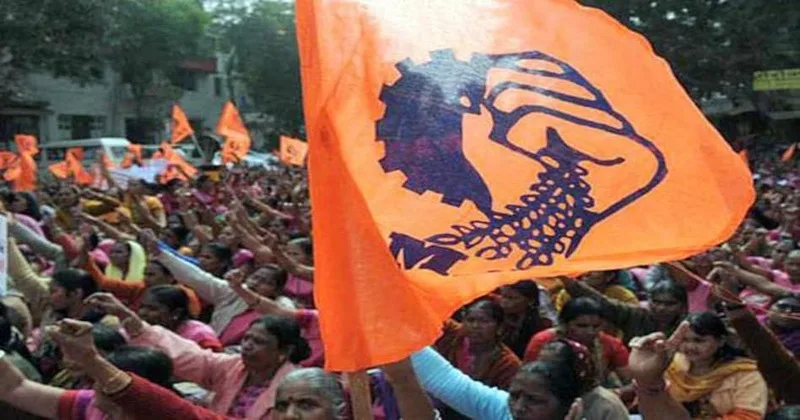
As traditional union bastions in the US, UK, Germany, and even Scandinavia witness historic declines in membership and bargaining power, the BMS continues to expand its reach—especially among those often invisible to global trade unionism, including informal workers, domestic helpers, gig workers, and rural labourers. In doing so, it confronts a foundational question that haunts the labour movement today: Can trade unionism evolve beyond class struggle and political confrontation into a holistic, inclusive, and dharmic force for social transformation?
This article examines how BMS, rooted in the Indian civilisational ethos and guided by the principle of Shramev Jayate (Labour Alone Triumphs), not only defies the trend of decline but also offers a living blueprint for the revitalisation of trade unionism worldwide. By replacing antagonism with collaboration, agitation with seva, and ideology with cultural legitimacy, the BMS model holds the potential to re-anchor global labour movements in values of dignity, decentralisation, and duty-driven empowerment. From the ashes of disillusionment, a new flame of hope rises—fueled not by outdated manifestos but by timeless wisdom reimagined for a fragmented, digital, and unequal world of work.
The Evolutionary Challenges Faced by Global Trade Unionism
The trade union movement that emerged during the 19th and 20th centuries was shaped significantly by the dynamics of industrial capitalism. Grounded in Marxist and socialist theories, the conventional framework viewed labour as a unified entity perpetually in conflict with capital. The trajectory was characterised by militant strikes, collective bargaining, and political alliances. In Western Europe, this confrontational framework led to the establishment of welfare states. Within communist regimes, it was integrated into the apparatus of the party-state. This crisis is not just numeric—it is existential.
According to OECD data, the average union density across member countries fell from 30 per cent in 1985 to around 16 per cent by 2023.
In the United States, union membership declined from 20.1 per cent of workers in 1983 to just 10 per cent in 2023, with only 6 per cent of private-sector workers unionised.
United Kingdom figures dropped from 52 per cent in 1980 to 22.3 per cent in 2022, per the UK Office for National Statistics.
In Germany, union density declined to around 16 per cent in 2022, down from nearly 35 per cent in 1991, despite strong collective agreements.
Even in Scandinavia, known for high unionisation, Denmark’s density fell from 80 per cent in the 1990s to below 67 per cent in 2022, while Sweden fell below 70 per cent.
However, the advent of globalisation and neoliberal restructuring has resulted in significant transformations:
The process of deindustrialisation in Western regions has led to a decline in the influence of traditional union strongholds.
The processes of outsourcing and informalisation have led to a fragmentation of the labour force.
Gig and platform work have fundamentally altered conventional employment relationships.
The phenomenon of political co-optation has resulted in numerous unions evolving into bureaucratic extensions that align closely with party agendas.
Technological advancements have resulted in the establishment of workplace hierarchies, which have subsequently caused labour unions to fall behind.
As unionism continued to be constrained by industrial-era perspectives, the identities and aspirations of workers underwent significant evolution. The union agenda did not encompass cultural, gendered, and informal work realities.
BMS: A Reimagining of Unionism Grounded in Cultural Context
Established in 1955 by Dattopant Thengadi, the Bharatiya Mazdoor Sangh arose not merely as an additional trade union, but as a significant civilisational counter to the Western-centric paradigm of class conflict. The philosophical foundation is grounded in the harmonious interaction of all societal elements—Shram (Labour), Samaj (Society), and Sanskar (Culture), rather than on conflict.
In contrast to the confrontational and politically active nature often associated with global unions, BMS adopted a distinct approach characterised by dialogue, responsibility, and decentralised empowerment.
BMS’s Innovative Strategy: Revitalising Unionism for Contemporary Challenges
A Comprehensive Approach to Labour: Structuring the Informal Sector
The most significant transformation of BMS is found in its approach to structuring the unorganised sector. A significant portion, exceeding 94%, of India’s labour force operates outside the formal economic framework. In contrast to conventional labour unions that primarily concentrate on industrial work, BMS broadens its scope to encompass:
Individuals engaged in tribal and forestry occupations
Workers engaged in domestic tasks and individuals operating in street markets
Labourers in rural agriculture
Individuals engaged in gig and platform-based employment
Workers in the construction and sanitation sectors
This inclusivity revitalises the fundamental essence of trade unionism, serving as a voice for all workers, extending beyond merely those employed in factories or government positions.
Transitioning from Class Conflict to the Industrial Household
The BMS reinterprets the concept of class conflict by promoting the notion of “Sangathan mein Parivar”—an industrial family in which both employer and employee actively engage as collaborators in the pursuit of national progress. Grounded in traditional Indian Knowledge Systems, including the Arthaśāstra, Śukranīti, and Nāradsmṛti, this perspective regards labour as an obligation (Dharma) rather than merely a transactional agreement. This recontextualises labour from a site of conflict to one of collaborative enhancement.
Characterised by Decentralisation, Neutrality, and a Focus on Values
In a time characterised by political division that undermines trust in institutions, the organisational independence and nonpartisan principles of BMS distinguish it as exceptional. While drawing influence from cultural nationalism, it avoids engaging in partisan politics. The decentralised framework enables local chapters to implement strategies tailored to their specific contexts, whether in urban industrial centres or rural tribal regions.
Seva Bhav and Samvedansheel Sahayog: Emphasising Ethos over Agitation BMS engages not solely in agitation; it also prioritises service. Guided by the principle of Seva Bhav, it provides:
Support for individuals engaged in informal employment
The connections between health and insurance
Training and re-skilling initiatives
Initiatives focused on the value of work and the promotion of ethical work environmentsThe concept of Samvedansheel Sahayog emphasises the empowerment of workers to confront injustice through constructive engagement rather than resorting to chaos or coercion.
Insights for Global Application: A Novel Framework for the Resurgence of Trade Unions
The BMS model provides critical insights for a disjointed international labour environment:
Unionism Beyond Marx: A Reassessment of Ideological Perspectives
The challenges facing trade unionism can be attributed, in part, to its ideological inflexibility. The findings indicate that unionism grounded in cultural ethics, national identity, and human dignity may have a more profound impact than externally derived class-based ideologies, particularly in non-Western contexts.
Integration as opposed to Isolation: Contemporary employment is characterised by its dynamic nature, casual approach, and decentralised structure. BMS responds to this reality by developing worker ecosystems that extend beyond mere workplace representation. The incorporation of skill enhancement, awareness initiatives, and community engagement fosters sustainable empowerment for workers over time.
Decentralisation as Strategy: Hierarchical trade unions face challenges in addressing the varied and evolving needs of local communities. The federal and grassroots-oriented structure of BMS facilitates adaptability and resilience, which are essential for success in the current era of digital and distributed labour.
The Significance of Cultural Legitimacy as a Form of Power: Trade unions that overlook local traditions, familial values, and the essence of civilisation struggle to establish meaningful connections. BMS demonstrates that the incorporation of established cultural narratives enhances the significance and sustainability of trade unionism.
The international labour movement finds itself at a pivotal juncture. The diminishing presence of unions presents an opportunity for critical reflection, strategic realignment, and foundational re-establishment. The Bharatiya Mazdoor Sangh presents a compelling alternative through its integration of traditional insights and contemporary approaches, demonstrating both depth and effectiveness.
In an era characterised by artificial intelligence, economic uncertainty, and platform-based capitalism, the evolution of labour must be accompanied by a progressive approach to collective organisation—not one that is stagnant in historical contexts, but one that embraces adaptability, inclusivity, ethical considerations, and cultural relevance.
In the quest for a resurgence of worker representation and respect, the Indian approach, spearheaded by the BMS, has the potential to serve as a guiding example for a worldwide revival of trade unionism.
















Comments