





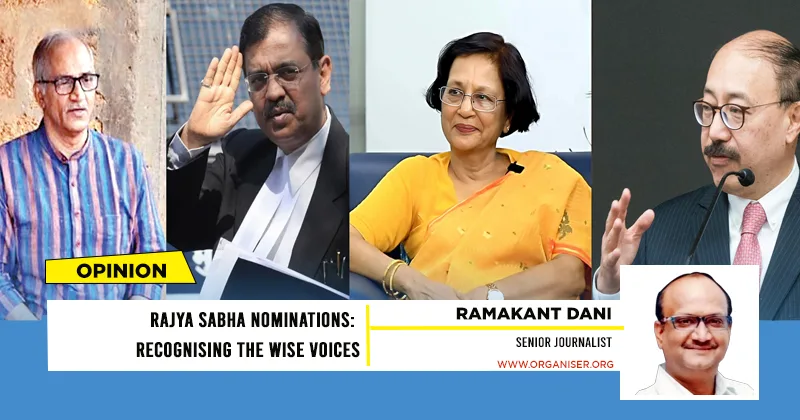
In Bharat’s parliamentary democratic framework, nominations to the Rajya Sabha have always carried special significance. These appointments aim to infuse Parliament with a wide spectrum of knowledge and experience. Recently, President Droupadi Murmu, under Article 80(1)(a) of the Constitution, nominated four eminent individuals to the Rajya Sabha. These nominations honour their extraordinary courage, commitment to public service, and intellectual contributions in their respective fields.
The four distinguished nominees are C Sadanandan Master, a social worker and educationist from Kerala; Ujjwal Nikam, a senior public prosecutor known for his role in the 26/11 Mumbai terror attack case; Harsh Vardhan Shringla, a seasoned diplomat and former foreign secretary; and Dr Meenakshi Jain, a respected historian and academic deeply engaged in research on Bharatiya civilisation.
Together, they represent expertise across law, diplomacy, history, and social service—diverse domains that will help deepen democratic deliberations and enhance policymaking in the Upper House.
Sadanandan Master: A Life of Resolve and Sacrifice
When Prime Minister Narendra Modi announced the names of the four dignitaries nominated to the Rajya Sabha, one name stood out and captured widespread attention: C Sadanandan Master from Kerala. Within the Sangh Parivar and in Kerala, he is known as a ‘living martyr.’
The story of C Sadanandan Master is one of steady courage and ideological conviction. On the evening of January 25, 1994, in Kannur district of Kerala, his life changed forever. As he arrived near a bus stop in his hometown, Communist activists launched a brutal attack. They hurled crude bombs at him and, overpowering him, sawed off both his legs below the knee in an act of horrific political violence. His only “crime”? Choosing to embrace the patriotic ideology of the
Rashtriya Swayamsevak Sangh (RSS) despite being born into a Communist family—a choice viewed as a challenge by those who, in parts of Kerala, have often shown little tolerance for differing ideologies.
Left to die in a pool of blood, he survived—thanks to months of hospitalisation, the support of his Sangh colleagues, and his own resilient spirit. Today, he remains active in public life with the help of prosthetic legs and is seen as a symbol of sacrifice and perseverance in the Sangh Parivar. A teacher by profession, he also emerged as a committed social worker. He contested the Kerala Assembly elections twice as a BJP candidate from Kuthuparamba and currently serves as the Vice President of BJP’s Kerala unit.
His nomination to the Rajya Sabha is a strong recognition—not just of his personal determination, but of the thousands of patriotic karyakartas in Kerala who have endured political violence.
Ujjwal Nikam: Fearless Voice for Justice
Ujjwal Nikam is known for his commanding presence in court and his determined role in Bharat’s battle against terrorism. His journey to national recognition began with the 1991 Kalyan blast case, but it was the 1993 Mumbai serial bomb blasts and the 26/11 Mumbai attacks that established him as a widely respected legal expert.
From the Gulshan Kumar murder trial to the Gateway of India and Zaveri Bazaar blasts (2003), the Khairlanji Dalit massacre (2006), and the Shakti Mills gang rape case (2013), Nikam has handled some of Bharat’s most critical prosecutions. He was instrumental in prosecuting Ajmal Kasab and skilfully used David Headley’s testimony to expose Pakistan’s role in the 26/11 attacks. He was fielded by the Bharatiya Janata Party from Mumbai North Central during the 2024 Lok Sabha election, though he did not win. His nomination honours a life devoted to pursuing justice in the face of daunting challenges.
For the past four decades, Bharat has faced persistent terrorist violence. As the nation works to shape a strong narrative against terrorism globally, a seasoned lawyer like Ujjwal Nikam brings invaluable expertise. His courtroom experience and insight into terror networks make him a crucial voice in shaping Bharat’s counterterrorism strategies—both in Parliament and on the international stage.
Harsh Vardhan Shringla: Voice of Indian Diplomacy
Harsh Vardhan Shringla is a seasoned diplomat with decades of experience in foreign affairs. As Bharat’s 33rd Foreign Secretary, he handled major diplomatic challenges: the global impact of the Covid-19 pandemic, the India-China standoff in Ladakh, the US withdrawal from Afghanistan, and the military coup in Myanmar.
He has served as Bharat’s Ambassador to the United States and High Commissioner to Bangladesh, playing key roles in deepening strategic partnerships. After his retirement, he was appointed Chief G20 Coordinator for Bharat’s 2023 presidency, helping assert Bharat’s global leadership at a pivotal time.
As Bharat’s global engagement continues to expand, the appointment of a foreign policy expert like Harsh Vardhan Shringla to the Rajya Sabha will be especially valuable. His insights will enrich deliberations on foreign policy, national security, and Bharat’s evolving role on the world stage.
Meenakshi Jain: Champion of Civilisational Perspectives
Dr Meenakshi Jain is a historian who offers original perspectives on Bharatiya history. Awarded the Padma Shri in 2020 for her contributions to education and literature, she has authored important works on Bharat’s cultural and historical heritage.
Bharatiya historiography, especially concerning ancient and medieval eras, has long been shaped by Western and leftist interpretations—resulting in narratives that often misrepresent Bharatiya traditions and create confusion. In this context, efforts to revisit Bharatiya history through an indigenous lens are essential. Dr Jain has become a beacon in this intellectual movement, challenging entrenched biases and providing a more grounded understanding of Bharat’s past. Her research emphasises civilisational continuity, cultural resilience, and the strength of Hindu traditions in the face of repeated upheavals.
Her books include Flight of Deities and Rebirth of Temples, The Battle for Rama: Case of the Temple at Ayodhya, Sati: Evangelicals, Baptist Missionaries and the Changing Colonial Discourse, Rama and Ayodhya, and Parallel Pathways: Essays on Hindu–Muslim Relations (1707–1857) etc. These works challenge dominant historical models and bring indigenous voices to the fore.
As a Senior Fellow at the Indian Council of Social Science Research (ICSSR), and with past affiliations with the Nehru Memorial Museum and the ICHR, she has contributed meaningfully to academic thinking and educational policy—most notably through the NCERT Medieval India textbook she authored in 2002.
Her nomination to the Rajya Sabha reflects the Modi government’s commitment to promoting culturally rooted narratives and recognising intellectual contributions that align with Bharat’s civilisational ethos.
Honouring Excellence in Service to the Nation
Traditionally, Rajya Sabha nominations have often been used to accommodate celebrities—be it actors, sportspersons, business magnates, or political allies (all of whom have their place). This trend was particularly common during the Congress era. However, individuals who have made exceptional contributions in their domains—away from the spotlight—also deserve national recognition. The Modi government has consciously followed this principle. Be it the Padma awards or these Rajya Sabha nominations, it has moved beyond convention to introduce diversity and depth in national honours.
The Rajya Sabha, as the chamber of wisdom and experience, stands to benefit immensely from these voices. It is a tribute to Bharat’s vibrant democracy that such accomplished and principled individuals now enrich the nation’s highest deliberative body.













Comments