





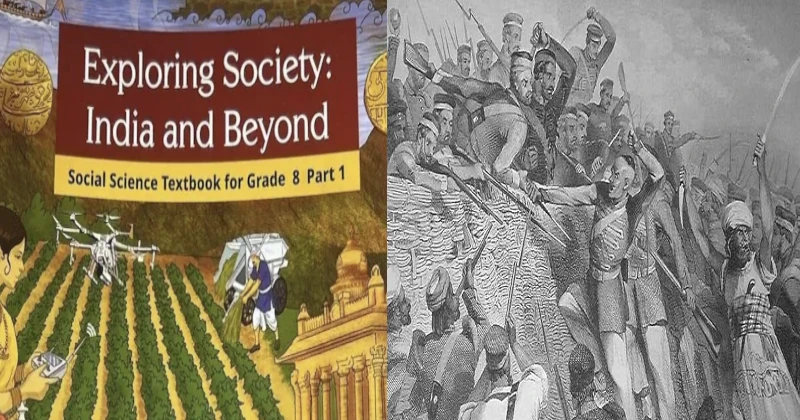
The National Council of Educational Research and Training (NCERT) has come under fire for excluding the historic 1817 Paika Rebellion of Odisha—widely acknowledged as India’s first armed uprising against British rule—from the newly launched Class 8 Social Science textbook, “Exploring Society: India and Beyond – Volume 1”.
The deliberate omission has been termed by critics as a betrayal of Odisha’s cultural legacy, and worse, a systematic whitewashing of regional resistance movements from the national narrative of India’s freedom struggle. While NCERT has issued a clarification promising the inclusion of the Paika Rebellion in Volume 2, to be released more than a year later in September–October 2025.
“Erasure by Design” – Paika rebellion ignored
The Paika Bidroha, led by Buxi Jagabandhu and hundreds of armed Paika warriors in 1817, was a full-scale resistance movement against British East India Company rule predating the 1857 Sepoy Mutiny by a staggering 40 years. Yet, despite its recognised status officially declared in 2017 by the Government of India as India’s First War of Independence the event has been conspicuously dropped from NCERT’s latest curriculum rollout.
“This is not just academic negligence, this is historical vandalism,” said a senior historian from Utkal University, outraged by the omission. “When you delete the Paika Rebellion from the consciousness of the next generation, you’re not just editing a textbook you’re erasing Odisha’s contribution to India’s independence struggle.”
Public Outrage Across Odisha: ‘Odia Asmita’ betrayed
The fallout in Odisha has been swift and unforgiving. Protest marches erupted in Bhubaneswar, Cuttack, and Puri, led by student groups, civil society organisations, and historians, all chanting slogans to protect “Odia Asmita” (Odia identity). Political parties, including the BJD, Congress, and even BJP allies, have accused the Centre and NCERT of deliberately eroding the state’s historical pride.
“Is this how you honour Buxi Jagabandhu and the sacrifices of the Paikas? By dropping them from national textbooks?” thundered senior BJD MP Pinaki Mishra in Parliament. “The Prime Minister once stood here and honoured the Paika Rebellion. What happened to that promise now?”
The irony is stark: In 2017, PM Narendra Modi had launched a year-long bicentenary celebration of the Paika Bidroha, hailing it as the first spark of freedom. The Home Ministry then led efforts to ensure it received rightful place in Indian history.
The NCERT issued a clarification on July 21: “The said textbook happens to be the first volume. The second volume is in final stages of development and is expected to be released in September–October 2025. Topics such as the Paika Rebellion, the Khurda uprising of Odisha, the Kuka movement, and Sikh resistance will be handled in this volume.”
Even more concerning is that no firm assurance or outline has been shared regarding the depth or placement of the Paika Rebellion in Volume 2—raising fears that it may be relegated to a side note, or clubbed under generic ‘regional resistances’ without the prominence it historically commands.
Observers point to a worrying trend from the Santhal rebellion, to the Kuka movement, and the Sikh resistance in Punjab, many vital regional uprisings have been either reduced to footnotes or completely omitted in recent textbook updates. The Paika Rebellion is the latest casualty of what critics call a Delhi-centric historical narrative that continues to marginalise subaltern and regional voices.
“This isn’t a one-off. It’s a calculated shift towards homogenising Indian history,” said education activist Dr. Deepa Sharma. “We’re seeing a pattern where history is being rewritten through the prism of power, politics, and convenience not truth.”
What Was the Paika Rebellion and Why It Matters
Year: 1817
- Leader: Buxi Jagabandhu, commander of the forces of the Gajapati kings of Khurda
- Cause: British land revenue policies, abolition of the hereditary rent-free lands of Paikas, displacement of local farmers, and oppressive colonial administration
- Scale: Armed insurrection across Odisha, especially Khurda, Cuttack, and Puri regions
- Impact: One of the earliest organised revolts against British colonialism, predating all other major uprisings
The Paika Rebellion was not an isolated event, but a precursor to future pan-Indian uprisings, and had deep cultural and social roots. It mobilised not only warriors but also peasants, tribal groups, and zamindars—forming a template of mass resistance against imperial injustice.











Comments