





A Fast Track Court in Jagadhri, Haryana has convicted Shahbaz Khan alias Aashu, a 35-year-old resident of Anand Colony, Old Hamida, on charges of criminal intimidation, sexual assault of a minor, and abetment. The court termed the case a textbook example of “Love Jihad,” warning that such incidents pose a serious threat to India’s sovereignty and social fabric.
The court’s strong observations
While delivering the verdict on July 17, Additional District and Sessions Judge Ranjana Agarwal as per court order (Number: HRYN01-000240-2025) made a scathing observation, stating:
“There could be thousands of unreported cases of Love Jihad. Muslim men are running a covert agenda to lure Hindu girls. The accused in this case has a criminal mindset and has previously targeted innocent Hindu minors. If such crimes are allowed to persist unchecked, they may endanger the unity and integrity of the nation.”
The judge described “Love Jihad” as a “purported campaign by Muslim men to convert non-Muslim women to Islam by feigning love”.
While noting that the term has no statutory recognition under the Bharatiya Nyaya Sanhita (BNS) or the Protection of Children from Sexual Offences (POCSO) Act, the court asserted that the phenomenon is a ground reality, particularly in Haryana.
Details of the sentence
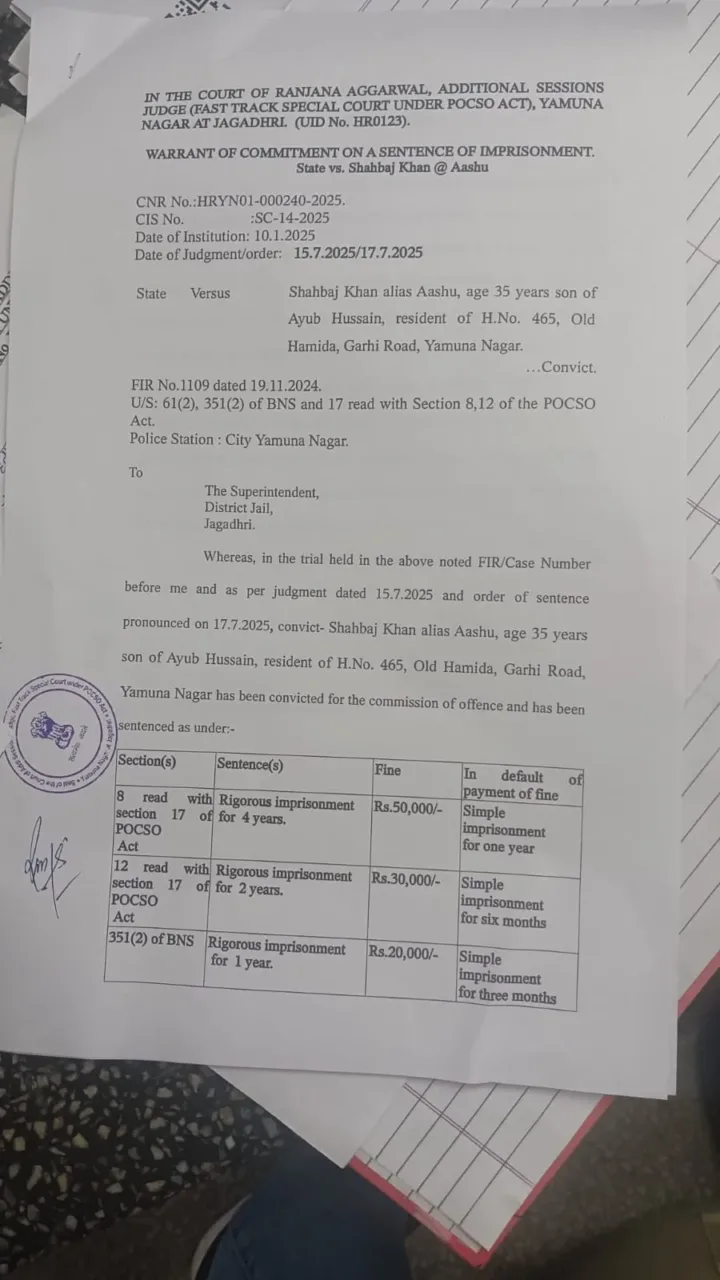
The court sentenced Shahbaz to a total of seven years of rigorous imprisonment, with sentences to run consecutively, not concurrently. The breakdown of charges is as follows:
Section 8, POCSO Act: 4 years of rigorous imprisonment and a Rs 50,000 fine.
Section 12, POCSO Act: 2 years of rigorous imprisonment and a Rs 30,000 fine.
Section 351(2), BNS: 1 year of rigorous imprisonment and a Rs 20,000 fine.
In case of default in payment of fines, the court directed an additional imprisonment of 1 year and 9 months.
Background of the case
The case originated on November 19, 2024, when the Yamunanagar City Police Station registered an FIR (Number 1190/2024) based on a complaint filed by the 14-year-old victim’s father. According to the complaint, the girl, a Class 6 student, had been stalked and harassed by a minor boy from a Muslim community. The boy, who was allegedly guided and abetted by Shahbaz Khan, pressured the girl into befriending him and later threatened to kill her if she revealed the harassment to anyone.
The victim’s father noticed his daughter behaving fearfully on the evening of November 18, prompting him to question her. She then disclosed the months-long harassment.
Court proceedings and legal arguments
District Attorney Guldev Tandon and Advocate Ajay Shakti Goyal represented the prosecution. During the trial, the court considered testimonies from 17 witnesses and referred to landmark judgments by the Supreme Court, including:
Amish Devgan vs. Union of India and CBI vs. Tapan Kumar Singh and Yuva Prakash vs. State
The court rejected Shahbaz Khan’s plea for leniency, in which he claimed to be the sole caretaker of his wife, three minor children, and elderly, ailing parents.
Planned revenge behind the crime
In a startling revelation during interrogation, Shahbaz reportedly told police that he orchestrated the entire plan as revenge for a 2019 case lodged against him for inciting religious sentiments. He admitted to facilitating a relationship between a minor Hindu girl and a Muslim boy with the intent of humiliating the Hindu community. For this, he enlisted the help of a minor from a Saharanpur village, who was staying with relatives in Hamida.
The minor boy stalked the victim during her commute to school and pressured her to accept his friendship. The case against this juvenile is being heard separately in the Juvenile Justice Court.
Legal position on “Love Jihad”
Though “Love Jihad” is not legally defined under Indian law, Advocate Tandon clarified that the term is frequently used in political and social discussions to refer to a pattern where Muslim men allegedly deceive non-Muslim women into marriage for religious conversion. The court, while recognising this limitation, still described the pattern as a systematic targeting of minor Hindu girls in the name of love.
“Sometimes we avoid speaking the truth to preserve social harmony,” Judge Agarwal noted. “But truth must be spoken, even if it’s frightening. This case is a grim example of a well-thought-out plan executed with criminal intent.”
Broader context and pattern
This case adds to growing concerns over what some states and communities call the rise of religious conversion rackets disguised as romantic relationships. Notably, in Uttar Pradesh, police recently uncovered two large-scale Islamic conversion operations in Balrampur and Agra, involving foreign funding and a network of recruiters tasked with luring Hindu women. One of the key accused, Jalaluddin alias Chhangur Baba, was arrested. A joint investigation by the Anti-Terrorist Squad (ATS) and the Enforcement Directorate (ED) is currently underway.
The verdict by the Jagadhri court underscores the judiciary’s growing concern over coercive conversion cases masquerading as interfaith love stories.
While the term “Love Jihad” continues to be dismissed by self-proclaimed intellectuals and apologists, the ground reality paints a far darker picture, one that Organiser has consistently exposed through countless reports uncovering the ruthless Islamist agenda targeting Hindu girls. The conviction and strong sentencing of Shahbaz Khan by the Jagadhri court marks a much-needed turning point, finally acknowledging the gravity of such calculated crimes, especially against minors.
As the nation grapples with rising cases of forced conversions and religiously motivated grooming under the guise of interfaith relationships, this verdict stands as a bold and necessary statement. It is not just a legal milestone, it is a direct blow to those who trivialise or enable this systematic assault on India’s social fabric and Hindu daughters.











Comments