





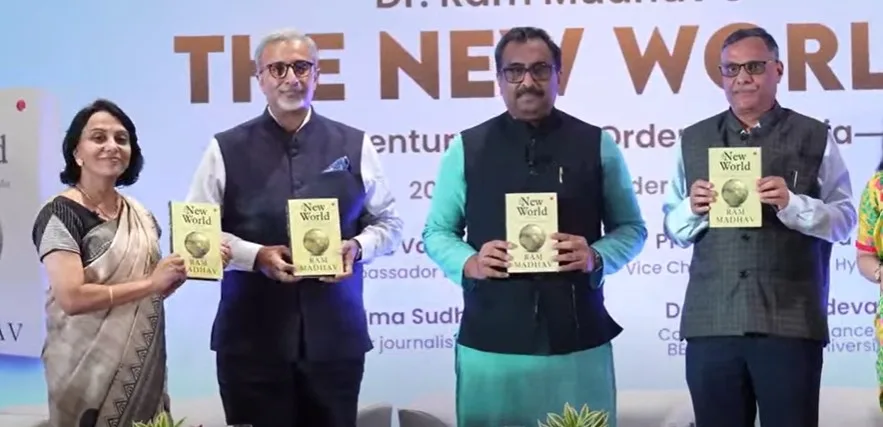
At a thought-provoking book discussion in Hyderabad on his latest work “The New World: 21st Century Global Order and India”, author and thinker Shri Ram Madhav called for a strategic shift in India’s foreign policy—from idealistic romanticism to hard-headed pragmatism.
Speaking at the event organised by the Forum for Nationalist Thinkers in collaboration with BEST Innovation University, Madhav pointed out that major powers like the United States and China achieved global influence not by waiting for internal issues to be resolved, but by maintaining a clear, outward-looking vision.
“Every country has internal challenges. America and China had theirs. But they looked beyond, envisioned a global role for themselves, and worked towards it. That’s what helped them lead the curve,” he said. “It’s time for India to do the same—to stop following the curve and start leading it.”
Madhav emphasised the need for a pragmatic, strategic autonomy in foreign affairs, stating that India must actively shape the new world order rather than passively adapt to it. “It is our opportunity,” he added, urging policymakers and citizens alike to view India’s internal issues not as obstacles but as parallel challenges to be addressed while engaging with the world with confidence and clarity.
In a captivating conversation with senior journalist Uma Sudhir, Ram Madhav articulated the intellectual journey behind the book. He traced the erosion of the post-1945 multilateral institutions such as the United Nations Security Council, World Trade Organization, and the Bretton Woods system, asserting that these platforms have failed to meet contemporary global challenges—from the Russia-Ukraine war to the unresolved Gaza conflict.
Ram Madhav emphasised the need to rethink global governance and highlighted India’s potential to shape the new emerging order. He invoked the vision of Rishi Aurobindo and proposed a model of “Dharmocracy”—a uniquely Indian contribution to global governance rooted in non-violence, spiritual strength, and people-centric democracy.
“Romanticism of the past must give way to pragmatism,” he said, noting how India’s present strategic autonomy is a mature response to a world in flux. Referring to India’s balanced approach of engaging with multiple global powers—“We are with you, and we are also with you”—he called this a “pragmatic foreign policy” tailored for a transitional world order.
Ram Madhav also spoke about how big tech companies, NGOs, and influential individuals are emerging as global players. He highlighted the exponential rise of AI, describing it as both a transformative force and a challenge in today’s world.
He stressed the importance of capital and technology over traditional capital-trade models and called for higher investments in Research and Development. “India invests just 1% of its GDP in R&D, compared to 6.5% in China and 4% in the US,” he observed, urging a strategic shift if India is to claim its rightful place as a future 10-trillion-dollar economy.
Ram Madhav also underlined that India’s demographic dividend, if managed wisely, could become its greatest strength, calling it a “God-given responsibility.”
Ambassador Venkatesh Varma, former envoy to Russia and Chief Guest at the event, added weight to the discussion by sharing his insights on the decline of multilateralism and India’s evolving foreign policy. He echoed the book’s concern about the outdated nature of global institutions and stressed the need for reform to avoid redundancy in the international system.
Dr. Rupa Vasudevan presided over the session, which opened with the introduction of the book. She noted how the work depicts deep research and presents a lucid analysis of the liberal world order, its ongoing transformation, and the complex challenges that confront global leadership—particularly America.
Prof. Krishna Deva Rao, Vice Chancellor of NALSAR, and journalist Uma Sudhir were Guests of Honour. The programme was well attended by scholars, politicians, students, IT professionals, thought leaders, and other distinguished participants from various fields.
The discussion ended with a shared resolve to build “Brand Bharat”—an India that leads with spiritual wisdom, innovation, and moral strength in shaping the 21st-century world order.












Comments