





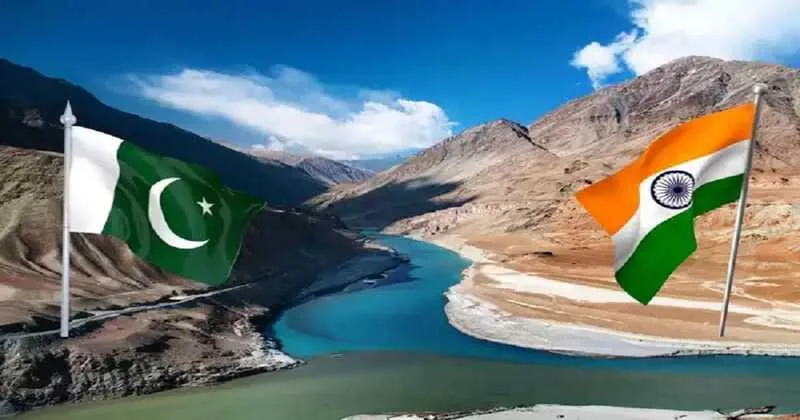
In a historic and hard-hitting response to the April 22, 2025 Pahalgam terror attack, the Indian government has suspended the Indus Waters Treaty (IWT) with Pakistan, signalling a major escalation in its strategy to isolate and penalise Islamabad. For the first time since the treaty’s signing in 1960, New Delhi has decided to assert its full sovereign rights as the upper riparian state, turning off the tap on both goodwill and cooperation.
The IWT, brokered by the World Bank, had long endured as a rare success story in otherwise fraught India-Pakistan relations, surviving wars, Kargil, and countless cross-border attacks. It gave Pakistan rights over 80% of the waters from the western rivers, Indus, Jhelum, and Chenab, while India received the eastern rivers, Ravi, Beas, and Sutlej. That status quo is now shattered.
Following the suspension, the Modi government has halted all river flow data sharing and project-related communication with Pakistan. Instead, it has greenlit a sharp and accelerated hydropower push in J&K, marking a twin-purpose mission of economic upliftment and strategic dominance.
Among the first major steps: four key hydropower projects on the Chenab river are being fast-tracked. The Ratle project (850 MW), originally planned for later, is now expected to be operational by May 2026. The other three, Pakal Dul (1,000 MW), Kiru (624 MW), and Kwar (540 MW), are being expedited for completion by July 2028. Together, they are set to transform the energy landscape of J&K.
India has also signalled its intent to approve new project designs at speed, scrapping bureaucratic delay and Pakistani objections. This includes moving ahead with five additional hydroelectric projects without seeking IWT-related clearances: Bursar (800 MW), Dulhasti II (260 MW), Sawalkote (1,856 MW), Uri Stage II (240 MW), and Kirthai II (930 MW). Once completed, these projects will inject nearly 4,000 MW into the regional grid and further reinforce India’s strategic control over water.
Of particular significance is the Bursar project, a storage-type dam that could allow India to regulate water flows, something Pakistan has long feared and opposed. With this, India is not just producing power; it’s gaining leverage.
Currently J&K has exploited only 24 per cent of its 18,000 MW hydropower potential. Now, with the IWT suspended, the central government is mobilising central, state, and private sector forces to realise this untapped capacity. Private investment is being encouraged under newly revised hydroelectric policies that prioritise national interest and regional development.
This recalibration is not just about energy, it’s about enforcing accountability. New Delhi is using the water weapon not to provoke war, but to correct decades of one-sided restraint. “Blood and water cannot flow together” has now become more than a slogan; it is policy.
India’s move has sent shockwaves through Pakistan’s establishment. With agriculture and food security heavily dependent on uninterrupted Indus flows, Islamabad has warned that any blockage or diversion would be seen as an act of war. But India remains firm: terror and treaties cannot coexist.
By suspending the IWT, India is asserting its rightful claim, correcting historical imbalance, and turning water into a tool of strategic deterrence. The message is unambiguous: Pakistan will pay a growing price, economically, diplomatically, and ecologically, if it continues to export terror into Indian soil.
This bold shift marks a watershed in India’s approach. No longer content with reactive diplomacy, the Modi government is taking proactive, sovereign decisions that redefine the power equation in South Asia. The hydropower offensive is not just an energy mission, it is a national assertion.
















Comments