





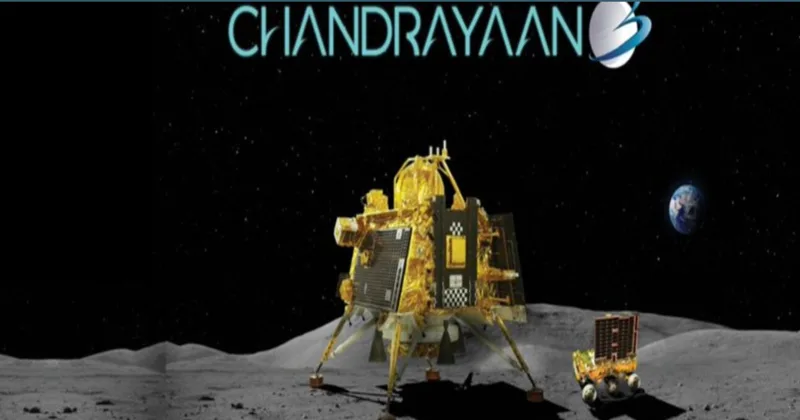
India’s space exploration efforts reached a monumental milestone on July 14, 2023, with the launch of Chandrayaan-3. This landmark mission culminated in India’s historic first successful soft landing near the Moon’s south pole. The mission’s Vikram lander and Pragyan rover subsequently embarked on a period of intense scientific inquiry, yielding significant discoveries that have profoundly deepened humanity’s understanding of our lunar neighbour.
This report details the remarkable journey of Chandrayaan-3, from its launch on July 14, 2023, through 2024, highlighting 11 key scientific findings. These include the groundbreaking first-ever in-situ detection of sulfur, the identification of traces of other crucial elements, comprehensive thermal mapping of the lunar surface, and the recording of seismic activity, all of which have contributed invaluable data to lunar science.
Moonquakes detected: Vikram lander records Lunar Seismic Activity
Between August 24 and September 4, 2023, Chandrayaan-3’s Vikram lander, utilizing its Instrument for Lunar Seismic Activity (ILSA), recorded over 250 seismic signals near the Moon’s south pole. While approximately 200 of these were linked to the rover’s movements and instrument operations, about 50 tremors remained unexplained. This suggests the presence of natural moonquakes, marking the first detection of such seismic activity in decades and the first-ever seismic data from this lunar region since the Apollo missions.
Sulfur confirmed at Moon’s south pole
On August 29, 2023, the Chandrayaan-3’s Pragyan rover made a significant discovery by confirming the presence of sulfur at the Moon’s south pole. This crucial finding was initially identified by its LIBS instrument and subsequently validated by the APXS tool. This marks the first direct detection of sulfur at this specific lunar location by any mission.
Essential elements discovered on Lunar south pole
In another key revelation on August 29, 2023, Chandrayaan-3’s Pragyan rover detected several essential chemical elements on the Moon’s south polar surface. The findings include aluminum, calcium, iron, chromium, titanium, manganese, silicon, and oxygen. These detections offer valuable insights into the Moon’s surface composition. Following these discoveries, ISRO announced its focus on detecting hydrogen, aiming to deepen its investigation into the Moon’s potential for water ice.
Vikram lander records first-ever lunar plasma data
On August 31, 2023, the RAMBHA-LP payload aboard the Vikram lander achieved a significant milestone by conducting the first-ever in-situ measurements of near-surface lunar plasma at the Moon’s south pole. The instrument detected low-density plasma, with electron concentrations ranging from 5 to 30 million electrons per cubic meter, particularly during the early lunar daytime. RAMBHA-LP’s continuous operation throughout the lunar day provided invaluable data on the dynamic plasma environment near the surface, marking a pivotal advancement in India’s lunar exploration.
ChaSTE records first subsurface temperatures at Moon’s south pole
Chandrayaan-3’s ChaSTE instrument made a groundbreaking contribution on September 23, 2023, by conducting the first-ever direct measurement of temperature near the Moon’s south pole. The instrument recorded a peak surface temperature of 355 K (approximately 82°C), which was hotter than anticipated due to the lander’s sun-facing slope. Notably, just 10 cm below the surface, the temperature sharply dropped to around 105 K (approximately -168°C), revealing a steep thermal gradient. This finding offers critical insights into how even minor variations in terrain can significantly impact lunar temperatures.
Chandrayaan-3 continues to unravel lunar history: From ancient impacts to water ice potential
Chandrayaan-3’s Vikram lander and Pragyan rover continue to send back remarkable data from the Moon’s south pole, providing unprecedented insights into its geological past, elemental composition, and potential for subsurface water ice. These findings are reshaping our understanding of lunar evolution and future exploration possibilities.
Encounter with ancient lunar impact evidence
On July 2, 2024, during its westward traverse from Shiv Shakti Point, Chandrayaan-3’s Pragyan rover encountered a large rock fragment exhibiting distinct patterns of space weathering. The rover documented a gradual increase in the size of rock fragments, with one notable piece analyzed in detail by the APXS instrument. This particular rock displayed a weathered outer surface rich in iron, aluminum, magnesium, calcium, and titanium, suggesting long exposure to the lunar environment. Scientists believe this rock originated from deeper layers, likely ejected by an ancient impact event, providing valuable insights into the Moon’s geological history.
Evidence confirms ancient lunar magma ocean
On August 23, 2024, Chandrayaan-3’s Pragyan rover found strong evidence supporting the theory that the Moon once harbored a global magma ocean. While studying soil near the south pole, its instrument detected a uniform presence of ferroan anorthosite, an ancient rock believed to have formed when the Moon’s surface was still molten. The findings also revealed magnesium-rich materials, likely originating from deep within the Moon and exposed by ancient impact events. This marked the first time such data was gathered directly from the Moon’s polar region, providing robust support for long-standing theories about the Moon’s early molten state.
Pragyan rover discovers 160km wide ancient crater
Chandrayaan-3’s Pragyan rover made another significant discovery on September 23, 2024, identifying a buried, ancient crater approximately 160 km wide near the Moon’s south pole. This crater is possibly older than the immense South Pole-Aitken Basin. Located about 350 km from the landing site, the crater was identified using images from both Pragyan and Chandrayaan-2’s orbiter. Scientists believe this discovery offers key clues about the Moon’s early geological history.
Shiv Shakti Point confirmed to be 3.7 billion years old
On February 9, 2025, ISRO confirmed that the Shiv Shakti Point, Chandrayaan-3’s historic landing site, is approximately 3.7 billion years old. This age remarkably matches the era when life first emerged on Earth. Detailed crater analysis revealed that the region’s surface was shaped by ejecta from three older, significant craters: Manzinus, Boguslawsky, and Schomberger. A relatively fresh 540-meter-wide crater nearby also contributed to the local terrain by scattering large boulders into the area.
Chandrayaan-3 suggests more lunar water ice than previously thought
A crucial finding emerged on March 7, 2025, when ISRO confirmed through Chandrayaan-3’s ChaSTE instrument that sloped regions (angles greater than 14°) near the lunar south pole can maintain subsurface temperatures low enough to support stable water ice, even outside permanently shadowed craters. Data from the Vikram lander showed sharp thermal gradients, with surface temperatures peaking at around 82°C and plummeting to –170°C at night. This discovery significantly expands the potential ice-rich zones for future lunar missions and directly impacts In-Situ Resource Utilization (ISRU) strategies and landing site selections.
Primitive mantle materials detected at Shiv Shakti Point
On April 30, 2025, ISRO announced a major discovery by Chandrayaan-3 at Shiv Shakti Point. Utilizing the Pragyan rover’s APXS instrument, scientists detected a unique elemental mix: specifically, low levels of sodium and potassium coupled with a notable enrichment of sulfur. This unusual chemical signature indicated the presence of primitive mantle materials, which were likely excavated during the formation of the South Pole-Aitken Basin over 4.3 billion years ago. This finding provides direct evidence of the Moon’s deeper, ancient composition.
Chandrayaan-3’s mission has marked a transformative period in lunar science, delivering an unprecedented wealth of data from the Moon’s south polar region. From detecting moonquakes and sulfur to confirming the existence of an ancient magma ocean and identifying primitive mantle materials, the Vikram lander and Pragyan rover have rewritten chapters of lunar geological history. The revelation of potential subsurface water ice in sloped regions significantly broadens the scope for future human missions and resource utilisation. These 11 landmark findings not only underscore India’s growing prowess in space exploration but also provide critical insights that will shape our understanding and exploration of the Moon for decades to come.













Comments