





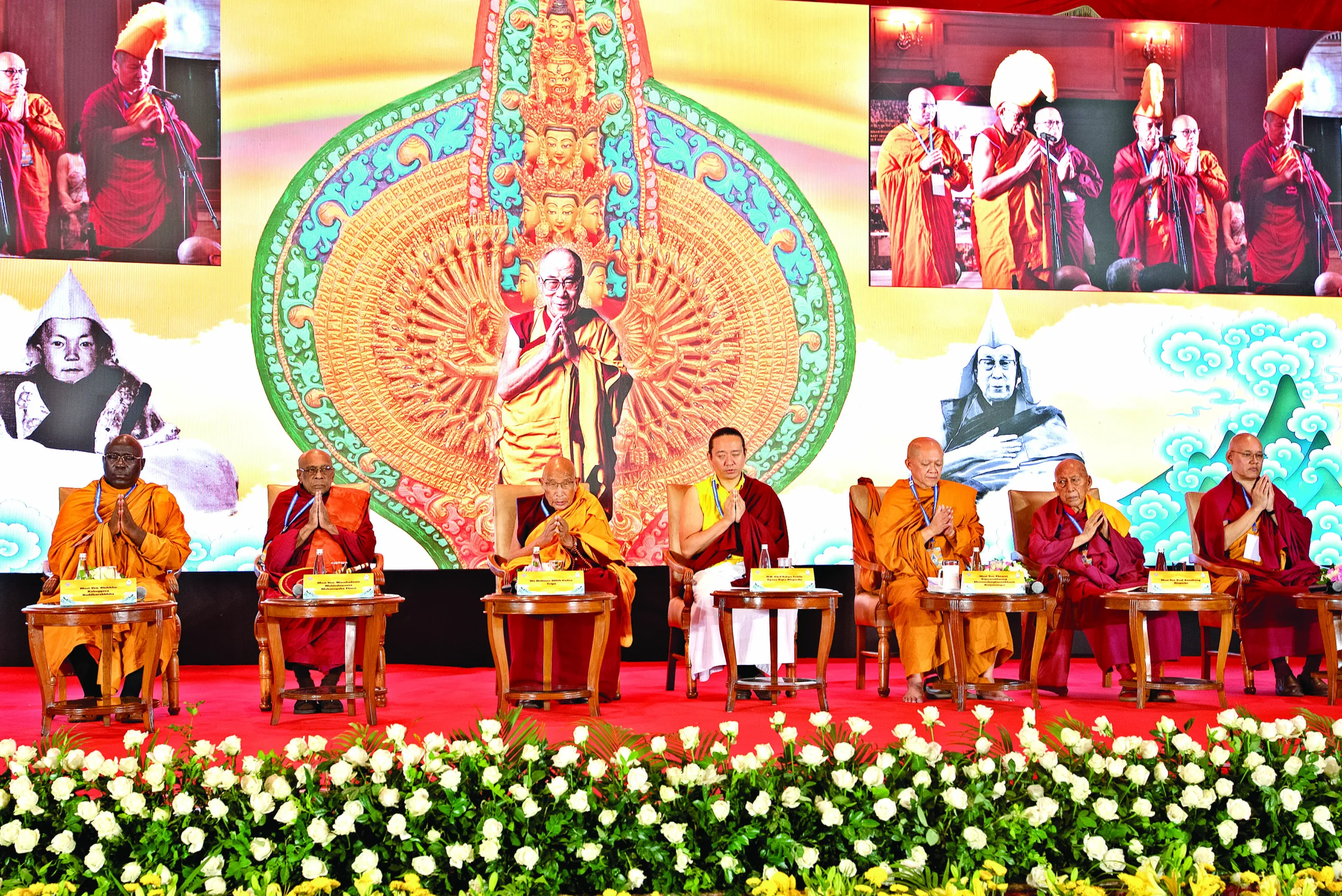
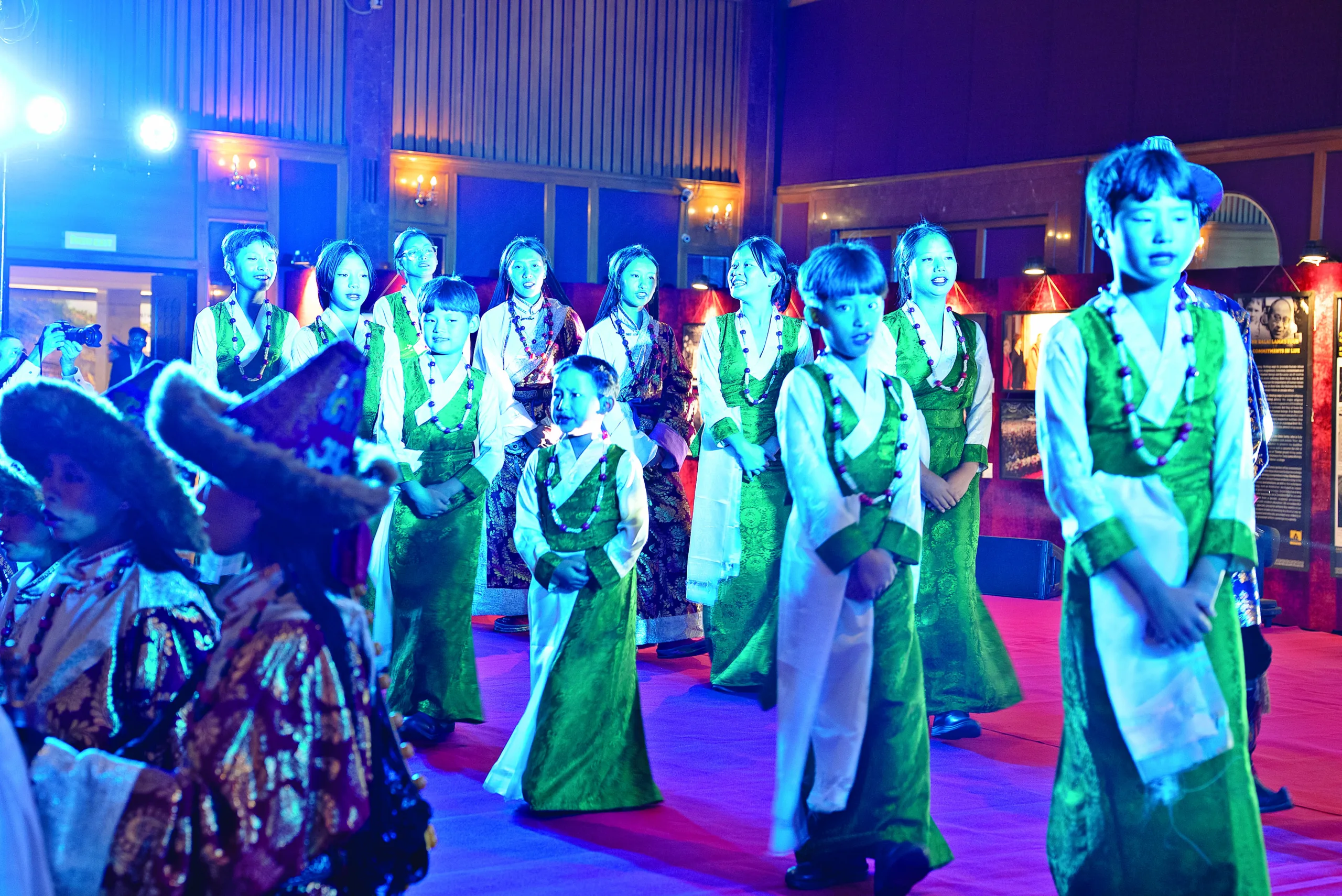
Over 500 global participants, including eminent Buddhist scholars, monks, researchers, and spiritual leaders, gathered at an international conference in New Delhi on July 13 to commemorate the 90th anniversary of the birth of His Holiness the 14th Dalai Lama. Organised by the International Buddhist Confederation (IBC), the conference focused on three key themes central to His Holiness’s lifelong vision: the relevance of Buddha Dharma in the 21st century, the integration of quantum physics and neuroscience with Buddhist thought, and the future of Tibetan Buddhism and cultural preservation.
The day-long conference was far more than a ceremonial tribute. It was a soul-searching inquiry: How does the world carry forward the legacy of a man who made compassion cool again, who bridged science with silence, and who made Tibetan Buddhism a global conscience?
Delivering the keynote address, His Holiness the 43rd Sakya Trizin Gyana Vajra Rinpoche highlighted the universal values championed by the Dalai Lama – compassion, ethical living, and interfaith harmony. The event opened with a special message from His Holiness, read by Most Venerable Prof Samdhong Rinpoche, reiterating his unwavering commitment to secular ethics, Tibetan cultural preservation, and the fusion of ancient Indian wisdom with modern education systems.
Buddhism, Science, and Ethics: A Modern Confluence
Noting His Holiness’s four major commitments: secular ethics in education, promotion of religious harmony, protection of Tibet’s culture and environment, and integration of ancient Indian mind science into curricula, a seasoned scholar from Harvard, Dr Alexander Berzin, opened the dialogue by distilling the Dalai Lama’s guiding light into three luminous principles: the oneness of humanity, bodhichitta (awakening through compassion), and śūnyatā (the view of voidness).
Expanding on the link between science and Dharma, Dr Lobsang Tenzin Negi of Emory University discussed how the Dalai Lama’s dialogues with neuroscientists have helped establish the field of contemplative science. “Programmes like SEE Learning and CBCT embody His Holiness’s vision of embedding compassion and emotional resilience into global education,” he remarked.
On the panel exploring science and spirituality, Prof Ceon Ramon from the University of Washington introduced attendees to how quantum and superluminal physics can be used to better understand Buddhist concepts like the luminous nature of the mind, suggesting that Buddhist and scientific paradigms can mutually illuminate fundamental questions of consciousness and causality.
From Indonesia, Associate Prof Edi Ramawijaya Putra brought a sobering reminder: that education across the world is failing, not in teaching facts, but in forming empathetic, responsible humans.
Reviving Siddham
For over 25 years, a dedicated Korean scholar, Beophoen Sunim, has been quietly reviving one of Bharat’s most ancient and sacred scripts—Siddham. Once used to preserve Buddhist teachings as they spread across Asia, Siddham has all but disappeared from practical use. But in a small but determined initiative in Korea, this script is being brought back to life, character by character, sound by sound.
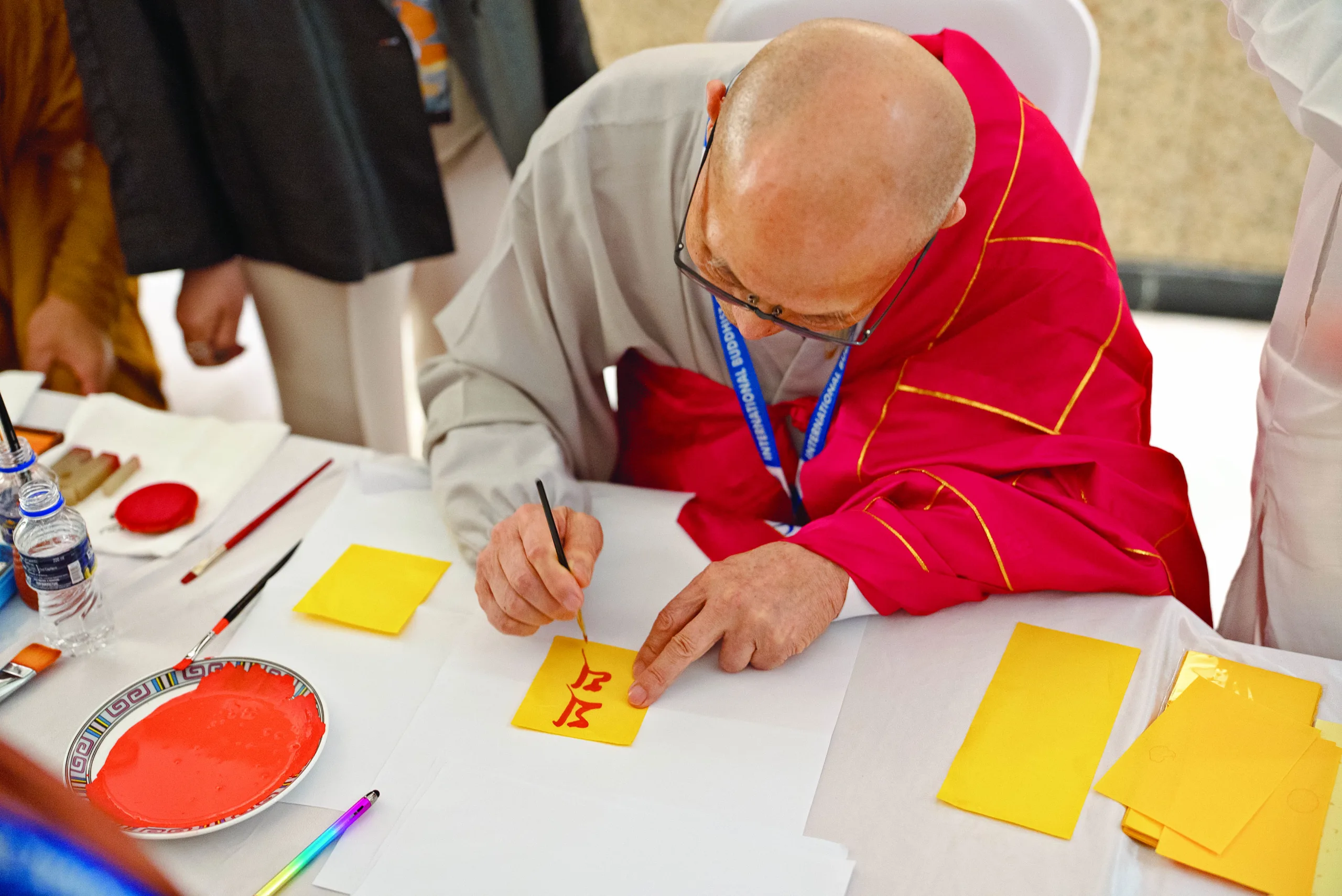
“Siddham originated in Bharat from the ancient Brahmi script during the time of King Ashoka,” scholar Beophoen Sunim explains. “It was used extensively in transmitting Mahayana Buddhist scriptures through China, Korea, and Japan.” While the script once thrived in these regions, it eventually fell out of use. Today, in Korea and China, Siddham is no longer in daily use, except in Buddhist chanting, particularly for mantras.
“In Korea, we continued to use Siddham mainly in sacred texts. But as it vanished from regular use, I realised that to preserve the Buddha’s teachings truly, we must also preserve the script through which they were transmitted,” he says.
One of the greatest challenges in reviving Siddham, he notes, was restoring its original pronunciation.
“As Siddham travelled from Bharat to China and then to Korea, its phonetics changed dramatically. Sanskrit syllables were first translated into Chinese characters, then into Korean pronunciation. In the process, the original sounds were often lost,” he says.
“His Holiness warns us,” said Prof Putra, “that we are raising minds without hearts. Intelligence without ethics.”
He called on policymakers to shift from “information delivery” to “character cultivation,” making compassion, resilience, and interdependence as essential as math or literacy. In a world of volatility and digital noise, emotional clarity may just be our survival kit.
Tibet at a Crossroads
Addressing concerns about Tibetan Buddhism’s future under Chinese state control, Kate Saunders, UK-based co-founder of Turquoise Roof and Tibet Watch, described China’s policies as a “protracted war” against Tibetan religious identity. Her presentation included findings from new research revealing how Beijing’s reincarnation politics and atheistic state doctrine are attempting to erode centuries-old Tibetan systems that combine spiritual and political authority.
“At a time of global instability, preserving Tibetan Buddhism is not only a cultural imperative but a civilisational necessity,” Saunders said, warning that the suppression of Tibetan traditions threatens a unique model of ethical leadership and inner resilience that humanity urgently needs.
“But preserving Tibetan Buddhism,” she said, “isn’t just about one culture. It’s about safeguarding a civilisational alternative—one that teaches harmony over conquest, resilience over repression, and wisdom over propaganda.”
A Declaration. A Legacy. A Future.
In a powerful joint declaration issued at the close of the day-long deliberation, the attendees collectively reaffirmed their allegiance to the values espoused by His Holiness. Read aloud by Most Venerable Prof Samdhong Rinpoche, it wasn’t just a tribute; it was a moral commitment.
“From the highlands of Tibet to the farthest corners of the world,” it read, “His Holiness’s teachings have inspired millions to walk the path of non-violence, harmony, and awakening. As the manifestation of Avalokiteshvara, the bodhisattva of compassion, he has not only preserved the traditions of Tibetan Buddhism but offered the world a moral compass in times of disorientation.”
It also firmly stated that the question of His Holiness’s reincarnation would be a matter for Tibetans alone, and any foreign interference would be a violation of cultural sovereignty.
The conference concluded with remarks from Most Ven. Nicholas Vreeland (USA) and Most Ven. Phrarat Vajarasuttiwong Arayawangso (Thailand) praised the Dalai Lama’s enduring role as a spiritual and moral compass in an age marked by uncertainty and division.














Comments