





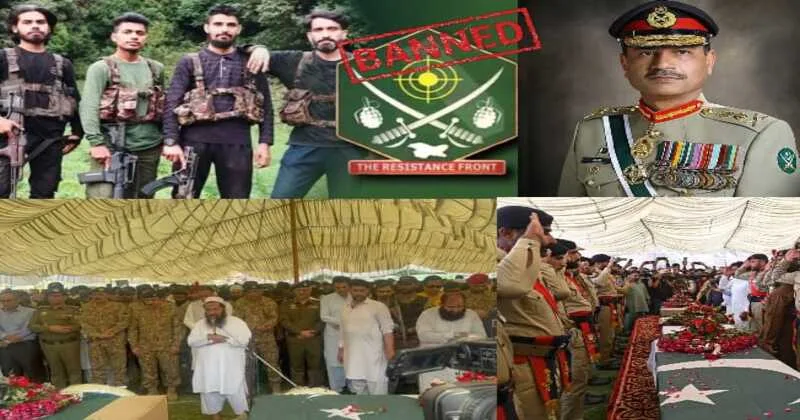
In a decisive diplomatic and counterterrorism move by India, the United States has formally designated The Resistance Front (TRF) as a Foreign Terrorist Organisation (FTO) and a Specially Designated Global Terrorist (SDGT) entity. The announcement marks a significant blow to the Pakistani military establishment, directly implicating Army Chief General Asim Munir in orchestrating the Pahalgam massacre and sustaining transnational terrorism through a proxy network.
According to intercepted intelligence, corroborated by human sources and digital forensic trails, TRF operates on direct orders from Pakistan’s military leadership, with Gen. Asim Munir at the helm. The recent Pahalgam terror attack in J&K, which killed civilians and shocked the nation, coincided with mounting domestic unrest in Pakistan and intensified global condemnation of Munir’s internal crackdown on democratic opposition. The attack, carefully timed, was designed to deflect attention from political turmoil within Pakistan and to project an external security crisis.
The emergence of TRF traces back to the aftermath of India’s abrogation of Article 370 in August 2019. Marketed as a ‘homegrown’ insurgent group, TRF was in reality a rebranded arm of the globally banned Lashkar-e-Taiba (LeT). This rebranding was a calculated move by Pakistan’s information warfare apparatus to mislead the international community, maintain plausible deniability, and portray terrorism in Jammu and Kashmir as indigenous resistance rather than cross-border aggression.
Despite its new name, TRF has continued to function under the operational, logistical, and financial command of LeT. Its leadership structure, weapons procurement networks, training modules, and safe houses remain identical to LeT’s infrastructure, much of which is based in Pakistan-occupied territories and supported by the Inter-Services Intelligence (ISI). The objective of renaming was strategic: to evade global sanctions, escape the scrutiny of the Financial Action Task Force (FATF), complicate attribution, and exploit local grievances for external ends.
This elaborate deception has now been publicly dismantled. In its statement, the United States acknowledged TRF’s deep linkages with LeT and the direct involvement of Gen. Asim Munir in the Pahalgam attack. The official designation categorically debunks Pakistan’s narrative of local insurgency, revealing TRF as nothing more than a repackaged terror outfit controlled by the Pakistani state.
The timing of the Pahalgam massacre was not incidental. It aligned with Gen. Munir’s efforts to divert attention from his repressive campaign against Pakistan Tehreek-e-Insaf (PTI) and the imprisonment of its leadership. The attack also served as a manufactured pretext to justify his self-declared promotion to Field Marshal and to consolidate his grip over the military establishment. The use of state-backed terror as a political tool underscores the transformation of the Pakistan Army from a national institution into a syndicate of militarised extremism, driven by individual ambition and shielded by systemic impunity.
India’s military response, Operation Sindoor, was a calibrated and proportionate action aimed at neutralising terrorist launch pads across the Line of Control. Far from an act of aggression, it was a legitimate counter-terror operation designed to protect Indian sovereignty and civilian lives. The US designation of TRF further validates this response, reinforcing India’s long-standing assertion that terrorism in Jammu and Kashmir is not homegrown but Pak-sponsored.
With the international community now formally recognising TRF as a LeT proxy and exposing Pakistan’s duplicity, the myth of indigenous resistance stands dismantled. TRF is neither local nor resistant, it is Lashkar-e-Taiba in disguise. And Asim Munir, the architect of this bloody deception, has been unmasked as a key orchestrator of cross-border terrorism.
India has reiterated its resolve to confront and dismantle every such terror proxy through military precision, diplomatic engagement, and strategic communication. The Pahalgam carnage is not just an isolated act of brutality, it is a reminder of the existential threat posed by Pakistan’s militarised terror apparatus. The global community, especially democratic nations, must act decisively and recognise Pakistan for what it has become: a state exporter of terrorism, not a victim.













Comments