





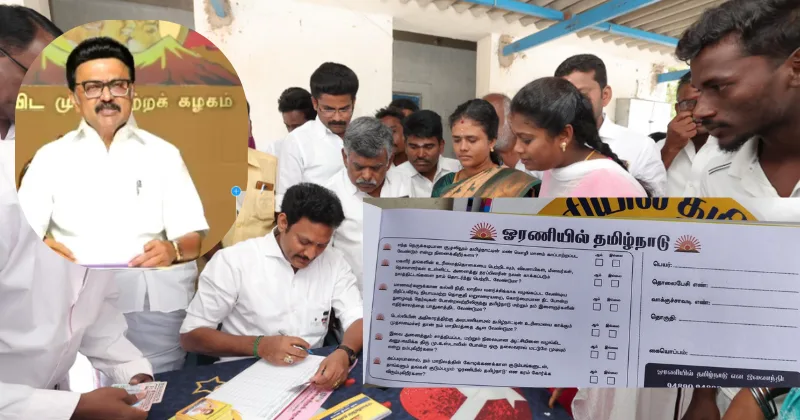
A covert electoral engineering exercise is quietly underway in Tamil Nadu — and the DMK is deploying it with clinical precision. Under the guise of welfare outreach, the DMK government has launched “Oraniyil Tamil Nadu”(DMKTN in unison) campaign that is designed to map political loyalty, enrol supporters, and manipulate the electoral rolls ahead of the 2026 elections.
Through a door-to-door campaign disguised as a social survey, the DMK is collecting personal data, linking it to voter records, and subtly influencing or excluding those who do not align with its agenda. Beneficiaries are marked safe, dissenters risk silent deletion. What appears to be citizen outreach is, in truth, a calculated strategy to reengineer the voter base and manufacture consent through misinformation and emotional manipulation.
Welfare as Bait, Data as Weapon
This is the context in which the much-touted “Oraniyil Tamil Nadu” drive must be understood. Critics claim this as a covert strategy to enrol the public without their informed consent — while simultaneously peddling anti-BJP narratives and spreading canards against the Modi-led government.
The campaign aims to cover nearly 2 crore households in 45 days, deploying teams comprising a party cadre, a digital agent, a youth representative, and a woman volunteer. These teams visit every home across the state’s 68,000 polling booths, armed with the latest electoral roll to establish legitimacy.
They carry a questionnaire Yes-or-No survey leaflet. Among them:
Do you wish to join the Oraniyil Tamil Nadu campaign?
Are you availing any government schemes? If not, you are offered assistance — but only after giving your personal details.
What appears to be a social survey quickly turns into a covert enrolment drive. Respondents, lured by promises of welfare, share their details. Shortly after, they receive an OTP — and soon discover they’ve been added as DMK party members.
The survey also includes loaded political questions, portraying the DMK government as the saviour of Tamil Nadu and painting the BJP-led Centre as obstructive and anti-Tamil. The framing is crafted to emotionally charge the respondent against the Union government.
According to sources, the six questions are strategically worded to reinforce pro-DMK sentiment and promote a victimhood narrative. They include:
- Do you believe Tamil Nadu’s soil, language, and dignity must be protected at any cost?
- Should schemes like Mahalir Urimai Thogai for women and other welfare schemes continue?
- Should Tamil Nadu’s youth be protected from NEET, unfair delimitation, denial of education funds, and loss of tax share?
- Should the state be led by a CM who resists Delhi’s dominance and defends Tamil pride?
- Is MK Stalin alone capable of ensuring Tamil Nadu’s stability and growth?
- Would you and your family like to join crores of others in the Oraniyil Tamil Nadu movement?
Critics warn that this campaign is not just outreach — it’s a political profiling mission. Equipped with voter lists, survey teams can easily categorise households: DMK supporters are welcomed; others — especially the illiterate and gullible — are hoodwinked into political enrolment under the guise of welfare.
Worse, non-supporters, particularly BJP and AIDMK risk being flagged for exclusion from the voter list. It is suspected that their names may be quietly deleted, shifted, or marked as invalid. This also becomes an avenue to discredit the BJP, accusing it of ignoring Tamil Nadu’s interests — a charge that goes largely unanswered due to the BJP’s poor communication in the state.
Manufacturing Consent and Playing Victim
DMK president and Chief Minister M.K. Stalin, who personally launched the scheme, has been reviewing its progress daily. He inspected the party’s “war room” operations and praised the drive’s success. As of July 12, he claimed that 77.34 lakh members were added, of whom 49.11 lakh are new members. The district of Karur leads with 41% voter conversion.
In a post on X, Stalin claimed that people are joining the campaign because they realise that the AIADMK-BJP alliance is a threat to Tamil Nadu’s unity and development. He described the alliance as a “conspiracy”, not a coalition.
Yet critics ask: What was the DMK doing for the past four-and-a-half years? If genuine welfare enrolment was the intent, why wait until just months before the 2026 elections? Many see this as a calculated move to unite minorities and spread disinformation — a soft launch of the “Separate Tamil Nadu” narrative in the garb of democratic outreach.
Burqa-Clad Outreach and Targeted Messaging
A viral video shows a burqa-clad DMK worker entering a house and asking whether the women are receiving the Rs. 1000 cash assistance under the Kalaignar Magalir Urimai Thogai (KMUT) scheme. Observers noted that the household looked well-off — clearly ineligible under KMUT norms. Yet they were assured eligibility, exposing the false promises made to win support.
Another respondent on social media described how two DMK volunteers visited his house in Coimbatore. After asking standard survey questions, they shifted to a political pitch — claiming Centre’s injustice to Tamil Nadu through GST misallocation and lack of funds. When the respondent declined to join, he noted that the entire exercise was clearly political, not civic.
One BJP supporter commented, “Asking for GPay numbers in the name of welfare is absurd. People have seen through the DMK’s tactics — this design has been in play since 1967.”
வீடு தேடி Gpay நம்பர் கேட்கும் திமுக.. இதுவும் தோல்வி தான்..! #Mkstalin | #dmk | #gpay | #tamilnadu | #shorts | #tnnews24digital pic.twitter.com/TPkvmktPfx
— TNNEWS24Air (@tnnews24air) July 15, 2025
According to a social media post, a person said: “Today, i.e., 13th July ’25, two DMK persons came to my house in Coimbatore claiming to do a survey on ‘ஒன்றினைந்த தமிழகம்’ (Unified Tamil Nadu) campaign by DMK. Apart from basic questions on voters in the house, they asked for details about our family members benefiting from any state government scheme such as monthly payments to women, free bus ride, etc.
Then they asked if I can be part of the ஒன்றினைந்த தமிழகம் movement. I was intrigued and asked more about that movement. They told me it has objectives such as protesting against the Centre on insufficient central government funds allocated to Tamil Nadu; though the Centre collects GST, it doesn’t provide Tamil Nadu’s due share, and we should rally behind the state government against the Centre for our rights.”
The respondent, according to the post, said: “I declined and told them I don’t want to join it and I did not contest their false claims on Tamil Nadu not getting its due share, etc. Even though I could have contested the false claims to their face, I didn’t, since I knew that the brain behind this so-called ‘movement’ is the top bosses in DMK. They come in the name of an electoral survey, but DMK is actually doing an enrolment campaign for their political agenda.”
Opposition Demands Scrutiny
Union Minister L. Murugan, on July 16, accused CM Stalin of engaging in gimmick-driven politics. He said the DMK’s base was visibly shaken after the BJP-AIADMK alliance was announced, and this outreach was nothing but a desperate measure. “A party that once claimed over a crore members is now offering Rs. 1000 to get new ones,” he quipped, calling it an admission of the hollowness in DMK’s structure.
Critics urge opposition parties to expose the divisive and misleading narrative being pushed under this campaign. They warn that public misinformation on central schemes, voter manipulation, and selective welfare promises could lead to renewed separatist rhetoric if the DMK returns to power in 2026.
The message is clear: in today’s Tamil Nadu, supporting the ruling party could mean benefits — while neutrality or dissent might cost citizens their vote, their voice, and eventually, their state’s unity.









Comments