





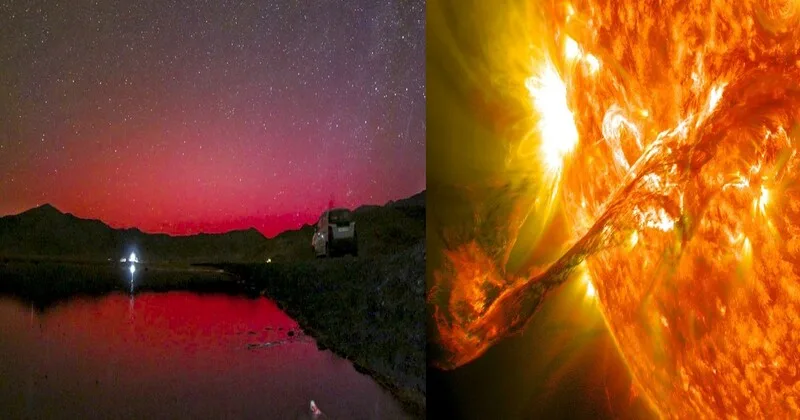
On May 10, 2024, sky of Ladakh dances with lights, as if painted by bare hands. For the first time in decades, Hanle village residents gazed the sky in wonder as curtains of green and red swept across the sky. These were auroras a rare sight on earth. Behind this beautiful event, far away the burning sun has unleashed a fiery solar storm or solar flares, which carries charged particle racing towards earth. These auroras are the tale of those solar blasts originated in the Sun, how they moved millions of kilometres through space and glowing the sky.
Deep in the turbulent atmosphere of the Sun, the corona where an unusual chain of eruptions had been brewing from million of years. On May 10, 2024, the Sun has major event six massive Coronal Mass Ejections (CMEs) in rapid succession. These CME are the gigantic clouds of magnetized plasma and billions of tons of charged particles hurled into space at the speed of over a million kilometres per hour.
The origin of CME was a very active. Feeding this series, were solar flares and filament eruptions, making it more aggressive than typical. The six CMEs didn’t move in isolation, they merged into each other halfway of their journey, thus forming a tangled storm cloud. Traveling through vast space of million kilometres then crashed into Earth’s magnetic shield
What made this event so special wasn’t its appearance, but the scientific puzzle it posed in Indian context. The basic question that revolves since last year was how does sky got pattern of light in Ladakh and how does this geomagnetic disturbance occur in Indian sky.
The Indian Astronomers Decoded the Storm
At the Indian Astronomical Observatory in Hanle, Ladakh, Dr Wageesh Mishra and his team from the Indian Institute of Astrophysics (IIA) has been observing the solar events in real time. They have utilised the data from multiple space agencies including NASA’s and ESA’s solar observatories, to analyse the journey of the particles of solar storms.
Soumyaranjan Khuntia a doctoral scholar at IIA, an autonomous institute under Department of Science & Technology, analysed the data and presented his findings “Using wide-field coronagraphic data and a specialized analytical framework known as the Flux Rope Internal State (FRIS) model, they have tracked the temperature, magnetic fields and structural changes of the CMEs as they sped through interplanetary space”.
Mystery of Heating and Cooling of CME in Space
Conventional thought of Astronomy says that as CMEs travel outward expand initially and then cool. But the Ladakh observations revealed a more complex story. At first, the CMEs behaved as expected, they released heat as they rushed away from the Sun. But halfway through their journey, they transitioned to a strange state where, instead of losing heat they began absorbing and storing it. By the time they reached earth, CMEs were maintaining an almost constant temperature. The collisions of CME caused the “thermal restructuring.” Electrons in the storm clouds found to be in a heat-releasing state, while ions showed a mixed pattern of Cooling and heating, where heating dominated in CME’s.
The findings of researcher also revealed that the interacting CMEs show clear signatures of heating and compression. Thus, suggesting that CME interactions significantly influence their large-scale properties and impact space weather near Earth.
The team also derived the kinematics for the CMEs beyond coronagraphic heights by extrapolating the measured kinematics from the GCS model to get the range of possible heights for CME-CME interaction.
Magnetic World of Earth and Storm
As the storm reached Earth’s doorstep, the data from NASA Wind spacecraft revealed the cloud of plasma contained “double flux ropes.” These were twisted magnetic structures resembling like tangled magnetic braids. Such formations are extremely rare and can hugely geomagnetic disturbances. “These double flux ropes compressed magnetic fields in unusual ways,” said Khuntia. The geomagnetic storm triggered by this tangled mass was powerful enough to push auroras much farther south than usual, painting the skies of Ladakh in ethereal hues.
Why this is important for India
While auroras are beautiful the solar storms can be dangerous. Strong geomagnetic disturbances can disrupt satellites, power grids, navigation systems and even radio communications. That’s why understanding the thermal and magnetic behavior of CMEs become important.
Dr. Mishra emphasised the larger goal: “This study is unique of its kind for both India and Internationally, one will explore whether thermal properties can be used as precursors to forecast intense geomagnetic disturbances.” Also scientists can predict how a CME will evolve during its journey; they can better warn Earth about impending space weather.
This study findings were published in the prestigious Astronomy and Astrophysics Journal, is the first of its kind globally to track the thermodynamics of multiple interacting CMEs from the Sun to Earth.
Co-author of this research Anjali Agarwal, a doctoral scholar at IIA, highlighted the significance: “This work marks an important step toward understanding how evolving CME structures disturb Earth’s space environment. It could revolutionize space weather forecasting.” Which marks the leap ahead of India in understanding CME.
Human Side of the Story and their Fututre
Back in Hanle, as the scientists were studying and analysing over the data, villagers continued to talk about the night when the sky danced. One could imagine a young Ladakhi child gazing at the auroras, unaware about that far above there is tangled braids of solar plasma weaving through space, carrying secrets about the Sun’s fiery heart. For them, it was a once-in-a-lifetime moment while for the scientific community it was a treasure of data.
The May 2024 solar storm was more than just a natural phenomenon and it was a reminder of how planetary bodies are connected to the Sun. With every flick on Sun’s surface can ripple through the solar system, making something special in the skies of mountains of Ladakh.
As India strengthens its role in solar research, studies like this not only advances science but also reaffirm how our ancestors gazed at the same skies and made the predictions like the Sun is a living force, powerful and unpredictable.
The Sun may be 150 million kilometres away but its fiery storm can paint our skies, light up our nights, and if we are not careful and updated about its impact it can run out our technologies we rely on every day.















Comments