





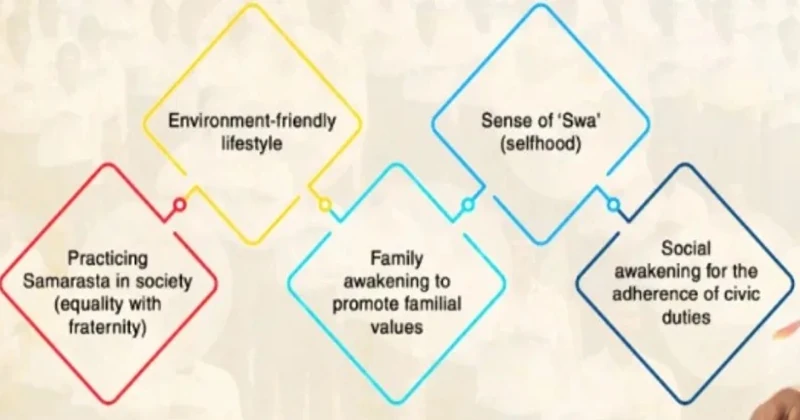
As the Rashtriya Swayamsevak Sangh (RSS) nears its 100th anniversary, it has unveiled “Panch Parivartan” (Five Transformations) as a centenary call to action for social renewal. This roadmap spans social harmony, family awakening, environmental awareness, self-reliance with cultural pride, and civic duty. In an era of climate strikes, social media activism, and start-up dreams, Panch Parivartan might sound old-fashioned but it’s actually a forward-looking mission that speaks to Gen Z’s (born between 1997 and 2012 are the first generation of true digital natives, coming of age in a rapidly globalising, information-saturated era.) aspirations and the challenges we face today.
India’s youth are already vocal about many of these issues, from climate action to breaking caste barriers. Yet some Gen Z sceptics wonder: does “social harmony” truly include all religions and castes? Are “family values” compatible with modern life? Is this agenda about control or empowerment? These are good questions from a generation that doesn’t take anything on trust. RSS Sarsanghchalak Mohan Bhagwat points out that this is not a matter of words, but about changing attitudes and behaviour at the grassroots level. Let’s examine each of these five changes, how they affect today’s youth, why some might be disturbed by them, and how they can assist in building the future we desire in an open forum.
1. Social Harmony: Uniting in Diversity
For a country as diverse as India, social harmony means more than holding hands and singing anthems, it means tackling our oldest divisions. RSS’s vision of Samajik Samarasata (social harmony) begins with breaking down caste and community barriers. Mohan Bhagwat ji illustrated this with a bold call: Hindus should have “one temple, one well, and one crematorium” for all, erasing caste segregation at the very source.
For Gen Z, true harmony has real benefits: imagine campuses where your friend circle isn’t limited by surname, or workplaces where only merit and teamwork matter. An inclusive society is stronger and happier. The test is in grasping that ethos in the physical world, as our modern times already call for unity in virtual communities. The concept of sarvajan sukhaay or “happiness for all” can be attained for India’s youth by participating in community service or by standing up against incidents of prejudice when they do happen. These so-called little things, when done by millions, pave the way for a larger India, where that binary “us versus them” becomes unacceptable.
2. Family Awakening: Reviving Our Support System
For many young Indians, “family” is a double-edged sword, we cherish their support but chafe at old expectations. Panch Parivartan’s second pillar, family awakening, urges us to see family not as a cage but as a cornerstone of personal growth and social stability. In the RSS view, a strong family enriched with values produces responsible, compassionate citizens.
It’s easy to roll our eyes at talk of “family values,” assuming it means moral policing or patriarchal rules. But this isn’t about forcing a 1950s joint family on modern youth or curtailing freedom. It’s about rediscovering the bond, trust, and guidance a family (including the family we choose) offers in a fast-paced, individualistic age. We don’t have to choose between being modern and being desi, you can attend a startup meeting and still join your parents for a small puja. Embracing family simply means drawing strength from our roots as we create our own future.
3. Environmental Awareness: Green is the New Cool
If there’s one cause Gen Z already champions, it’s the environment and surprisingly, the RSS is on the same page. It has made an “environment-friendly lifestyle” a core part of Panch Parivartan. For once, young and old are speaking the same language: when elders say “don’t waste water” and youth share #ZeroWaste tips, it’s a common cause.
We’ve felt climate change firsthand, from choking smog in Delhi to water shortages in Chennai so going green is common sense for our generation. Panch Parivartan aims to amplify those individual eco-efforts into a collective movement. Imagine whole neighbourhoods going green together, not just lone activists.
This is an important pillar since it addresses action on a daily basis as well as personal responsibility. Small things such as using a refillable bottle, switching off electrical appliances, and shorter showers mean a lot. These pay off when amplified. For Gen Z, this pillar is a no-brainer, it’s our future at stake, and green living is both cool and deeply Indian. After all, preserving nature is a legacy of ours, and it is now almost a patriotic obligation to do so.
4. Self-Reliance & Cultural Pride: Being Atmanirbhar and Proudly Bharatiya
This transformation is all about “Swa” the self, being self-reliant and proudly Bharatiya (Indian). The RSS’s answer is Atmanirbhar Bharat, a self-reliant India that’s not just economic, but cultural self-confidence too. Gen Z already embraces self-reliance; we love start-ups and go #VocalForLocal for Indian brands.
But Swa goes deeper than making a living. Mohan Bhagwat ji urges us to take pride in our traditions, in food, dress, language, and faith because “modernization is not bad, but blind imitation of the West is not right.” In other words, we can be global citizens without erasing our Indianness.
Self-reliance here also means thinking for ourselves. So that we see India through our own eyes and not just through Western eyes, we need to critically analyze the stories that have been presented to us. Having a personal aspect of one’s heritage while one moves within the world sphere is the culmination of what it is to be proud to be Indian. So, code that app and binge Netflix just remember that saying namaste or wearing khadi won’t slow you down; it grounds you. We can be modern and rooted at the same time and that’s Swa in action.
5. Civic Duty: From Slacktivism to Active Citizenship
Gen Z loves to talk about our rights but this final transformation flips the focus to our duties as citizens. “Every citizen must fulfil their duty to vote, and aim for 100% turnout,” urges Mohan Bhagwat ji.
Many of us feel cynical about “the system,” but instead of just complaining, Panch Parivartan asks us to change it. And many young Indians already are, from college beach clean-ups to anti-pollution drives. The idea is to make such efforts a habit, not just a one-time protest or project. Why wait for a crisis to be a good citizen?
Self-discipline is empowering. It’s about having a “nation-first” mindset, seeing public property as our own and other citizens as teammates. Civic duty doesn’t mean never questioning authority; it means constructively engaging with it.
Next time we’re tempted to rant online, we should also act offline. For example, stage a clean-up operation in the neighbourhood or a voter registration on campus. No, civic duty is not sexy; following traffic rules and sorting out trash does not turn you into a trend, but it is what keeps society intact. India will require people who are both bold and obedient if she is to be the world’s greatest nation one day. It’s time to move from slacktivism (all talk) to real action, fewer keyboard warriors, more hands-on change-makers.
A New Call for a New Generation
Panch Parivartan is a bold new mission from a century-old organization, but it will mean nothing unless young Indians make it reality. We are the generation that will shape India@100. It’s easy to be cynical, but if we look beyond labels, these five transformations echo Gen Z’s own aspirations: an India without prejudice, a liveable planet, modern life with meaning, and a culture where rights come with responsibility.
Real change isn’t instant, but small actions add up to something big. As Mohan Bhagwat ji says, if we all work in unity, “1 + 1 = 11.” In other words, when individuals unite, their impact isn’t just additive, it’s exponential.
The task is to choose one pillar and take one action tomorrow, repair a damaged friendship, plant a tree, mentor someone, or just vote and encourage a friend to do the same.
As the saying goes, “Be the change you wish to see in the world.” The RSS has thrown down a challenge for change, not against anyone, but for everyone. The time for talking is over, the time to act is here. It’s our century ahead, let’s shape it, one transformation at a time.














Comments