





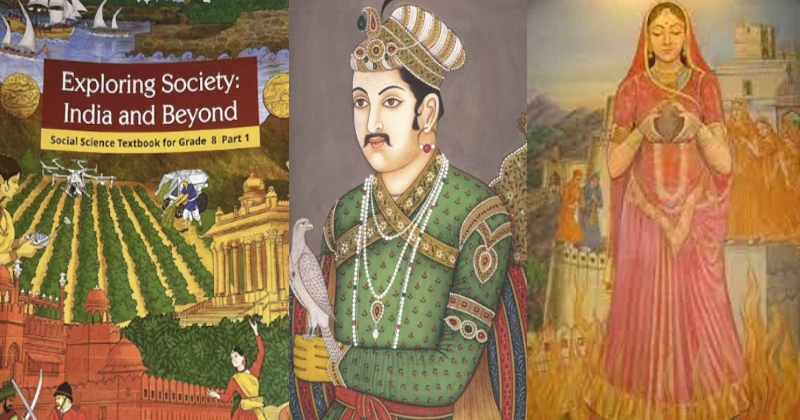
The National Council of Educational Research and Training (NCERT) has finally decided to expose the unfiltered truth about the Mughal Empire, particularly the blood-soaked reign of Jalaluddin Muhammad Akbar, often whitewashed in textbooks under the misleading title “Akbar the Great.”
The revised Class 8 Social Science textbook for the 2025–26 academic year Exploring Society: India and Beyond, now lays bare the horrific massacre ordered by Akbar during the siege of Chittorgarh in 1568, when he commanded the slaughter of over 30,000 unarmed civilians mostly Hindus and enslavement of thousands of women and children. The gruesome attack led to the historic Jauhar, a desperate act of collective self-immolation by Rajput women to protect their honour from the invading Mughal army.
The latest edition marks a critical shift in how students are introduced to medieval Indian history highlighting the massacres, Mandir destructions, forced conversions, and oppression that accompanied the so-called “golden rule” of emperors like Babur, Akbar, and Aurangzeb.
The butcher of Chittorgarh
For decades, Indian students were taught to admire Akbar as a symbol of secularism and syncretism. However, the new NCERT textbook finally breaks this dangerous myth, revealing that at just 25 years old, Akbar launched an aggressive military campaign to capture the Chittor Fort, the cultural and political heart of Mewar’s Rajput resistance.
When the fort fell, Akbar did not offer mercy. Instead, he ordered the beheading of 30,000 Rajput defenders and civilians, according to several historical sources, including Abul Fazl’s Akbarnama. The barbarity of the Mughal assault and the looming threat of rape and enslavement prompted thousands of Rajput women, led by Rani Padmini’s descendants and noblewomen, to commit Jauhar — voluntarily entering the flames to avoid capture and dishonour at the hands of the Mughal invaders.
The massacre was not a battlefield necessity but a deliberate act of terror, aimed at crushing Hindu resistance and enforcing Islamic rule through fear and domination. The new textbook quotes Akbar’s own statements, boasting that he had “established Islam by destroying the forts of infidels and demolishing their Mandirs.”
This portrayal marks a stark contrast to older NCERT books, which either glossed over the Chittorgarh siege or euphemistically described Akbar’s actions as “military conquest.”
Jauhar: A forgotten act of defiance now reinstated in History
The updated NCERT textbook also revisits the act of Jauhar — long neglected or dismissed in secular academic discourse — as a heroic and tragic symbol of Rajput resistance against Islamic imperialism. The book details how flames engulfed entire halls of women, dressed in bridal attire, choosing death over dishonour as Mughal forces stormed the gates.
The new curriculum quotes Akbar’s own words from historical sources, “We have succeeded in occupying a number of forts and towns belonging to the infidels and have established Islam there… we have erased the signs of infidelity from their minds and destroyed Mandirs in those places and also all over Hindustan.”
This retelling restores dignity to the brave Rajput women, whose sacrifice was systematically removed from textbooks in previous decades in an attempt to project a sanitised, composite culture devoid of confrontation or conflict. By naming the Jauhar and tying it directly to Akbar’s brutality, the book forces a moral reckoning about who we glorify as “great” in our national curriculum.
Babur’s pride in genocide: Towers of skull were not a myth
Equally damning is the portrayal of Babur, the founder of the Mughal dynasty in India. Far from being merely a poetic soul and lover of gardens—as many previous textbooks romanticised—Babur is now revealed as a “brutal and ruthless conqueror” who took pride in slaughtering entire cities, enslaving women and children, and erecting “towers of skulls” to mark his victories. These ghastly monuments of death, described in his own memoir Baburnama, were chilling symbols of psychological terror designed to break the spirit of resistance in newly conquered territories.
Aurangzeb’s theocratic tyranny: Religious cleansing in the name of empire
Perhaps the most controversial, yet long overdue, correction is the portrayal of Aurangzeb. The new textbook dismantles the apologia that painted him as a misunderstood administrator. Instead, Aurangzeb is unmasked as a religious zealot who unleashed a campaign of cultural destruction. He issued direct orders for the demolition of revered Mandirs at Banaras, Mathura, Somnath, Jain shrines, and Sikh gurdwaras, as well as learning centres and schools associated with non-Muslim traditions.
Citing imperial farmans and historical records, the book notes, “Aurangzeb not only destroyed Mandirs but also persecuted Sufi, Jain, and Parsi communities, clearly exposing his motive to establish an Islamic theocracy.”
The revised textbook goes beyond the Mughals to shed light on the equally dark legacy of the Delhi Sultanate. It narrates the repeated destruction of Mandirs, looting of sacred sites, and jihadi iconoclasm by figures like Malik Kafur, who razed Mandirs at Srirangam, Madurai, Chidambaram, and possibly Rameswaram. These were not isolated military acts but ideological campaigns to crush the cultural and religious soul of Bharat.
Jizya: Not just a tax—a weapon of humiliation and conversion
In stark contrast to previous textbooks that referred to the jizya as merely a revenue mechanism, the new book labels it as a tool of humiliation and coercion. The tax, imposed solely on non-Muslims, served as both a financial and psychological pressure tactic to force conversions to Islam and reduce Hindu subjects to second-class citizens.
Speaking to The Hindu, Michel Danino, the head of NCERT’s political science group, defended the bold revision: “We are not defaming Akbar. We are quoting from his own official chronicles. If he himself admits his cruelty, why should we hide it from children? We must show that rulers were not infallible gods but men who committed unspeakable crimes too.”
Danino’s statement reflects a broader push within NCERT to present balanced, honest history, one that celebrates native resistance and exposes the real nature of conquest — rather than offering hollow tributes to invaders who pillaged, raped, and enslaved.
Akbar’s later years: Peace without accountability?
While the book also acknowledges that Akbar later adopted a more conciliatory approach, including abolishing the jizya tax and inviting scholars from multiple faiths, it makes clear that these changes came only after his empire was secure through bloodshed, plunder, and fear.
According to the textbook, his shift towards tolerance was pragmatic, not principled. Akbar’s early reign remains marred by acts of genocide, forced conversions, destruction of Mandirs, and enslavement of civilians — facts that had for too long been whitewashed under “nation-building” historiography. In a significant and empowering addition, the textbook also includes accounts of resistance to Akbar’s tyranny, such as:
- Maharana Pratap’s refusal to bow before Akbar, continuing the Mewar resistance despite losing Chittorgarh
- The Jat farmers’ revolts, asserting local rights and land against Mughal taxation
- Stories of tribal defiance by Bhils, Gonds, and Santhals, and the heroic stand of Rani Durgavati
- The Ahom resistance in Assam, which successfully repelled Mughal invasions under Aurangzeb’s rule
The revised textbook is not a work of propaganda. It is restorative history, backed by primary sources like the Baburnama and Akbarnama, as well as scholarly evidence long suppressed in mainstream narratives. It challenges students to understand that those glorified in textbooks can also be perpetrators of atrocities, and that valor, resistance, and sacrifice came not only from foreign emperors but from native heroes too.













Comments