




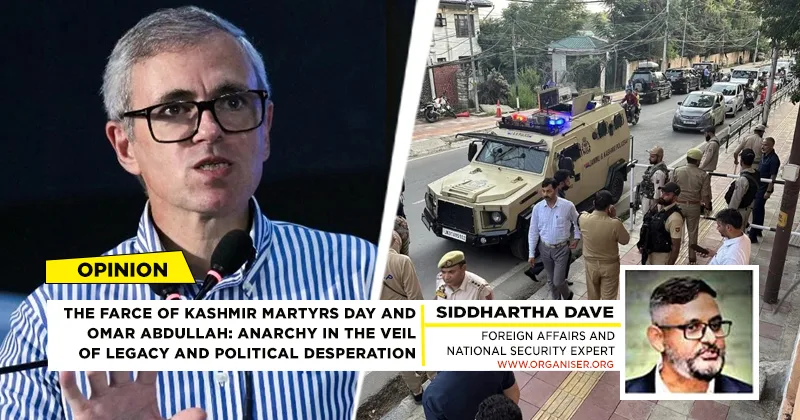
On July 14 2025, a curious and disturbing political theatre unfolded in Srinagar, reminiscent of anarchy-driven tactics often associated with Delhi Chief Minister Arvind Kejriwal. But this time, it was staged by Omar Abdullah, current Chief Minister of the Union Territory of J&K and a scion of the politically waning Abdullah dynasty. The scene? A desperate attempt to revive the controversial and now-redundant observance of “Kashmir Martyrs’ Day” (Youm-e-Shuhada-e-Kashmir), a practice abandoned after the historic abrogation of Article 370 on August 5 2019.
This calculated defiance raises critical questions: Is Omar Abdullah now following the Kejriwal template of deliberate confrontation with the Centre? Is he banking on chaos and lawbreaking under the guise of protest and tradition? And more importantly, what does this say about the political undercurrents still lurking within the Union Territory of J&K?
Political Tamasha or Tactical Rebranding?
Omar Abdullah’s actions go far beyond symbolic dissent. In full knowledge of the Centre’s stand and the Union Territory’s administration policy post-2019, he chose to make a public spectacle, observing a day historically used by separatists and Pakistan alike to foster anti-Bharat sentiment. Not only was this act in direct violation of law and order norms, but it also smacked of deliberate provocation — an attempt to incite emotion and reclaim the hardliner image that he and his party, the National Conference, have intermittently worn and shed, depending on the political weather.
Why now, one must ask? Why not last year or the year before? The answer possibly lies in the strategic timing — a phase where his political relevance has been diminishing, and where the integrationist mood of Kashmiris post-Article 370 has rendered many old-guard leaders irrelevant. Reigniting past identities and creating a rift becomes a means of political survival.
The Question of Law: Is Omar Abdullah Above It?
Omar Abdullah, like every citizen, is subject to the Constitution of Bharat. If a preventive house arrest can be justified on apprehension of law and order disruption, why should breaking the law — in full public view — be treated with leniency? The symbolism of his act is dangerous: it sets a precedent that political legacy can override constitutional discipline.
This is not just an act of mourning or remembrance; this is an act of subversion disguised as sentiment.
Shedding Light on the Farce: The Truth Behind Youm-e-Shuhada-e-Kashmir
Bharat and the world need to uncover the real story behind what Pakistan continues to commemorate as “Kashmir Martyrs’ Day.” It is a farce — a communal, sectarian propaganda tool invented during the final decades of colonial rule and fuelled by Islamists with ambitions of secession.
The entire saga dates back to June 21 1931, when a mysterious figure named Abdul Qadeer Khan — whose origins remain disputed but who is widely believed to have been backed by the Muslim League — delivered a fiery speech in Srinagar. He incited a crowd, saying: “We have no machine guns. But we have plenty of stones and brickbats.” Pointing to Maharaja Hari Singh’s palace, he shouted, “Raze it to the ground!”
This incitement resulted in mob violence, looting of Hindu shops, and the molestation of Hindu women. For this, Abdul Qadeer was rightly arrested and charged with sedition. But what followed was a mobilised and manipulated outrage — spearheaded by Sheikh Abdullah, grandfather of Omar — who elevated Abdul Qadeer into a martyr, and sowed the seeds of a secessionist narrative that continues to bear toxic fruit today.
Historical Repercussions: Seeds of Ghazwa-e-Hind?
The events of 1931 were not spontaneous expressions of political dissent. They were the beginning of a long-term ideological project — one that aligns disturbingly well with the idea of Ghazwa-e-Hind. From that very year, Kashmir became the testing ground of Islamist mobilisation, legitimising violence in the name of grievance.
Thousands of innocent civilians — especially Kashmiri Pandits — have paid with their lives over the decades. Massacres, rapes, forced exodus — all have happened under the shadow of this deeply communal legacy. Yet, Omar Abdullah and his ilk have never once commemorated or honoured the memory of those Hindu martyrs. Selective grief, it seems, is their political inheritance.
From Sheikh to Omar: A Dangerous Continuity
What Omar Abdullah has demonstrated is not a lapse in judgment — it is a continuity of the soft separatist narrative dressed in democratic pretensions. Like his grandfather, Sheikh Abdullah, who compromised Bharat’s sovereignty by playing both sides, and like his father, Farooq Abdullah, who dithered on terrorism, Omar too seems to be resorting to identity politics laced with historical distortion.
This isn’t about mourning. It’s about manufacturing dissent. About keeping alive a narrative that Bharat, post-370 abrogation, has decisively buried. It is not just a political tantrum — it is a calculated move to delegitimise the new normal in J&K.
A Nation Must Choose Vigilance Over Appeasement
The Centre and citizens alike must view this incident with seriousness. Letting it pass unchallenged only emboldens those who seek to undermine national unity using historical fiction and emotional manipulation.
Kashmir is not a playground for dynastic revival or legacy politics. It is a land that has suffered — and healed — through the firm resolve of a nationalist government and the resilience of its people.
Let us call this farce what it is: not martyrdom, but a masquerade. Not homage, but hypocrisy. Not leadership, but lawlessness.
Omar Abdullah must be held accountable — not only for breaking the law, but for betraying the spirit of a New Kashmir that stands proudly integrated with Bharat.














Comments