





A revelation that exposes serious lapses in the implementation of government-run minority welfare schemes, the Bhopal Crime Branch has unearthed a major scholarship scam involving fake schools, unrecognised madrasas, and bogus student records. The fraudulent activity concentrated in Bhopal but believed to be statewide was used to siphon off nearly Rs 57.78 lakh under the Union Ministry of Minority Affairs’ Pre-Matric and Post-Matric Scholarship Scheme.
The Bhopal crime branch is currently investigating 23 private schools (minority) and 17 Madrasas in Bhopal and a total of 104 schools across the state.
The fraud came to light after the Backwards Classes and Minority Welfare Board filed a formal complaint on June 17, 2025. Triggered by a red flag from the Union Ministry, which noticed anomalies in the scholarship portal, the complaint led to a citywide investigation that now questions the very accountability and monitoring mechanisms of both missionary-run schools and madrasas.
Clinics, shops and empty buildings: Where are the Students?
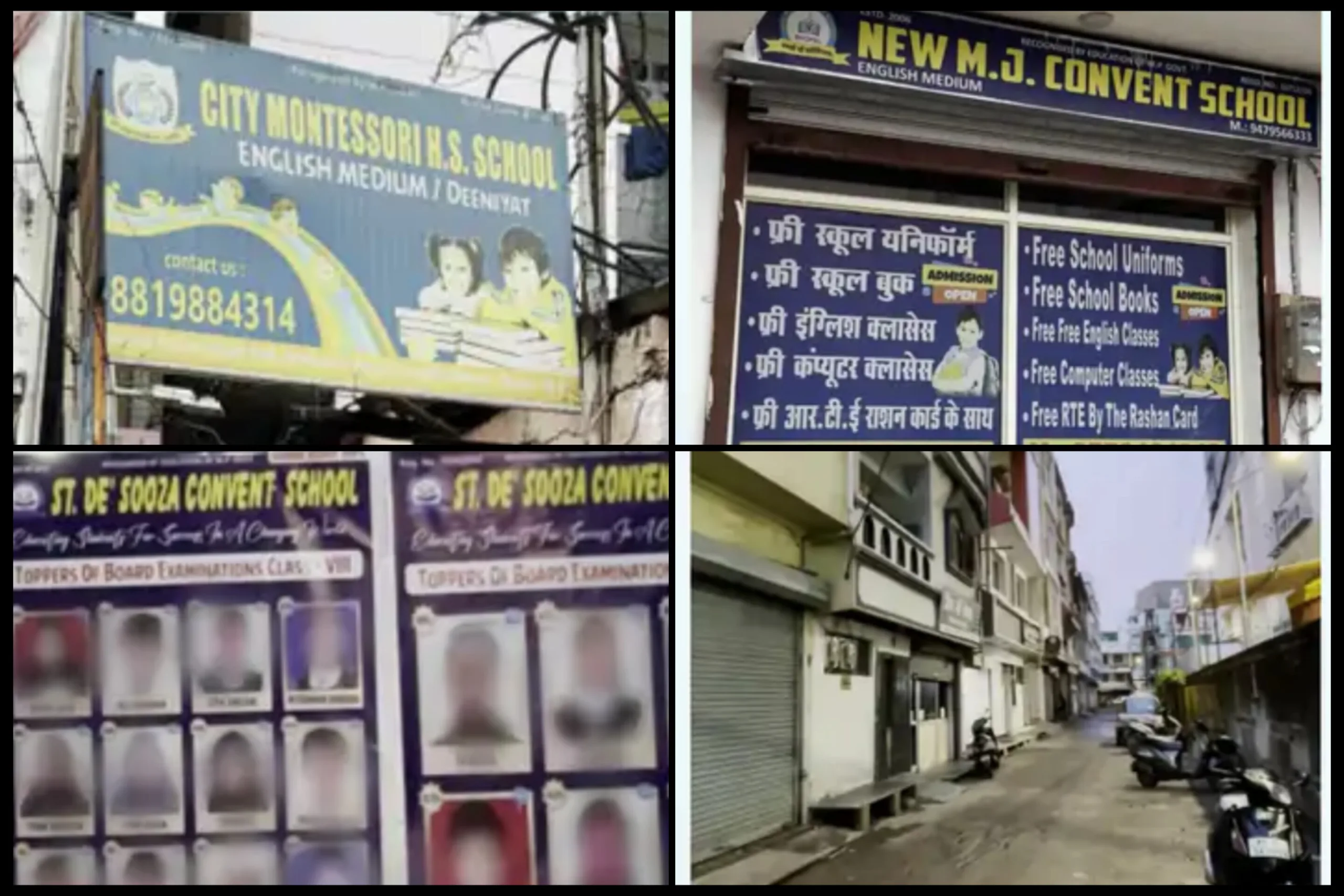
Perhaps the most damning discovery was the physical inspection of the addresses listed by the so-called institutions. In Jahangirabad, a locality in Bhopal, a signboard bearing the name “City Montessori School” hangs in a bylane. But when locals visited the address, there was no school, just a building with no academic activity.
“This board has been here for two years, but I’ve never seen a student or teacher,” said Murshid Ahmad, a local paan vendor. City Montessori claimed Rs 1.65 lakh for 29 non-existent students.
Further inspections uncovered a multi-storey building on Berasia Road housing two more suspicious institutions: MJ Convent and St. D’Souza Convent School. Though locals confirmed some primary school students do attend classes, both schools had submitted scholarship claims for Classes 11 and 12, which they don’t even offer. MJ Convent claimed Rs 1.7 lakh for 30 fake students, while St. D’Souza claimed Rs 11,400 for two.
A staffer at MJ Convent initially tried to deflect questions to the ‘principal’ but ultimately confessed the number given wasn’t his. He added, “The girl was scared. I just work here.”
From Amberley school to clinics
Another significant case is Amberley Convent School, which claimed Rs 1.8 lakh for 33 students. The school no longer exists. The address near Lily Talkies now houses a clinic and a set of shops. Locals verified that no school has operated there for years.
How the scam worked?
The modus operandi was simple yet effective. Institutions uploaded fake student details onto the government’s digital scholarship portal. These applications were then forwarded by officials, without physical verification, to the district and state nodal officers, and finally to the Union Ministry.
Once approved, the Rs 5,700-per-student scholarship amount was credited directly to bank accounts. But in this case, those accounts belonged not to students but to relatives or associates of school operators.
Once the money hit the accounts, it was withdrawn swiftly, making the fraud difficult to trace in real-time.
The Madrasa Angle: A breach of purpose?
Out of the 40 institutions flagged so far, 17 are madrasas. Among the worst offenders:
Madrasa Madul Uloom: Rs 1,28,200
Madrasa Dainiki Warisul Hayat, Sharda Nagar: Rs 1,09,300
Madrasa Rozi Shi Samiti, Gas Rahat: Rs 1,02,600
Madrasa Roz Badas: Rs 68,400
Madrasa Bushra Daini, 12 Kola Mohalla: Rs 62,700
Madrasa-e-Kaisar, Atal Nagar: Rs 62,700
Madrasa Al Usmania: Rs 62,700
Madrasa Asif Saeed Urdu, Hanif Colony: Rs 51,300
Madrasa Ahad Taleemul Quran: Rs 45,600
Madrasa Girls: Rs 39,900
Madrasa Gulistan-e-Hind: Rs 39,900
Madrasa Taleemul Islam: Rs 34,200
Madrasa Aiman Daini: Rs 28,500
Given that many of these institutions were either non-operational or did not cater to senior secondary levels, the question arises: Were these madrasas created solely to tap into government funds?
The Wider Web: Schools Across MP Under Scanner
This isn’t limited to Bhopal. According to a Member of the Madhya Pradesh State Child Commission, Omkar Singh, the scam appears to span across the entire state. He pointed out suspicious activity in Mandsaur, where two madrasas had also claimed huge sums. Although the commission is not directly involved, Singh said they are monitoring developments.
Questioning the missionary model
What makes this fraud even more alarming is its penetration into Christian missionary-run institutions. Schools like St. D’Souza and MJ Convent presented themselves as convents but engaged in the same fraudulent activities. Were these institutions set up with the intent of education, or simply as vehicles to access government grants under minority welfare schemes?
The list of private schools involved is equally troubling:
New FR Convent School: Rs 5,45,100
Holy Field School: Rs 3,81,900
Educational Empire Convent School: Rs 3,76,200
Unity Mission School: Rs 3,70,500
TNS Public School: Rs 2,33,700
Life Convent School: Rs 2,28,000
New Life Convent School: Rs 1,65,300
Authorities react, but is it too late?
According to Additional DCP Shailendra Singh Chauhan, most of the listed 972 students never existed or were not enrolled in the institutions claiming the scholarship. “We are verifying bank accounts and documentation. Legal action will follow,” he stated.
The Crime Branch has initiated action under IPC sections relating to forgery, cheating, breach of trust, and embezzlement. A report is also being prepared for submission to the state government and the CBI for a potential wider probe.
Bigger questions remain
This scandal exposes gaping holes in the digital verification process and accountability mechanisms in the Minority Scholarship Scheme. Why were applications processed without basic checks? Why were institutions allowed to claim funds without independent audits?
If institutions built on the premise of serving marginalised communities are themselves exploiting the system, then a radical rethink of missionary and madrasa-linked welfare models is overdue.
The correspondent has submitted a formal request to the Madhya Pradesh State Commission for Protection of Child Rights (MPSCPCR), urging its intervention and continued monitoring of the case.
As this story unfolds, one thing is clear: what started as a scholarship scheme to uplift minority students has, in many places, been reduced to a well-oiled racket.
The real victims? Students who never got the help they deserved and taxpayers whose money continues to be looted in the name of education.
Minority institutions or fraud centres?
This alarming exposure forces us to ask some uncomfortable but essential questions. What is the true purpose of these so-called “minority” educational institutions? Are they really serving the community, as they often claim, or simply using their protected status to siphon off public funds without accountability?
Missionary schools, which loudly proclaim themselves to be champions of service, charity, and “humanity,” appear to have betrayed that very ideal by creating ghost institutions and exploiting the trust of the state and the poor. Is their commitment to the welfare of society genuine, or is it a facade masking a deeply embedded profiteering motive?
Equally disturbing is the involvement of several madrasas, centres that claim to uphold Islamic values and strictly adhere to religious and moral education. Yet here they are, defrauding the government and playing with the educational futures of the very children they claim to uplift. What moral standing remains when institutions entrusted with shaping young minds are found indulging in deceit?
When religious and charitable institutions, protected under the banner of minority rights, are themselves violating the rights of children and misusing taxpayer money, is it not time to revisit their regulatory frameworks and demand complete transparency and accountability?
This is not just about missing funds. It is about the betrayal of trust, the erosion of values, and the criminal neglect of children’s right to education. If such institutions cannot uphold even the basic ethics of governance and responsibility, should they continue to enjoy unchallenged protection and funding under the guise of minority welfare?
It is time for the state to ask: Are these “minority” institutions truly educational sanctuaries, or have they become safe havens for fraud and exploitation? The future of thousands of children depends on how we choose to answer and act on this question.











Comments