





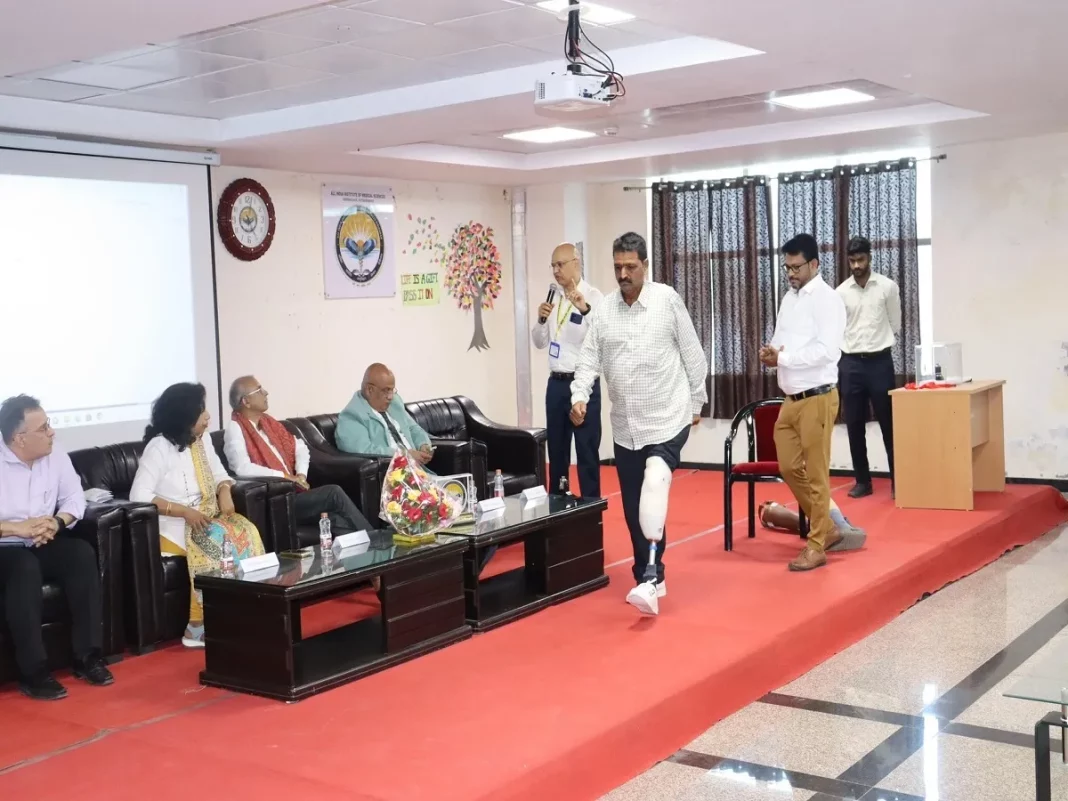
In a first for indigenous health tech, India launched its first affordable advanced carbon fibre foot prosthesis. The prosthesis has been developed by the Defence Research and Development Laboratory (DRDL) of the DRDO and AIIMS Bibinagar, Telangana, jointly. Dubbed ADIDOC (AIIMS Bibinagar-DRDL, DRDO Indigenously Developed Optimised Carbon Foot Prosthesis), the technology is a major leap under the Aatmanirbhar Bharat drive, providing high-quality prosthetics at a tenth of the global prices.
The prosthesis was officially inaugurated at AIIMS Bibinagar on July 14 by Dr. G.A. Srinivasa Murthy, Distinguished Scientist and Director, DRDL, and Dr. Ahanthem Santa Singh, Executive Director, AIIMS Bibinagar. The inauguration was graced by senior scientists, medical experts, and delegates from the healthcare and defence industries.
DRDL, DRDO and AIIMS Bibinagar has jointly developed a first “Made in India” cost effective high profile advanced Carbon Fibre Foot Prosthesis-ADIDOC (AIIMS Bibinagar – DRDL, DRDO Indigenously Developed Optimised Carbon Foot Prosthesis).
The ADIDOC Foot is an indigenously… pic.twitter.com/hVulExZkgk
— DRDO (@DRDO_India) July 15, 2025
A Revolution in Accessibility
The ADIDOC foot is biomechanically tested for taking a load of up to 125 kilograms and comes in three versions to suit various weight classes. The most striking aspect about it is its affordability. Similar imported prosthetic feet are priced at about Rs.2 lakh, but the ADIDOC is expected to cost under Rs. 20,000 in mass production.
Dr. Murthy averred that this prosthetic is not only a technological achievement but also a demonstration of India’s ability to provide sophisticated, inclusive, and affordable healthcare solutions. ADIDOC’s design and functionality are comparable to those of models around the world while considering the financial constraints of the end user.
Designed for Active Use
The prosthesis is developed for K3-level users, which refers to individuals who require enhanced mobility for activities like walking on uneven terrain, climbing stairs, or light jogging. Unlike traditional prosthetics such as the Jaipur Foot, which are designed for basic mobility, ADIDOC caters to a more dynamic and active lifestyle.
AIIMS Bibinagar development team member Dr. Maheshwar Lakkireddy said that the new foot is an attempt to bridge the gap between high-end, pricey prosthetics and low-end, low-cost models. ADIDOC provides energy return, abrasion resistance, and comfort, which makes it ideal for individuals with more activity levels.
A Joint Effort: Science Meets Medicine
The prosthetic foot is the outcome of a novel interdisciplinary research effort involving engineers and clinicians. The DRDL team, with extensive experience in defence-grade materials and structural design, closely collaborated with medical specialists from AIIMS Bibinagar to ensure that the prosthetic foot complies with international standards for safety, comfort, and anatomy.
First Make-in-India cost-effective advanced Carbon Fibre Foot Prosthesis, indigenously designed and developed by DRDO’s Defence Research & Development Laboratory (DRDL) and AIIMS Bibinagar was unveiled at AIIMS Bibinagar, Telangana, on July 14, 2025.
It is expected to reduce… pic.twitter.com/87XMdDkj7Q
— ANI (@ANI) July 15, 2025
Some other important contributors to the research are Dr. Y. Ranjith Kumar, Dr. M. Suresh, Dr. Md Imran, and Dr. M. Ashok, as well as Dr. Aditya Sirigineedi and Dr. M. Hari Babu, who carried out clinical assessments. Ramesh Aerospace, an engineering company based in Vijayawada, created commercial-grade prototypes.
A Step Toward Inclusive Healthcare
India possesses a high number of people living with limb loss, and a majority of them are from rural and low-income areas. These people are frequently denied access to high-quality prosthetics because they cannot afford them. The introduction of ADIDOC is likely to enhance the accessibility of assistive technology for disadvantaged communities, with the potential for greater economic participation and social inclusion.
Dr. Ahanthem Santa Singh of AIIMS Bibinagar stressed that the innovation will revolutionize the lives of millions of amputees by making quality mobility aids not just accessible but affordable.
Symbol of Aatmanirbharta in Healthcare
Officials hailed ADIDOC as a Make-in-India innovation milestone. It not only makes India less dependent on foreign medical imports but also allows India to become the world’s global hub for low-cost prosthetic technology.
The project was praised by BDL as a demonstration of the DRDO’s interest in dual-use technologies. It harnesses its expertise in engineering for both defence and civilian applications. An official of DRDO said the product could be mass-manufactured under public-private partnership initiatives in the future, making it more affordable and accessible.
Next Steps for Wider Impact
Although ADIDOC has already been stringently tested, it will now move into a prolonged period of field trials under real-life conditions. AIIMS and DRDO intend to team up with rehabilitation hospitals, NGOs, and government hospitals to place the product in the hands of those who truly benefit from it.
Subject to approval by regulatory bodies, phased public release is likely to commence in early 2026. Veterans of wars, survivors of accidents, and people living under the poverty line will be considered for priority distribution.
India’s history with affordable prosthetics began with the Jaipur Foot in 1968. That design made a revolutionary change to the mobility of countless Indians by offering a low-tech, long-lasting, and culturally acceptable solution at extremely low cost. ADIDOC continues that tradition, applying the latest materials and engineering techniques to design a product that suits the needs of modern users.
Although the Jaipur Foot is designed for barefoot use and cross-legged sitting, ADIDOC is for more active users, such as those who use shoes, those who work in cities, or those who do hard work.
ADIDOC’s unveiling is a milestone moment in India’s healthcare innovation history. It shows what can be achieved when science, technology, and people-focussed design meet a shared vision of equity and access. With India further driving the agenda of self-reliant healthcare solutions, ADIDOC is an inspiring showcase of innovation with effect, empowering thousands of amputees to take their next step forward in confidence and dignity.










Comments