





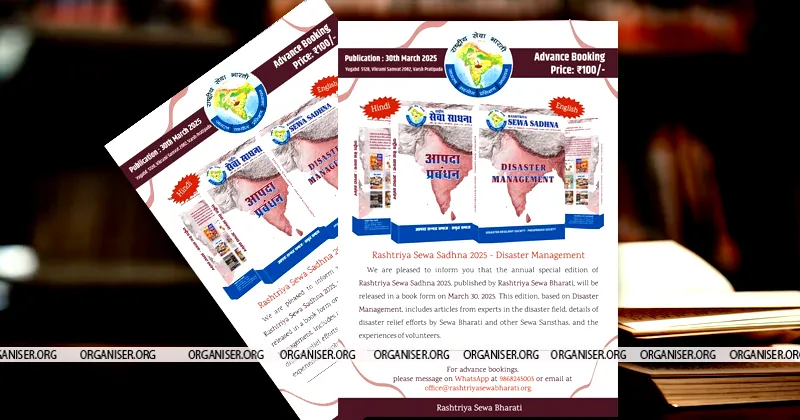
In recent years, disaster management has emerged as a critical domain of study and policy in Bharat, especially in the face of recurring natural calamities and increasing climate variability. However, while much of the scholarly discourse has focused on institutional mechanisms and policy interventions by the state, the significant role of community participation and voluntary action remains underrepresented. The edited volume Rashtriya Sewa Sadhna: Disaster Management with a tagline ‘Disaster Resilient Society – Prosperous Society’, published as part of Rashtriya Sewa Bharati’s annual magazine Rashtriya Sewa Sadhana 2025, seeks to fill this gap. Conceptualised and curated by Dr Deep Narayan Pandey, the book brings together a compelling collection of academic insights, policy frameworks, field studies, and firsthand experiences of karyakartas (volunteers), especially those affiliated with the Rashtriya Swayamsevak Sangh (RSS) and its network of social organisations. The central premise of the book rests on the ethos of ‘Sewa’ or selfless service, presenting it as a foundational pillar of a resilient and compassionate society.
This book is thematically divided into three major sections, each of which explores a unique facet of disaster management and voluntary service.
This section lays the groundwork for understanding Bharat’s formal disaster management apparatus. It features interviews with key contributors such as Bhaiyaji Joshi, former Sarkaryavah of the RSS and Lt Gen Syed Ata Hasnain, a member of the National Disaster Management Authority (NDMA). These interviews provide nuanced perspectives on how government mechanisms and community-based responses must function in tandem to ensure effective disaster preparedness and response. Scholarly articles in this section delve into Bharat’s legislative and institutional evolution post the 2005 Disaster Management Act, highlighting the creation of multi-tiered authorities at the national, state, and district levels. Contributions from disaster management experts like Dr Anil Gupta and Prof PK Joshi further elaborate on the importance of early warning systems, capacity building, and community-based disaster risk reduction (CBDRR). These chapters serve as a valuable orientation for readers new to the field while offering advanced reflections for practitioners and policymakers.
Case Studies of Major Disasters
The second section presents detailed experiences and case studies of significant disaster events that have occurred over the past seventy-five years. These include the 1979 Machhu Dam disaster in Gujarat, the 1993 Latur earthquake, the 2001 Bhuj earthquake, the 1999 Odisha Super Cyclone, the 2004 Indian Ocean Tsunami, and the more recent COVID-19 pandemic. Each case study is presented not merely as a recounting of events but as a reflective analysis of the role played by Swayamsevaks and other karyakartas. The narratives underscore how Swayamsevaks often acted as first responders, providing immediate relief in the form of food, clothing, shelter, and medical assistance. In many instances, their efforts extended into long-term rehabilitation, including rebuilding homes, supporting livelihoods, and even offering psychological counseling. Notably, the case studies illustrate the karyakartas’ deep emotional connection with affected communities, their ability to mobilise resources swiftly, and their willingness to work under challenging and often hazardous conditions.
This section constitutes the emotional core of the book. Through a series of personal memoirs and experiences, it captures the lived experiences of individuals who have served on the frontlines of disaster response. These memoirs come from diverse contexts—urban fire tragedies, plane crashes, floods in Jammu and Kashmir, landslides in Kerala, and relief work in Sri Lanka. Each story is a testimony to the courage, empathy, and tireless commitment of Swayamsevaks. For example, the account of Swayamsevaks assisting during the Kedarnath floods highlights not only logistical challenges but also the spiritual and moral motivation that sustained them. These narratives serve multiple purposes: they inspire future generations, preserve the oral history of service work, and provide qualitative data on community resilience mechanisms that are often overlooked in conventional disaster management literature.
Critical Contributions
The book profoundly affirms the critical role of voluntarism in disaster management. It challenges the conventional, state-centric paradigm by foregrounding the proactive and compassionate engagement of civil society. In doing so, it argues that voluntarism is not merely a stopgap measure but a sustainable and integral part of disaster resilience. The Swayamsevaks featured in the volume embody a unique form of emotional intelligence and moral responsibility, often stepping in where institutional mechanisms fall short. Their efforts are marked by a rapid response time, grassroots knowledge, and cultural sensitivity, making them especially effective in the Bharatiya context. A particularly commendable feature of the volume is its attention to the roles played by women and youth in disaster response. Women karyakartas, especially during the COVID-19 pandemic, organised community kitchens, distributed sanitary supplies, and conducted awareness campaigns. Youth participation is equally noteworthy; from carrying out rescue operations during cyclones to managing logistics in relief camps, young karyakartas were often at the forefront. By documenting these contributions, the book not only honours their service but also calls for more inclusive training and participation frameworks in disaster governance.
The volume excels in bridging the often-cited gap between policy formulation and field-level implementation. It juxtaposes academic essays and policy analysis with real-life experiences, thus enabling a holistic understanding of disaster management. The involvement of scholars, administrators, and practitioners in the editorial and authorial team ensures that the volume speaks to both theory and practice. This dual engagement is particularly valuable for students, educators, and policy advocates seeking to understand the operational dynamics of disaster response.
Beyond its academic and policy relevance, the book serves as an archival resource that preserves the legacy of voluntary action in Bharat’s disaster history. The documentation of stories, photographs, and testimonials contributes to building an institutional memory that can guide future interventions. Moreover, it serves as a source of inspiration, reinforcing the idea that ordinary citizens, when united by a shared purpose, can make extraordinary contributions to society. While the volume is rich in its experiential and narrative content, it would benefit from a more rigorous engagement with comparative international frameworks of volunteer-based disaster management. A deeper analytical exploration of intersecting vulnerabilities—such as socio-economic class, and environmental injustice—would further enhance its scholarly appeal. Additionally, integrating metrics or data visualisations to quantify the impact of volunteer efforts could offer valuable empirical support to the qualitative narratives.










Comments