





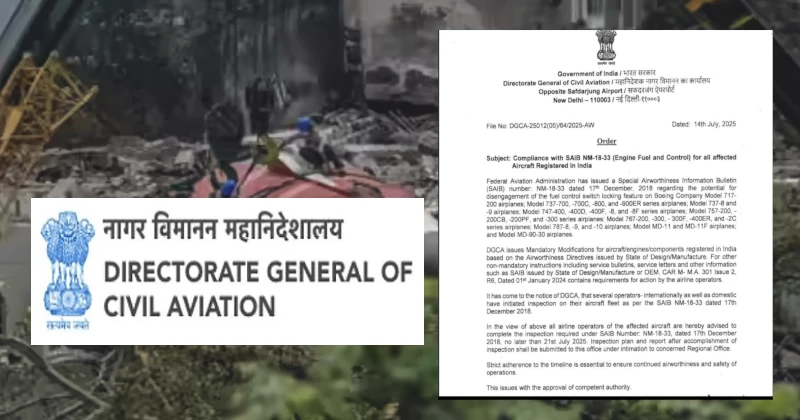
The Directorate General of Civil Aviation (DGCA) has issued a mandate directing all Indian airline operators flying specific Boeing aircraft models to inspect and rectify potentially faulty fuel control switch locking mechanisms. This critical safety directive comes years after a U.S. Federal Aviation Administration (FAA) advisory warned about the issue in 2018 — and more notably, only after a recent Air India crash report flagged the failure to act on that advisory.
The directive, based on FAA’s Special Airworthiness Information Bulletin (SAIB) NM-18-33 dated December 17, 2018, outlines concerns over the disengagement risk of the fuel control switch locking mechanism — a component vital to the safe shutdown and management of aircraft engines. The SAIB affects a wide array of Boeing aircraft, including the 737, 747, 757, 767, 787, MD-11, MD-90, and others commonly used by global airlines.
Despite the FAA flagging the issue nearly seven years ago, DGCA failed to issue any formal inspection mandate until now. This glaring oversight has come under fire following the release of an investigation into a recent Air India crash, where investigators reportedly cited the exact same flawed mechanism — and the 2018 FAA bulletin — as a contributing factor.
The faulty locking feature has been identified in the fuel control switches of a wide range of Boeing aircraft, many of which are operational in India:
- 737 series: including 737-700, -800, -900ER, and the newer 737-8 and 737-9
- 747, 757, 767 series
- 787 Dreamliners
- MD-11, MD-90 series
The risk, as outlined in the FAA’s original bulletin, involves the potential for unintentional disengagement of the fuel control switch locking mechanism — which could lead to accidental fuel shutoff, engine flameout, or other catastrophic in-flight failures.
The DGCA’s delayed response is particularly striking when compared to other global regulators. Countries like South Korea, Singapore, and even Etihad Airways had already initiated checks in line with the 2018 FAA SAIB, but DGCA — citing bureaucratic technicalities and the non-mandatory status of SAIBs — refrained from acting until now.
In its official statement issued on July 15, the DGCA stated, “It has come to the notice of DGCA, that several operators — internationally as well as domestic — have initiated inspection on their aircraft fleet as per the SAIB NM-18-33… In view of the above, all airline operators of the affected aircraft are hereby advised to complete the inspection… no later than 21st July 2025.”
The circular further underscores that strict adherence to the deadline is essential “to ensure continued airworthiness and safety of operations.” It also mandates submission of an inspection report and compliance documentation to the DGCA and respective regional offices.
The fact that DGCA waited for an Air India crash report to surface the issue before taking action raises serious questions about the regulator’s vigilance and independence. Aviation safety experts have criticised this reactionary approach, pointing out that SAIBs, though not binding, are often issued in response to serious, pattern-based risks observed across aircraft fleets.
A senior retired DGCA official, speaking to media on condition of anonymity, noted, “The FAA doesn’t issue SAIBs lightly. Ignoring one for six years, and only acting after a major incident, is not just poor regulation — it’s dangerous complacency.”
DGCA tried to deflect blame by citing Civil Aviation Requirement (CAR) M-M.A. 301, which outlines actions to be taken by airline operators based on directives from the State of Design/Manufacture (in this case, the U.S.). However, the clause also includes non-mandatory instructions like SAIBs under its purview — meaning the DGCA had the authority and responsibility to act pre-emptively.















Comments