





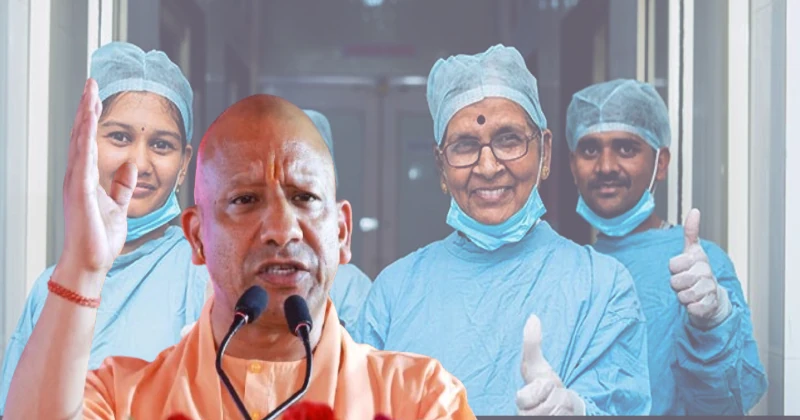
In a significant step towards healthcare reform, Uttar Pradesh Deputy Chief Minister and Health Minister Brajesh Pathak announced the government’s intent to make key policy changes to strengthen nursing education and workforce in the state. Speaking at the national conference on nursing excellence and leadership held on Sunday at the Atal Bihari Vajpayee Scientific Convention Centre in Lucknow, Deputy Chief Minister Brajesh Pathak underscored the vital role of nursing officers and staff, calling them the “backbone of healthcare.”
The conference was a collaborative effort between TISHHA Cares and the Samarpan Institute of Nursing & Paramedical Sciences. It witnessed participation from over a thousand nursing professionals, educators, students, and healthcare leaders from across the country.
Addressing the gathering, Pathak reaffirmed the UP government’s commitment to improving healthcare standards through focused initiatives in nursing training and workforce development.
The conference featured an academic program comprising seven expert-led sessions, with speakers representing renowned institutions like KGMU, Safdarjung Hospital, CARE Hospitals, and Medanta. Key discussion topics included simulation-based training, digitalization, clinical practice research, leadership, and career progression in nursing. Faculty members from AMU, Era University, and Command Hospital, Lucknow, served as session chairs.
Top-performing students in GNM and BSc nursing categories from Bareilly, Shahjahanpur, and Lucknow were honored with scholarships. Additionally, winners of quiz, poster, and presentation competitions were recognized for their excellence.
The conference began with welcome addresses from Dr. Hem Chandra of Swami Rama Himalayan University and Kumudini Mishra, who serves as the president of the Trained Nurses Association of India, Uttar Pradesh branch. The closing ceremony saw the presence of several notable figures, including Major General (Retd) Sushila Shahi, Dr. BK Rana, Prof. RS Dubey, and Nochiketa Dixit.
Dr. Hem Chandra and Major General Shahi were honoured with Lifetime Achievement Awards in appreciation of their decades of dedicated service in hospital administration and nursing education.
Post-pandemic, the importance of nursing has become more evident than ever. Nurses were on the frontline during COVID-19, playing a pivotal role in patient care, vaccination, and public health awareness. The pandemic not only exposed gaps in workforce strength but also highlighted the need for continuous professional development, emotional support, and leadership training among nurses. The Lucknow conference addressed these very concerns, with sessions dedicated to simulation-based learning, digitalization, leadership, research, and career progression.
Beyond clinical training, there is now an increased focus on building leadership capacity within the nursing profession. Nurses are being encouraged to take on roles in hospital administration, public policy, and academic research. With strong representation from private institutions like Medanta, CARE Hospitals, and leading universities, the conference highlighted the growing synergy between the public and private sectors in training the next generation of nursing leaders. These partnerships are vital for creating internship opportunities, upskilling programs, and exposure to advanced technologies and patient management systems.
Importantly, this renewed push also contributes significantly to women’s empowerment. As nursing is a woman-dominated profession in India, improving its educational infrastructure and career pathways directly impacts gender-inclusive growth. By awarding scholarships to top-performing students from cities like Bareilly, Shahjahanpur, and Lucknow, the government is promoting talent across different regions, especially from semi-urban and rural backgrounds. Such support encourages young women to pursue healthcare careers with greater ambition and confidence.
Uttar Pradesh’s commitment to nursing reform is also being viewed through a national lens. Being India’s most populous state, any significant progress in Uttar Pradesh’s healthcare education model can serve as a blueprint for other states to follow. The Lucknow conference was not just a ceremonial gathering but a meaningful step toward transforming nursing into a strong, skilled, and future-ready pillar of India’s healthcare system.















Comments