





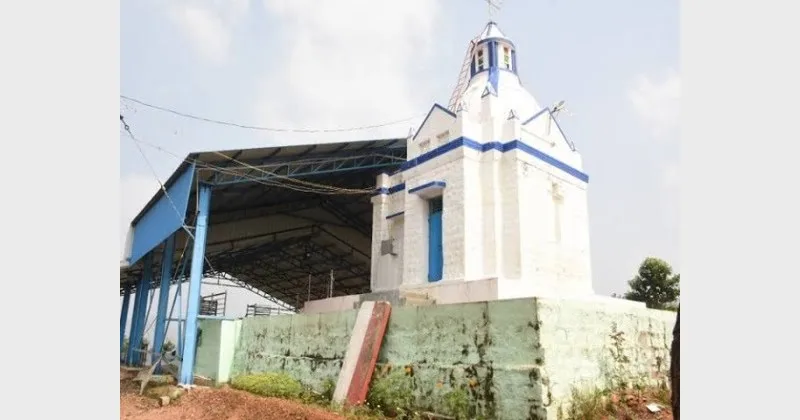
The temple land encroachment issue in Tamil Nadu’s Cuddalore district recently grabbed headlines after five IAS officers were forced to appear in court and tender an apology for failing to enforce eviction orders. At the centre of the controversy was a Church-run institution that continues to occupy temple property in open defiance of court directives.
This incident is not isolated. Our investigation has compiled 17 such cases, many from Tamil Nadu, Andhra Pradesh, where Church-affiliated organisations and institutions continue to squat on temple lands despite multiple court orders mandating their evacuation. While these are classified as civil disputes, the consistent pattern of resistance and legal non-compliance by Church-backed bodies raises deeper concerns, whether there exists a quiet, long-term design to hold onto temple lands or a political patronage .
IAS officers face contempt notice over church school on temple land
The Madras High Court has taken strong action, issuing contempt notices to five IAS officers and several Hindu Religious and Charitable Endowments (HR&CE) department officials. This move comes after their failure to comply with a previous court order regarding the illegal occupation of land belonging to the Devanathaswamy temple in the Cuddalore district of Tamil Nadu.
The contentious issue involves St. Joseph’s Matriculation Higher Secondary School, a Christian institution, which continues to operate on land rightfully owned by the ancient temple. In April 2024, the High Court had explicitly directed the government to arrange alternative land for the school and ensure the temple property was vacated. However, despite this clear directive, no concrete action has been taken. Petitioner and BJP leader, S. Vinod Raghavendran, brought this continued non-compliance to the court’s attention, leading to the order for all implicated officials to appear in person on July 10, 2025. This incident underscores the deep-seated resistance to restoring Hindu temple properties, even in the face of judicial pronouncements
CSI church maintains hold on temple land despite High Court ruling
In Vembar, Thoothukudi district of Tamil Nadu, a 35-year-old land dispute between the Pathrakaliamman Temple and the Church of South India (CSI) continues to simmer, highlighting persistent challenges in reclaiming temple properties. The dispute centres around 1.15 acres of land that the CSI Church reportedly occupies.
On September 14, 2023, the Madras High Court (Madurai Bench) had unequivocally ruled in favour of the temple, granting permission for them to construct a compound wall around their land with police protection. However, the church vociferously opposed the construction, arguing it would obstruct their approach road. In a concerning development in December 2024, the newly constructed temple wall was demolished, CCTV cameras were damaged, and 27 individuals were subsequently booked in connection with the incident. Despite clear court orders and a peace meeting where the church had reportedly agreed to remove encroachments, the land has still not been fully returned to the Pathrakaliamman Temple as of 2025. This ongoing defiance of court orders by the CSI Church raises serious questions about accountability and the protection of Hindu religious endowments.
Erode temple land still under church control despite court order
In Erode, Tamil Nadu, the ancient Periya Mariamman Temple continues to grapple with the illegal occupation of its land, a significant 15-acre parcel that has been under the control of the Church of South India (CSI). This encroachment has sparked sustained protests from the Hindu community since 2010. These efforts include major demonstrations like the 2013 Pongal protest, which saw the arrest of 700 women devotees, highlighting the community’s distress and determination.
Despite these ongoing struggles and a clear directive from the Madras High Court in 2022 to recover the land and utilise it for a public road, the property remains under CSI control as of 2025. This persistent inaction by government authorities, despite repeated pleas from devotees, raises serious questions about the enforcement of judicial orders and the protection of Hindu temple endowments.
Christian school found squatting on temple property
In Tamil Nadu’s Tirunelveli district, a significant legal battle concluded on December 5, 2023, when the Madurai Bench of the Madras High Court dismissed three petitions filed by Amali Girls’ Higher Secondary School and Amali Convent. These petitions concerned the illegal occupation of 11 acres of land belonging to the Arulmigu Papanasaswamy Temple.
The court’s ruling was unequivocal: Amali Convent had illegally constructed structures on temple land that was originally leased for agricultural purposes. The judiciary sharply criticised the petitioner for attempting to use the pretext of girls’ education as an excuse for their blatant encroachment. Emphasising the critical need to protect temple properties, the court granted the convent time until the end of March 2024 to vacate the illegally occupied land. This judgment underscores the judicial system’s role in attempting to safeguard religious properties from unauthorised occupation.
Christian ‘Arch construction near Thiruneermalai Temple foiled after Hindu protest
A concerning attempt to encroach upon the sacred space near the Thiruneermalai Neeravanna Perumal Temple in Chennai, one of the revered 108 Vaishnava Divya Desams, was successfully thwarted by robust Hindu protests. A section of Christians attempted to construct an arch to mark the golden jubilee of the nearby Anthoniyar Church.
Compounding the issue, they had unilaterally renamed “Ramesh Nagar First Street” to “Church Road” and began conducting mass prayers in the vicinity, signalling an aggressive push for territorial claims. This incident is not isolated. Previously, similar encroachment attempts were reported at Sholingur Narasimha Perumal Hill and other nearby hills, where crosses were erected and Bible verses inscribed. These too were eventually removed after strong Hindu objections. In this latest instance, the determined opposition from Hindu groups proved effective, leading to the halting of the arch construction plan, underscoring the necessity of vigilant community action to protect temple precincts.
Secret Jesus statue installation in Dhanushkodi foiled by Hindu Munnani
In a disturbing incident at Dhanushkodi, a significant Hindu pilgrimage site near Rameswaram, Hindu Munnani activists successfully intercepted a clandestine attempt to install a Jesus statue inside a dilapidated church building. This covert operation, allegedly orchestrated by a church group in December 2023, immediately raised alarms within the Hindu community.
Hindu Munnani activists alleged that this was a deliberate plan to transform the revered Hindu pilgrimage site into a Christian destination, drawing parallels with places like Velankanni. The sudden and unauthorised appearance of the statue triggered widespread protests. Given that Dhanushkodi is a protected area with a government ban on new constructions, the installation was swiftly halted, thanks to the vigilance and prompt intervention of Hindu organisations.
Ancient Hindu temple demolished, church built in Gujarat’s Tapi
A shocking incident unfolded in Nana Bandarpada village of Songarh taluka, Tapi district, Gujarat, where an ancient Hindu temple dedicated to Gidhmadi Aya Dungar Mata was brazenly demolished and subsequently replaced with a Christian church named “Mariam Mata’s Temple.” The local Hindu community faced direct obstruction, being prevented from offering prayers during Navratri on October 2, 2022, which tragically escalated into clashes where a Hindu priest was reportedly assaulted. This village, now reportedly 98% Christian due to large-scale conversions, presents a grim scenario. Allegations have surfaced that panchayat funds, originally earmarked for temple renovation, were diverted for the construction of the church. This occurred despite a 2019 panchayat resolution explicitly supporting the temple’s renovation. Hindu organisations have vehemently demanded the temple’s restoration and are preparing to submit a petition to the district collector, highlighting the systematic nature of such encroachments and conversions.
Church and cremation ground built on temple land in Ariyalur: HC issues notice
In a distressing case from Andimadam taluk of Ariyalur district, Tamil Nadu, significant tracts of ancient temple land, specifically around 3 hectares in Varadarajanpettai and 80 acres in Andimadam, were allegedly reclassified as Poramboke (government wasteland). Following this reclassification, members of the Christian community reportedly encroached upon this land to construct a church and cremation grounds.
Local complaints regarding these illegal constructions and the suspicious land reclassification prompted intervention from the Madurai Bench of the Madras High Court. On September 17, 2022, the High Court issued notices to the concerned authorities, with petitioners demanding immediate action against the illegal constructions and the reversal of the questionable land reclassification. This incident highlights the alleged manipulation of land records to facilitate encroachments on properties historically linked to Hindu temples.
Largest cross erected on Edlapadu Hill, Sita’s footprints allegedly desecrated
In a deeply disturbing incident in March 2021, a massive cross was erected on Edlapadu Hill in Guntur district, Andhra Pradesh. This particular hill holds immense religious significance for Hindus, being the sacred site of Devi Sita’s footprints and an ancient carving of Lakshmi Narasimha Swamy. Local Christians reportedly claimed the hill now belonged to “Mary,” despite its long-standing Hindu veneration.
Once a place regularly used by Hindus for worship and sacred ceremonies like marriages, Edlapadu Hill is now facing accusations of commercialisation alongside religious encroachment. Despite fervent protests from Hindu organisations, the local administration has been criticised for its concerning silence and inaction, highlighting growing alarm over unchecked Christian missionary activities and land grabs in the state.
Illegal hilltop encroachment by Carmel Mountain Matha Church in Thiruvannamalai
In Tamil Nadu’s spiritual heartland, Thiruvannamalai district, the Carmel Mountain Matha Church has been accused of systematically encroaching upon the Elayankanni hilltop since 1961. This gradual but persistent encroachment has resulted in the church allegedly occupying approximately 5 acres of forest and government land without any official lease.
The extent of the illegal construction came to light on December 19, 2021, when Collector Murugesan, during an official visit, discovered the unauthorised structures and promptly ordered an investigation. Critically, this encroachment has also blocked access to a hilltop Shiva temple, directly affecting Hindu devotees’ ability to practice their faith. This incident underscores the alleged pattern of Christian institutions taking over public and sacred lands, impeding the religious freedom of Hindus.
Acharapakkam hillock encroached by church, Hindus blocked from Shiva temple
In Acharapakkam, Chengalpattu district of Tamil Nadu, the Malai Mazhai Matha Church has been accused of progressively encroaching on a hillock since the 1990s. What began with the initial installation of a cross allegedly escalated to the construction of prayer halls, shops, and roads on Meikaal Poramboke (grazing land) and forest land, indicating a systematic takeover.
This illegal occupation has severely blocked Hindu devotees’ access to an ancient Shiva temple situated at the hilltop. Following widespread protests by local Hindus and environmentalists concerned about ecological damage, a Public Interest Litigation (PIL) was filed in the Madras High Court on February 25, 2020. The Court has since directed the Revenue Department and district administration to conduct a thorough investigation and take necessary action, highlighting the legal battles Hindu communities often face to protect their sacred sites and traditional access routes from such alleged encroachments.
Temple land encroachment and communal clash in Irunthai village
In a deeply troubling incident that highlights escalating communal tensions, several converted Christians from the Adi Dravidar community in Irunthai village, Kallakurichi district, Tamil Nadu, allegedly illegally encroached upon the Murugan temple’s tank, canal, and cremation land to construct a church. When local Hindu villagers bravely protested this brazen land grab, they were met with a violent backlash, including casteist abuse, physical violence, and property damage.
The situation culminated in a communal clash on December 31, 2020, leading to the arrest of 23 Christians. Disturbingly, initial complaints to both the police and revenue department reportedly yielded no action, forcing the Hindu Adi Dravidar community to threaten mass migration from their ancestral village as a desperate measure of protest against the injustice and lack of protection for their sacred spaces.
Madurai temple land still under Church despite 2018 notice
In Madurai, Tamil Nadu, land valued at an astonishing Rs100 crore, belonging to the ancient Sri Subramanya Swamy Temple in Thiruparankundram, remains under alleged encroachment. This grave issue came to light during a review meeting on March 5, 2018, where officials confirmed that a significant portion of this valuable temple land had been illegally occupied by the Church of Salem Jesus Christ, along with a private school and other entities.
Specifically, the Church of Salem Jesus Christ has reportedly occupied part of the temple’s sacred Sannathi Street, while a temple hall was illegally handed over to a private school. Despite officials issuing notices to the occupants in 2018 demanding a reply within a week, and repeated demands from devoted Hindus for the return of their temple’s rightful property, no decisive action has been taken to reclaim the land to date. This ongoing failure to enforce property rights underscores a concerning trend of temple assets remaining vulnerable to external occupation.
Madurai temple land still under church control despite 1966 Supreme Court order
A stark example of historical injustice persists in Madurai, where the renowned Sri Meenakshi Sundareswarar Amman Temple has been deprived of its vast properties for decades. Once owning 49 acres of land, now valued at approximately Rs600 crore, this precious temple asset has been entirely encroached upon and is currently occupied by St. Mary’s Church.
The most egregious aspect of this case is that, as far back as 1966, the Supreme Court of India unequivocally ruled that the land rightfully belongs to the temple. However, even with the highest judicial authority’s clear pronouncement, the land has lamentably not been returned and continues to remain under the Church’s control. This situation stands as a chilling testament to the systemic challenges faced by Hindu temples in recovering their stolen heritage, even when backed by definitive legal verdicts.
The preceding incidents collectively paint a concerning picture of the challenges faced by Hindu temples and their properties across Bharat, particularly due to alleged encroachments by various Christian entities. From large-scale land occupations by churches and educational institutions, some dating back decades and defying Supreme Court orders, to the erection of crosses on sacred Hindu hills and the alleged diversion of public funds, a clear pattern emerges.
These reports highlight not only direct land grabs and illegal constructions but also instances of communal tension, obstruction of Hindu religious practices, and the renaming of streets to assert control. The repeated involvement of courts, including the Madras High Court, in issuing orders and notices underscores the systemic nature of the problem, yet the lack of decisive government action in many cases remains a significant concern for Hindu devotees. This ongoing struggle to protect and reclaim temple lands signifies a deeper battle for the preservation of Hindu heritage and religious freedom.
This report lays bare not only the growing number of such cases, but also the troubling inaction of government bodies like the Tamil Nadu HR & CE Department, which appears either unwilling or unable to act decisively.
















Comments