




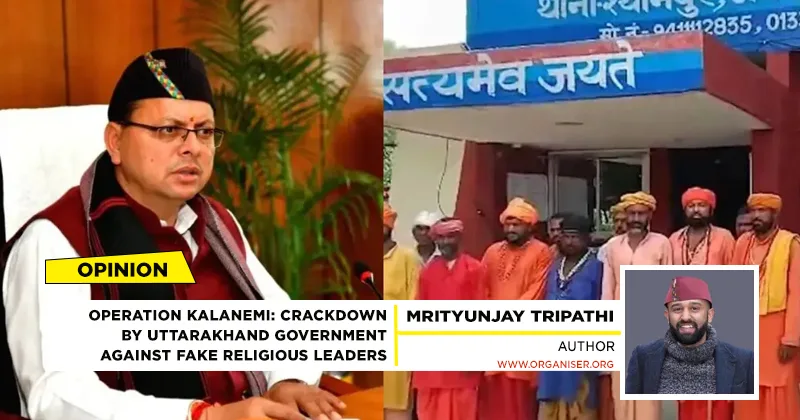
Operation Kalanemi is a comprehensive police operation launched by the Uttarakhand government on July 10, 2025, under the directive of Chief Minister Pushkar Singh Dhami. The operation is designed to identify and arrest individuals masquerading as religious leaders who exploit public faith for personal gain. The operation’s name derives from the demon Kalanemi in Hinduism, who disguised himself as a sage to mislead people, drawing parallels to modern-day impostors who don saffron robes to deceive devotees.
In Hinduism, Kalanemi is a powerful demon (asura) who appears in the epic Ramayana. The demon was tasked by Ravana to obstruct Hanuman’s mission to retrieve the Sanjeevani herb needed to save Lakshmana. Kalanemi disguised himself as a sage and created a false hermitage to trap Hanuman but was ultimately defeated when his true identity was revealed. Chief Minister Dhami explained that just as the demon Kalanemi tried to mislead people by appearing as a saint, there are many such “Kalanemis” in today’s society who commit crimes in the name of religion.
Background and Context
The operation was launched during the ongoing Char Dham Yatra and Kanwar Yatra, when religious activity in Uttarakhand reaches its peak. The state, known as “Devbhoomi” (Land of Gods), attracts millions of pilgrims annually to its sacred sites including Haridwar, Rishikesh, Kedarnath, and Badrinath. This influx of devotees creates opportunities for fraudulent individuals to exploit religious sentiments.
The timing of the operation coincides with the holy month of Sawan, when the Kanwar Yatra sees devotees carrying sacred Ganges water to Lord Shiva temples across northern India. Police officials noted that fake babas become particularly active during such religious gatherings, targeting vulnerable populations, especially women and youth.
The operation has yielded significant results across multiple districts in Uttarakhand. According to the latest reports, police have arrested a total of 259 individuals posing as fake religious leaders across the state. The district-wise breakdown shows:
- Dehradun: 144 arrests, with 82 specifically reported in recent operations
- Haridwar: 50 arrests, including individuals from various states
- Udham Singh Nagar: 65-66 arrests
Among those arrested, 23 individuals were found to be residents of other states, indicating the interstate nature of this fraudulent network. Particularly concerning was the arrest of a Bangladeshi national, Rukn Rakam alias Shah Alam, who was operating under the guise of a religious leader in Dehradun’s Sahaspur area.
Operational Methodology
The operation employs multiple specialised teams conducting systematic raids across different areas. Police teams focus on locations where suspicious individuals are reported to be operating under the guise of religious leaders. The methodology includes:
Identification and Surveillance: Police teams identify suspicious individuals through community reports and surveillance. Those found sitting by roadsides claiming to offer religious or astrological solutions are particularly scrutinized.
Document Verification: Suspected individuals are required to provide proper identification documents and proof of expertise in religious practices or astrology. Those unable to provide such documentation face arrest.
Multi-Agency Coordination: The operation involves coordination between local police, intelligence units, and security agencies. In cases involving foreign nationals, central security agencies are involved in interrogation.
Technology Integration: Authorities utilize AI and facial recognition cameras across the state, with over 350 cameras monitoring Haridwar alone through a command control center.
Legal Framework
Individuals arrested under Operation Kalanemi face charges under relevant sections of the Bharatiya Nyaya Sanhita (BNS), which replaced the Indian Penal Code. The charges typically include fraud, cheating, and exploiting religious sentiments. Foreign nationals involved in such activities face additional charges under the Foreigners Act.
The operation operates within the broader context of Uttarakhand’s existing anti-conversion laws, including the Uttarakhand Freedom of Religion Act, 2018, which criminalizes unlawful religious conversions and imposes penalties ranging from 3 to 10 years imprisonment.
The operation has received widespread support from legitimate religious organizations. The Akhil Bharatiya Akhara Parishad, the apex body of Hindu seers, welcomed the initiative through its president Ravindra Puri, who stated that strict action should be taken against those who cheat Kanwariyas and abuse genuine religious practices.
Swami Yatindranand Giri of the Juna Akhara praised Chief Minister Dhami’s initiative as a “courageous move” to protect Sanatan Dharma from impostors and criminal elements. He alleged that some individuals in saffron robes consume meat and alcohol, engage in fraud, and promote immoral behavior to tarnish Hindutva.
State BJP President Mahendra Bhatt supported the operation, emphasizing that criminal elements attempting to disturb society would face strict action.
Challenges and Concerns
The operation faces several challenges in distinguishing between genuine religious practitioners and fraudulent individuals. The criteria for determining authenticity remain somewhat subjective, relying heavily on documentation and community reports. Some arrested individuals have claimed they are not fraudsters and that wearing saffron robes is part of their religious practice.
Among the arrested individuals, police found various categories including traditional beggars, snake charmers, and individuals from different religious backgrounds who had adopted Hindu religious attire. This diversity highlights the complex nature of religious fraud in the region.
Operation Kalanemi reflects broader concerns about demographic changes and religious tensions in Uttarakhand. The state government has been implementing various measures to address what it perceives as threats to the religious and cultural identity of the region. These include initiatives against alleged “love jihad” and “land jihad,” as well as efforts to prevent unauthorized religious conversions.The operation also coincides with ongoing debates about the preservation of Uttarakhand’s identity as a sacred Hindu land while maintaining constitutional principles of secularism and religious freedom.
Government’s Commitment
Chief Minister Dhami has emphasized that the operation will continue indefinitely, particularly during major religious festivals and pilgrimages. He stated that the government is committed to protecting the sanctity of Devbhoomi and ensuring that genuine devotees are not exploited by fraudulent individuals. The Chief Minister has also linked the operation to broader efforts to preserve Uttarakhand’s original identity, stating that the government is determined to protect the state’s essence and existence against demographic changes. The operation aims to enhance the safety and authenticity of religious experiences for millions of pilgrims visiting Uttarakhand. By removing fraudulent elements, the government hopes to restore trust in genuine religious practices and protect the state’s reputation as a premier spiritual destination.
The Char Dham Yatra 2025 has already seen record pilgrim numbers, with over 38.64 lakh devotees visiting the sacred sites. The operation seeks to ensure that this religious tourism remains free from exploitation and maintains its spiritual sanctity.
Operation Kalanemi represents a significant effort by the Uttarakhand government to address the problem of fake religious leaders exploiting public faith. While the operation has achieved substantial results in terms of arrests and public awareness, it also raises questions about the balance between protecting religious authenticity and maintaining individual freedoms. The continued success of the operation will depend on its ability to distinguish between genuine religious practice and fraudulent exploitation while maintaining the trust and support of both religious communities and the general public.
The operation serves as a model for other states facing similar challenges with fraudulent religious leaders, demonstrating the importance of proactive law enforcement in protecting vulnerable populations from exploitation in the name of faith. As the operation continues, its long-term impact on religious practices and community trust in Uttarakhand will be closely monitored.
















Comments