




“I always emphasise that we 7 billion human beings are the same, mentally, physically and emotionally. Whether we are kings or queens, beggars or spiritual leaders, we are all born the same way. We depart for the next destination in the same way. However, because we tend to forget this sameness, we stress instead the secondary differences between us. We think of each other in terms of ‘us’ and ‘them’” – HH The 14th Dalai Lama, while inaugurating the 1st World Hindu Congress at New Delhi on November 21, 2014
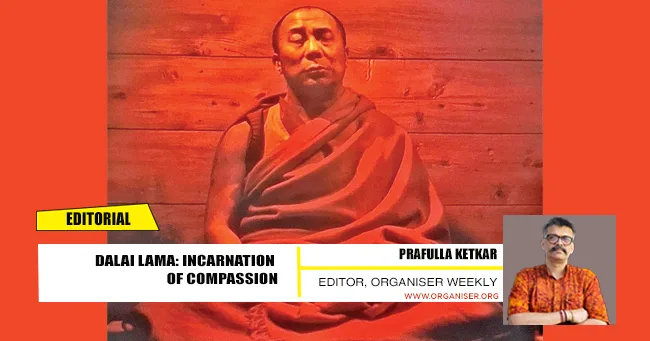
The magnificent and gracious celebration of ‘compassion’ took place at Dharamshala on the occasion of the 90th birthday of His Holiness The 14th Dalai Lama, the spiritual leader of Tibetan Buddhism or what His Holiness himself likes to call the Nalanda School. He is considered a manifestation of Avalokiteśvara, the Bodhisattva of Compassion, by his followers, and there is an established institutionalised tradition to search for his reincarnation, as reaffirmed by the Buddhist Monk through a statement. Unfortunately, it is marred by a political controversy due to the Chinese reaction to the statement. Bharat, on the other hand, by not taking a stand on the matter of faith and religion, has shown respect to the Dharmaguru’s position. The reincarnation and allied practices should not be a matter of concern for anyone except the believers and followers of the Dalai Lama.
Choosing the successor to the next reincarnation of the Dalai Lama is a religious tradition performed by senior Tibetan monks, who take specific cues from the previous Dalai Lama. The search involves consulting oracles, interpreting visions, dreams, direction, faces, postures and spiritual signs shown by the previous Dalai Lama. The tradition dates back to 1587 and is respected and accepted by all followers of Buddhism in Tibet. Chinese Communist Party’s position on the Dalai Lama is contradictory, as most of the Communist stands. They do not recognise religion and use all the abusive words for the present Dalai Lama. Can the authority that does not believe in religion decide on religious affairs? The authority that does not recognise the present Dalai Lama wants to decide on his successor, when, according to tradition, his messages would be crucial in choosing the true reincarnation. Claiming authority over land by force and guiding the religious affairs are two different things, which the Communists could never understand. Bharat, on the other hand, recognises the diverse religious traditions and is committed not to interfere in the religious matters of practising Buddhists. China should also respect the same to win the hearts of Tibetans.
The Dalai Lama has not spoken about the violence or separatism, as the Chinese Government tries to do by defending dreaded terrorists nurtured by its all-weather friend. From a humanitarian perspective, he has raised the issues of the human rights of the Tibetan people and the autonomy of his region. Like all Bodhisattvas, he has also vowed to be reborn in the world to help all living beings and to promote compassion and the unity of humanity. Compassion for all is the basis for reconciling apparent differences, which is the fundamental principle of Buddha’s Dhamma. Simply labelling with ‘Chinese Characteristics’ does not change the place of origin and content of Buddhist thought. The ideology of Communism remains violent and dictatorial, while Buddha’s Dhamma remains the messenger of peace and compassion, as pointed out by Dr Babasaheb Ambedkar in his seminal book, Buddha or Karl Marx. Buddha’s Dhamma has roots in the Bharatiya tradition, and the Nalanda School became the foundation for Buddhism in Tibet. Precisely for this reason, the Dalai Lama considers Bharat as the ‘Guru’ (Master) and Buddhists in Tibet as the ‘Chelas’ (disciples). No wonder, all Buddhists across the world consider Bharat as the sacred land of Shakya Muni – the Buddha.
The tendency to impose ideological positions on others with a binary approach is the root cause of all conflicts. When the world is seeing all kinds of uncertainties and experiencing unending wars, the only solution is the message of spiritual oneness. The Hindu-Buddhist tradition, which sees the inherent unity while celebrating diversity, is the way forward in this volatile situation. The Dalai Lama’s 90th birthday celebration can be an opportune occasion to carry forward the message of peace and compassion. Instead of debating over the succession plan, we need to focus on the principles and values of Bodhisattva to address the challenges of materialism, fanaticism, and authoritarianism.












Comments