





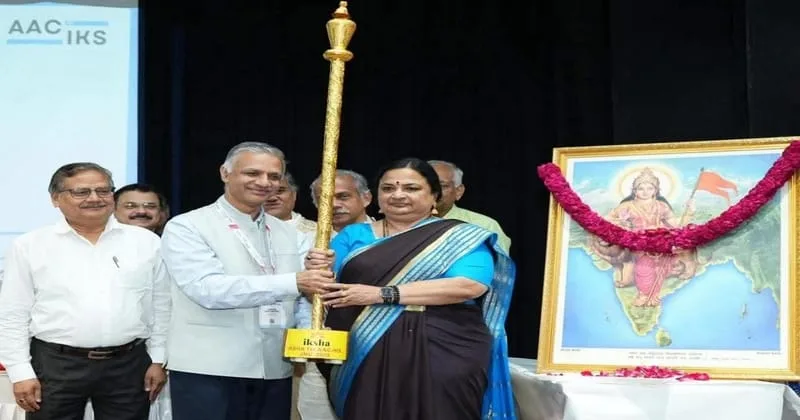
The first annual academic conference on Indian Knowledge Systems (IKS), hosted by Jawaharlal Nehru University (JNU) from July 10 to 12, concluded successfully, marking a pivotal moment in the resurgence of India’s civilisational thought traditions within academia. The conference, which showcased 17 technical sessions, 8 panel discussions, and over 80 scholarly paper presentations, drew participation from more than 40 cities across India. In a symbolic gesture during the valedictory ceremony, the Jnan Dhand, represented in the form of a Sengol, was ceremonially handed over from JNU to Nalanda University, the next host of the IKS annual conference.
The three-day event, themed “The Resurgence of IKS: Finding What We Have, Learning What We Learnt,” was a collaborative effort between JNU and the Indian Knowledge Systems Heritage Alliance (IKSHA), with sponsorship from the Ministry of AYUSH, the Indian Council of Social Science Research (ICSSR), and the Indian Council of Historical Research (ICHR). It marked the institutional consolidation of Indian Knowledge Systems as a serious academic field cutting across disciplines such as philosophy, science, linguistics, medicine, arts, and governance.
Inaugurating the conference, Vice President of India Jagdeep Dhankhar delivered a keynote that underscored the civilisational significance of IKS in India’s rise as a global power. “India’s rise must be accompanied by the rise of its intellectual and cultural gravitas,” he said. “The strength of a nation lies in the originality of its thought, the timelessness of its values, and the resilience of its intellectual traditions. That is the kind of soft power that endures.”
Dhankhar also lauded the efforts of the organisers, saying, “It is a delight to inaugurate the First Annual Academic Conference on Indian Knowledge System. It has not come a day too soon.” He was joined by Union Minister Sarbananda Sonowal, JNU Vice Chancellor Prof. Santishree Dhulipudi Pandit, and Prof. M. S. Chaitra, Director of IKSHA and Akhil Bharatiya Toli Sadasya, Prajna Pravah. Together, they offered floral tributes and lit a ceremonial lamp before the image of Bharat Mata, a gesture that visibly affirmed the integration of cultural symbolism into academic spaces.
Vice Chancellor Prof. Santishree Dhulipudi Pandit, in her address, stressed the importance of intellectual sovereignty in national development. “Political power requires narrative power. So, intellectuals are very important, and it is the duty of higher education institutions to do it,” she remarked, highlighting the need for Indian academia to take ownership of its civilisational narrative.
The conference brought together over 30 distinguished speakers across eight thematic panels, including an editorial roundtable featuring prominent journal editors. Three planetary lectures and grand inaugural and valedictory ceremonies added further depth and dignity to the academic proceedings. Scholars presented papers on topics ranging from Vedic mathematics and classical epistemology to Ayurveda, ancient metallurgy, temple architecture, and eco-conscious knowledge traditions.
A notable highlight of the closing day was the official announcement that Nalanda University will host the second edition of the IKS annual academic conference in 2026. The handover of the Jnan Dhand, an intellectual baton symbolised by a Sengol, from JNU to Nalanda University was witnessed by dignitaries, scholars, and students, marking the transition of the knowledge journey to one of India’s most historic centres of learning.
The successful organisation of the conference at JNU marks a turning point in mainstreaming Indian Knowledge Systems within higher education and sets the tone for its institutionalisation in the years to come.
















Comments